


Page 921 - Hematology_ Basic Principles and Practice ( PDFDrive )
P. 921
804    Part VII  Hematologic Malignancies


                            X = PML (15q22)
                              MLL (11q23)                                          RARA (17q21)
                              PLZF/ZBTB16 (11q23)
                              NPM (5q35)
                              NuMA (11q13)
                              STAT5B (17q11)
                              PRKAR1A (17q24)
                              FIP1L1 (4q12)
                              BCOR (Xq11)
                                                            Fusion  Product

                                                                 Responsive to ATRA
                                                                 PML, NPM, NuMA, Stat5b, 3p25
                                             Two syndromes
                                                                 Nonresponsive to ATRA
                                                                 PLZF

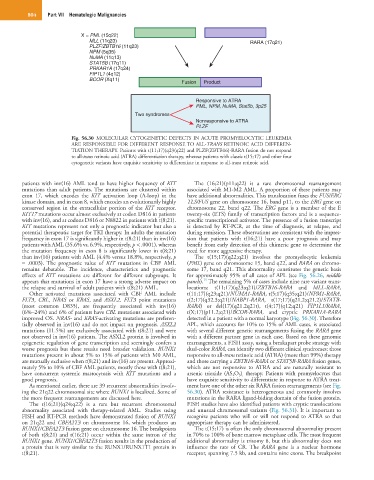
                        Fig. 56.30  MOLECULAR CYTOGENETIC DEFECTS IN ACUTE PROMYELOCYTIC LEUKEMIA
                        ARE RESPONSIBLE FOR DIFFERENT RESPONSE TO ALL-TRANS RETINOIC ACID DIFFEREN-
                        TIATION THERAPY. Patients with t(11;17)(q23(q22) and PLZF(ZBTB16)-RARA fusion do not respond
                        to all-trans retinoic acid (ATRA) differentiation therapy, whereas patients with classic t(15;17) and other four
                        cytogenetic variants have exquisite sensitivity to differentiate in response to all-trans retinoic acid.


        patients with inv(16) AML tend to have higher frequency of KIT   The  (16;21)(p11;q22)  is  a  rare  chromosomal  rearrangement
        mutations than adult patients. The mutations are clustered within   associated with M1-M2 AML. A proportion of these patients may
        exon  17,  which  encodes  the  KIT  activation  loop  (A-loop)  in  the   have additional abnormalities. This translocation fuses the FUS/ERG
        kinase domain, and in exon 8, which encodes an evolutionarily highly   TLS/FUS gene on chromosome 16, band p11, to the ERG gene on
        conserved  region  in  the  extracellular  portion  of  the  KIT  receptor.   chromosome 22, band q22. The ERG gene is a member of the E
        KIT17 mutations occur almost exclusively at codon D816 in patients   twenty-six (ETS) family of transcription factors and is a sequence-
        with inv(16), and at codons D816 or N8822 in patients with t(8;21).   specific transcriptional activator. The presence of a fusion transcript
        KIT mutations represent not only a prognostic indicator but also a   is  detected  by  RT-PCR,  at  the  time  of  diagnosis,  at  relapse,  and
        potential therapeutic target for TKI therapy. In adults the mutation   during remission. These observations are consistent with the impres-
        frequency in exon 17 is significantly higher in t(8;21) than in inv(16)   sion  that  patients  with  t(16;21)  have  a  poor  prognosis  and  may
        patients with AML (35.6% vs. 6.9%, respectively, p < .0001), whereas   benefit from early detection of this chimeric gene to determine the
        the  mutation  frequency  in  exon  8  is  significantly  lower  in  t(8;21)   need for more aggressive therapy.
        than inv(16) patients with AML (4.4% versus 18.8%, respectively, p   The  t(15;17)(q22;q21)  involves  the  promyelocytic  leukemia
        =  .0003).  The  prognostic  value  of  KIT  mutations  in  CBF  AML   (PML) gene on chromosome 15, band q22, and RARA on chromo-
        remains  debatable.  The  incidence,  characteristics  and  prognostic   some 17, band q21. This abnormality constitutes the genetic basis
        effects  of  KIT  mutations  are  different  for  different  subgroups.  It   for approximately 95% of all cases of APL (see Fig. 56.26, middle
                                                                    15
        appears that mutations in exon 17 have a strong adverse impact on   panels).  The remaining 5% of cases include nine rare variant trans-
        the relapse and survival of adult patients with t(8;21) AML.  locations:  t(11;17)(q23;q21)/ZBTB16-RARA  and  MLL-RARA,
           Other  activated  mutations  associated  with  CBF  AML  include   t(11;17)(q23;q21)/NUMA1-RARA, t(5;17)(q35;q21)/NPM1-RARA,
        FLT3,  CBL,  NRAS  or  KRAS,  and  ASXL2.  FLT3  point  mutations   t(2;17)(q32.3;q21)/NABP1-RARA,  t(17;17)(q21.2;q21.2)/STATB-
        (most  common  D835),  are  frequently  associated  with  inv(16)   RARA)  or  del(17)(q21.2q21t),  t(4;17)(q12;q21)  FIP1L1/RARA,
        (6%–24%) and 6% of patients have CBL mutations associated with   t(X;17)(p11.2;q21)/BCOR-RARA,  and  cryptic  PRKAR1A-RARA
        improved OS. NRAS- and KRAS-activating mutations are preferen-  detected in a patient with a normal karyotype (Fig. 56.30). Therefore
        tially observed in inv(16) and do not impact on prognosis. ASXL2   APL, which accounts for 10% to 15% of AML cases, is associated
        mutations (11.5%) are exclusively associated with t(8;21) and were   with several different genetic rearrangements fusing the RARA gene
        not observed in inv(16) patients. The ASXL2 protein is involved in   with a different partner gene in each case. Based on these genomic
        epigenetic regulation of gene transcription and seemingly confers a   rearrangements, a FISH assay, using a breakapart probe strategy with
        worse prognosis but these results need broader validation. RUNX1   dual-color RARA, can identify two different clinical syndromes: those
        mutations present in about 5% to 15% of patients with M0 AML,   responsive to all-trans retinoic acid (ATRA) (more than 99%) therapy
        are mutually exclusive when t(8;21) and inv(16) are present. Approxi-  and those carrying a ZBTB16-RARA or STAT5B-RARA fusion genes,
        mately 5% to 10% of CBF AML patients, mostly those with t(8;21),   which  are  not  responsive  to  ATRA  and  are  naturally  resistant  to
        have  concurrent  systemic  mastocytosis  with  KIT  mutations  and  a   arsenic trioxide (AS 2 O 3 ) ,  therapy. Patients with promyelocytes that
        good prognosis.                                       have exquisite sensitivity to differentiate in response to ATRA treat-
           As mentioned earlier, there are 39 recurrent abnormalities involv-  ment have one of the other six RARA fusion rearrangements (see Fig.
        ing the 21q22 chromosomal site where RUNX1 is localized. Some of   56.30). ATRA  resistance  is  heterogeneous  and  commonly involves
        the more frequent rearrangements are discussed here.  mutations in the RARA ligand-biding domain of the fusion protein.
           The  t(16;21)(q24;q22)  is  a  rare  but  recurrent  chromosomal   FISH studies have also identified patients with cryptic translocations
        abnormality  associated  with  therapy-related  AML.  Studies  using   and unusual chromosomal variants (Fig. 56.31). It is important to
        FISH and RT-PCR methods have demonstrated fusion of RUNX1   recognize  patients  who  will  or  will  not  respond  to  ATRA  so  that
        on  21q22  and  CBFA2T3  on  chromosome  16,  which  produces  an   appropriate therapy can be administered.
        RUNX1/CBFA2T3 fusion gene on chromosome 16. The breakpoints   The t(15;17) is often the only chromosomal abnormality present
        of  both  t(8;21)  and  t(16;21)  occur  within  the  same  intron  of  the   in 70% to 100% of bone marrow metaphase cells. The most frequent
        RUNX1 gene. RUNX1/CBFA2T3 fusion results in the production of   additional abnormality is trisomy 8, but this abnormality does not
        a protein that is very similar to the RUNX1/RUNX1T1 protein in   influence  the  rate  of  CR.  The  RARA  gene  is  a  nuclear  hormone
        t(8;21).                                              receptor, spanning 7.5 kb, and contains nine exons. The breakpoint

