


Page 918 - Hematology_ Basic Principles and Practice ( PDFDrive )
P. 918
Chapter 56  Conventional and Molecular Cytogenomic Basis of Hematologic Malignancies  801


                                                                t(15;17)/PML-RARA 11%
                                          Other adverse 14%
                                                                              t(8;21)RUNX1-RUNX1-T1
                                   RUNX1 mut 4%                               8%
                                     MLL-PTD 5%
                                                                                inv(16)/CBFB-MYH11
                                inv(3)t(3;3)/EVI-1 3%                           6%

                                        ADVERSE
                                          26%                                   FAVORABLE
                                                                                   45%
                               FLT3-ITD/NPM1 wt 12%                             NPM1 Mut/FLT3-ITD
                                                                                neg/WT1
                                             ADVERSE                            wt 18%
                                               17%
                                              Intermediate 17%  CEBPAmut (biallelic)/FLT3-
                                                                      ITD neg 3%
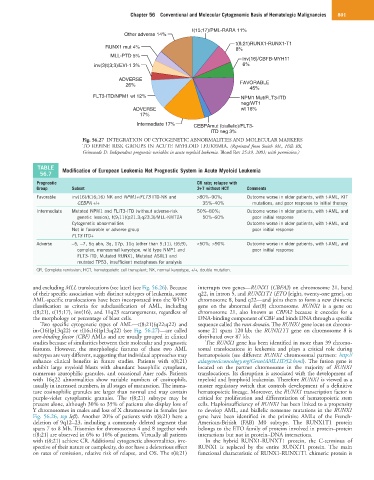
                            Fig. 56.27  INTEGRATION OF CYTOGENETIC ABNORMALITIES AND MOLECULAR MARKERS
                            TO  REFINE  RISK  GROUPS  IN  ACUTE  MYELOID  LEUKEMIA.  (Reprinted  from  Smith  ML,  Hills  RK,
                            Grimwade D: Independent prognostic variables in acute myeloid leukemia. Blood Rev 25:39, 2001; with permission.)


             TABLE   Modification of European Leukemia Net Prognostic System in Acute Myeloid Leukemia
              56.7
             Prognostic                                          CR rate; relapse with
             Group       Subset                                  3+7 without HCT  Comments
             Favorable   inv(16)/t(16;16) NK and NPM1+/FLT3 ITD-NK and   >80%–90%;   Outcome worse in older patients, with t-AML, KIT
                          CEBPA +/+                                35%–40%          mutations, and poor response to initial therapy
             Intermediate  Mutated NPM1 and FLIT3-ITD (without adverse-risk   50%–80%;   Outcome worse in older patients, with t-AML, and
                          genetic lession), t(9;11)(p21.3;q23.3)/MLL-KMT2A  50%–60%  poor initial response
                         Cytogenetic abnormalities                                Outcome worse in older patients, with t-AML, and
                         Not in favorable or adverse group                          poor initial response
                         FLT3 ITD+
             Adverse     −5, −7, 5q abn, 3q, 17p, 11q (other than 9;11), t(6;9),   <50%; >90%  Outcome worse in older patients, with t-AML, and
                          complex, monosomal karyotype, wild type NMP1 and          poor initial response
                          FLT3-ITD, Mutated RUNX1, Mutated ASXL1 and
                          mutated TP53, insufficient metaphases for analysis
             CR, Complete remission; HCT, hematopoietic cell transplant; NK, normal karyotype, +/+, double mutation.


            and excluding MLL translocations (see later) (see Fig. 56.26). Because   interrupts two genes—RUNX1 (CBFA2) on chromosome 21, band
            of their specific association with distinct subtypes of leukemia, some   q22, in intron 5, and RUNX1T1 (ETO [eight, twenty-one gene], on
            AML-specific translocations have been incorporated into the WHO   chromosome 8, band q22—and joins them to form a new chimeric
            classification  as  criteria  for  subclassification  of  AML,  including   gene  on  the  abnormal  der(8)  chromosome.  RUNX1  is  a  gene  on
            t(8;21), t(15;17), inv(16), and 11q23 rearrangements, regardless of   chromosome  21,  also  known  as  CBFA2  because  it  encodes  for  a
            the morphology or percentage of blast cells.          DNA-binding component of CBF and binds DNA through a specific
              Two  specific  cytogenetic  types  of  AML—t(8;21)(q22;q22)  and   sequence called the runt domain. The RUNX1 gene locus on chromo-
            inv(16)(p13q22) or t(16;16)(p13;q22) (see Fig. 56.27)—are called   some  21  spans  120 kb;  the  RUNX1T1  gene  on  chromosome  8  is
            core-binding factor (CBF) AMLs and are usually grouped in clinical   distributed over 87 kb.
            studies because of similarities between their molecular and prognostic   The RUNX1 gene has been identified in more than 39 chromo-
            features.  However,  the  morphologic  features  of  these  two  AML   somal  translocations  in  leukemia  and  plays  a  critical  role  during
            subtypes are very different, suggesting that individual approaches may   hematopoiesis (see different RUNX1 chromosomal partners: http://
            enhance  clinical  benefits  in  future  studies.  Patients  with  t(8;21)   atlasgeneticsoncology.org/Genes/AML1ID52.html). The  fusion  gene  is
            exhibit  large  myeloid  blasts  with  abundant  basophilic  cytoplasm,   located  on  the  partner  chromosome  in  the  majority  of  RUNX1
            numerous azurophilic granules, and  occasional  Auer rods.  Patients   translocations. Its disruption is associated with the development of
            with  16q22  abnormalities  show  variable  numbers  of  eosinophils,   myeloid and lymphoid leukemias. Therefore RUNX1 is viewed as a
            usually in increased numbers, in all stages of maturation. The imma-  master  regulatory  switch  that  controls  development  of  a  definitive
            ture eosinophilic granules are larger than normal and may contain   hematopoietic lineage. Moreover, the RUNX1 transcription factor is
            purple-violet  cytoplasmic  granules.  The  t(8;21)  subtype  may  be   critical  for  proliferation  and  differentiation  of  hematopoietic  stem
            present alone, although 30% to 35% of patients also display loss of   cells. Haploinsufficiency of RUNX1 has been linked to a propensity
            Y chromosomes in males and loss of X chromosome in females (see   to develop AML, and biallelic nonsense mutations in the RUNX1
            Fig. 56.26, top left). Another 20% of patients with t(8;21) have a   gene  have  been  identified  in  the  primitive  AMLs  of  the  French-
            deletion of 9q12–23, including a commonly deleted segment that   American-British  (FAB)  M0  subtype.  The  RUNX1T1  protein
            spans 7 to 8 Mb. Trisomies for chromosomes 4 and 8 together with   belongs to the ETO family of proteins involved in protein–protein
            t(8;21) are observed in 6% to 10% of patients. Virtually all patients   interactions but not in protein–DNA interactions.
            with t(8;21) achieve CR. Additional cytogenetic abnormalities, irre-  In  the  hybrid  RUNX1-RUNXT1  protein,  the  C-terminus  of
            spective of their nature or complexity, do not have a deleterious effect   RUNX1  is  replaced  by  the  entire  RUNXT1  protein.  The  main
            on rates of remission, relative risk of relapse, and OS. The t(8;21)   functional characteristic of RUNX1-RUNX1T1 chimeric protein is

