


Page 917 - Hematology_ Basic Principles and Practice ( PDFDrive )
P. 917
800    Part VII  Hematologic Malignancies


        heterozygosity  resulting  in  homozygous  mutated  allele  and  high   TET2 proteins are necessary for the conversion of 5-methylcytosine
        FLT3-ITD allelic ratio.                               to 5-hydromethylcytosine and play a role in demethylation processes
           Intact  functioning  of  the  CCAAT/enhancer  binding  protein   within the cell. TET2 mutations have been reported in 10% to 23%
        (CEBPA) gene is essential for normal granulocytic differentiation. It   of patients with AML with a normal karyotype. The impact of TET2
        is a lineage-specific transcription factor that is required for the forma-  mutations on the prognosis and outcome remains poorly defined.
        tion of committed myeloid progenitors from multipotent progenitor   DNMT3A  mutations,  which  affect  the  DNA  methyltransferase
        cells. CEBPA execute this function by coupling the direct transcrip-  enzymes and subsequent epigenetic modulation, have been described
        tional  activation  of  myeloid-specific  genes  with  the  arrest  of  cell   in about 27% to 33% of normal karyotype AML and are associated
        proliferation.  CEBPA  is  an  intronless  gene  whose  mRNA  can  be   with  a  worse  OS  (see  earlier  sections  on  Clonal  Origin  and  Early
        translated into two different AUG codons to give rise to two distinct   Mutations). 12,13
        isoforms, p42 and p30. Only the p42 isoform of CEBPA can promote   Currently,  a  newly  diagnosed  patient  with  AML  and  a  normal
        proliferation arrest. CEBPA mutations, leading to arrest of differentia-  karyotype should be checked for more common mutations such as
        tion, are seen in 5% to 10% of de novo AML and in up to 15% of   FLT3,  NPM1,  CEBPA,  RUNX1,  MLL-PTD,  or  EVI1, TET2  and
        normal  karyotype  AML.  Only  mutations  affecting  both  alleles,   DNMT3A,  which  may  have  prognostic  and  possibly  therapeutic
        double  mutations,  confer  superior  survival  as  compared  to  single   implications.  Patients  with  overexpression  of  other  single  genes
        mutations. Concomitant GATA1 and WT1 mutations are seen more   should  stay,  until  more  data  are  collected,  in  a  research  setting  of
        often  in  double  mutants  while  FLT3-ITD,  NPM1,  ASXL1,  and   clinical trials (Table 56.6).
        RUNX1 are mutations more commonly associated with single muta-
        tions, possibly contributing to the poorer prognosis. 11
           A rare but specific subset of adult AML can be defined by the   Acute Myeloid Leukemia with an Abnormal Karyotype
        cytogenetically cryptic NUP98-NSD1 fusion gene that involves the
        nucleoporin  gene  98  (NUP98)  on  chromosome11p15,  and  the   Among  patients  with  an  abnormal  karyotype,  25%  have  balanced
        nonhomeobox  gene  NSD1  present  on  chromosomal  band  5q35.   translocations  and  27%  showed  unbalanced  abnormalities  or  a
        NUP98 encodes a 98-kDa protein of the nuclear pore complex, and   complex karyotype.
        is known to fuse with at least 21 different fusion gene partners in   The pretreatment karyotype in AML constitutes an independent
        chromosomal rearrangements in various hematologic malignancies.   prognostic determinant for attainment of CR and risk for relapse and
        NSD1 is thought to function both as a transcriptional co-activator   survival. Four broad cytogenetic risk categories of AML are useful in
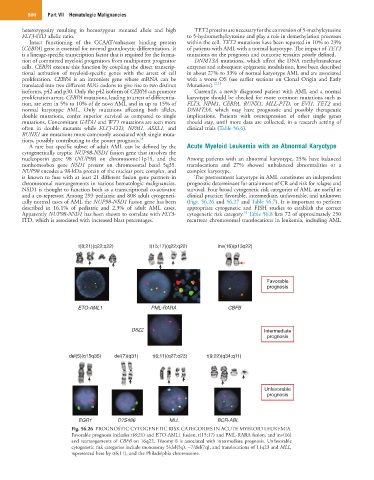
        and a co-repressor. Among 293 pediatric and 808 adult cytogeneti-  clinical practice: favorable, intermediate, unfavorable, and unknown
        cally normal cases of AML the NUP98-NSD1 fusion gene has been   (Figs. 56.26 and 56.27 and Table 56.7). It is important to perform
        described  in  16.1%  of  pediatric  and  2.3%  of  adult  AML  cases.   appropriate  cytogenetic  and  FISH  studies  to  establish  the  correct
                                                                                 14
        Apparently NUP98-NSD1 has been shown to correlate with FLT3-  cytogenetic risk category.  Table 56.8 lists 72 of approximately 250
        ITD, which is associated with increased blast percentages.  recurrent chromosomal translocations in leukemia, including AML


                           t(8;21)(q22;q22)       t(15;17)(q22;q22)     inv(16)(p13q22)


                                                                                        Favorable
                                                                                        prognosis


                           ETO-AML1               PML-RARA                  CBFB


                                            D8Z2                                       Intermediate
                                                                                        prognosis


                        del(5)(q15q35)  del(7)(q31)  t(6;11)(q27;q23)  t(9;22)(q34;q11)


                                                                                        Unfavorable
                                                                                        prognosis


                           EGR1        D7S486           MLL             BCR-ABL
                        Fig. 56.26  PROGNOSTIC CYTOGENETIC RISK CATEGORIES IN ACUTE MYELOID LEUKEMIA.
                        Favorable prognosis includes t(8;21) and ETO-AML1 fusion, t(15;17) and PML-RARA fusion, and inv(16)
                        and rearrangements of CBFB on 16q22. Trisomy 8 is associated with intermediate prognosis. Unfavorable
                        cytogenetic risk categories include monosomy 5/del(5q), −7/del(7q), and translocations of 11q23 and MLL,
                        represented here by t(6;11), and the Philadelphia chromosome.

