


Page 920 - Hematology_ Basic Principles and Practice ( PDFDrive )
P. 920
Chapter 56  Conventional and Molecular Cytogenomic Basis of Hematologic Malignancies  803


                                                                                     t(16;16)(p13;q22)


                        8  der(21)  21  der(21) ider(21)


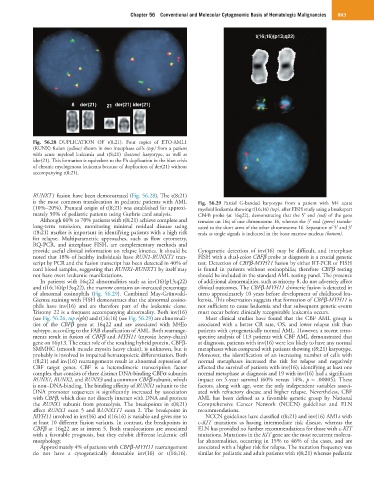
            Fig.  56.28  DUPLICATION  OF  t(8;21).  Four  copies  of  ETO-AML1
            (RUNX) fusion (yellow) shown in two interphase cells (top) from a patient
            with  acute  myeloid  leukemia  and  t(8;21)  (bottom)  karyotype,  as  well  as
            ider(21). This formation is equivalent to the Ph duplication in the blast crisis
            of chronic myelogenous leukemia because of duplication of der(21) without
            accompanying t(8;21).


            RUNXT1 fusion have been demonstrated (Fig. 56.28). The t(8;21)
            is the most common translocation in pediatric patients with AML   Fig.  56.29  Partial  G-banded  karyotype  from  a  patient  with  M4  acute
            (10%–20%). Prenatal origin of t(8;21) was established for approxi-  myeloid leukemia showing t(16;16) (top), after FISH study using a breakapart
            mately 50% of pediatric patients using Guthrie card analysis.  CBFB  probe  (at  16q22),  demonstrating  that  the  5′  end  (red)  of  the  gene
              Although 60% to 70% patients with t(8;21) achieve complete and   remains on 16q of one chromosome 16, whereas the 3′ end (green) translo-
            long-term  remission,  monitoring  minimal  residual  disease  using   cated to the short arms of the other chromosome 16. Separation of 5′ and 3′
            t(8;21) marker is important in identifying patients with a high risk   ends as single signals is indicated in the bone marrow nucleus (bottom).
            for  relapse.  Multiparametric  approaches,  such  as  flow  cytometry,
            RQ-PCR,  and  interphase  FISH,  are  complementary  methods  and
            provide useful clinical information on relapse kinetics. It should be   Cytogenetic  detection  of  inv(16)  may  be  difficult,  and  interphase
            noted that 18% of healthy individuals have RUN1-RUNXT1 tran-  FISH with a dual-color CBFβ probe at diagnosis is a crucial genetic
            script by PCR and the fusion transcript has been detected in 40% of   test. Detection of CBFβ-MYH11 fusion by either RT-PCR or FISH
            cord blood samples, suggesting that RUNX1-RUNXT1 by itself may   is  found  in  patients  without  eosinophilia;  therefore  CBFβ  testing
            not have overt leukemic manifestations.               should be included in the standard AML testing panel. The presence
              In patients with 16q22 abnormalities such as inv(16)(p13;q22)   of additional abnormalities, such as trisomy 8, do not adversely affect
            and t(16;16)(p13;q22), the marrow contains an increased percentage   clinical outcomes. The CBFβ-MYH11 chimeric fusion is detected in
            of  abnormal  eosinophils  (Fig.  56.29).  Combined  May-Grünwald-  utero approximately 10 years before development of childhood leu-
            Giemsa staining with FISH demonstrates that the abnormal eosino-  kemia. This observation suggests that formation of CBFβ-MYH11 is
            phils  have  inv(16)  and  are  therefore  part  of  the  leukemic  clone.   not sufficient to cause leukemia and that subsequent genetic events
            Trisomy 22 is a frequent accompanying abnormality. Both inv(16)   must occur before clinically recognizable leukemia occurs.
            (see Fig. 56.26, top right) and t(16;16) (see Fig. 56.29) are abnormali-  Most  clinical  studies  have  found  that  the  CBF  AML  group  is
            ties  of  the  CBFβ  gene  at  16q22  and  are  associated  with  M4Eo   associated  with  a  better  CR  rate,  OS,  and  lower  relapse  risk  than
            subtype, according to the FAB classification of AML. Both rearrange-  patients with cytogenetically normal AML. However, a recent retro-
            ments result in fusion of CBFβ and MYH11 (myosin heavy-chain)   spective analysis of 113 patients with CBF AML demonstrated that
            gene on 16p13. The exact role of the resulting hybrid protein, CBFβ-  at diagnosis, patients with inv(16) were less likely to have any normal
            SMMHC (smooth muscle myosin heavy chain), is unknown, but it   metaphases when compared with patients showing t(8;21) karyotype.
            probably is involved in impaired hematopoietic differentiation. Both   Moreover, the identification of an increasing number of cells with
            t(8;21) and inv(16) rearrangements result in abnormal repression of   normal  metaphases  increased  the  risk  for  relapse  and  negatively
            CBF  target  genes.  CBF  is  a  heterodimeric  transcription  factor   affected the survival of patients with inv(16); identifying at least one
            complex that consists of three distinct DNA-binding CBFα subunits   normal metaphase at diagnosis and 19 with inv(16) had a significant
            RUNX1, RUNX2, and RUNX3 and a common CBFβ subunit, which   impact  on  5-year  survival  (60%  versus  14%,  p  =  .00005). These
            is non–DNA-binding. The binding affinity of RUNX1 subunit to the   factors, along with age, were the only independent variables associ-
            DNA  promoter  sequences  is  significantly  increased  by  association   ated with refractory disease and higher relapse. Nevertheless, CBF
            with CBFβ, which does not directly interact with DNA and protects   AML  has  been  defined  as  a  favorable  genetic  group  by  National
            the  RUNX1  subunit  from  proteolysis. The  breakpoints  in  t(8;21)   Comprehensive  Cancer  Network  (NCCN)  guidelines  and  ELN
            affect  RUNX1  exon  5  and  RUNX1T1  exon  2. The  breakpoint  in   recommendations.
            MYH11 involved in inv(16) and t(16;16) is variable and gives rise to   NCCN guidelines have classified t(8;21) and inv(16) AMLs with
            at least 10 different fusion variants. In contrast, the breakpoints in   c-KIT  mutations  as  having  intermediate  risk  disease,  whereas  the
            CBFβ at 16q22 are at intron 5. Both translocations are associated   ELN has provided no further recommendations for those with c-KIT
            with a favorable prognosis, but they exhibit different leukemic cell   mutations. Mutations in the KIT gene are the most recurrent molecu-
            morphology.                                           lar  abnormalities,  occurring  in  15%  to  46%  of  the  cases,  and  are
              Approximately 4% of patients with CBFβ-MYH11 rearrangement   associated with a higher risk for relapse. The mutation frequency was
            do  not  have  a  cytogenetically  detectable  inv(16)  or  t(16;16).   similar for pediatric and adult patients with t(8;21) whereas pediatric

