


Page 919 - Hematology_ Basic Principles and Practice ( PDFDrive )
P. 919
802    Part VII  Hematologic Malignancies


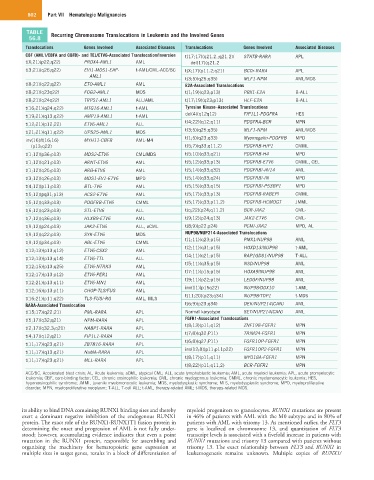
          TABLE   Recurring Chromosome Translocations in Leukemia and the Involved Genes
          56.8
         Translocations     Genes Involved   Associated Diseases  Translocations  Genes Involved  Associated Diseases
         CBF (AML1/CBFA and CBFB)- and TEL/ETV6-Associated Translocation/Inversion  t(17;17)(q21.2.;q21.2)/  STATB-RARA  APL
         t(X;21)(p22;q22)   PRDX4-AML1       AML               del(17)(q21.2
         t(3;21)(q26;q22)   EVI1-MDS1-EAP-   t-AML/CML-ACC/BC  t(X;17)(p11.2;q21)  BCOr-RARA      APL
                              AML1
                                                              t(3;5)(q25;q35)    MLF1-NPM         AML/MDS
         t(8;21)(q22;q22)   ETO-AML1         AML              E2A-Associated Translocations
         t(8;21)(q23q22)    FOG2-AML1        MDS              t(1;19)(q23;p13)   PBX1-E2A         B-ALL
         t(8;21)(q24q22)    TRPS1-AML1       ALL/AML          t(17;19)(q23;p13)  HLF-E2A          B-ALL
         t(16;21)(q24;q22)  MTG16-AML1       t-AML            Tyrosine Kinase–Associated Translocations
                                                              del(4)(q12q12)     FIP1L1-PDGFRA    HES
         t(19;21)(q13;q22)  AMP19-AML1       t-AML
                                                              t(4;22)(q12;q11)   PDGFRA-BCR       MPN
         t(12;21)(p12;22)   ETV6-AML1        ALL
                                                              t(3;5)(q25;q35)    MLF1-NPM         AML/MDS
         t(21;21)(q11;q22)  UPS25-AML1       MDS
         inv(16)/t(16;16)   MYH11-CBFB       AML-M4           t(1;5)(q23;q33)    Myomegalin-PDGFRB  MPD
           (p13;q22)                                          t(5;7)(q33;q11.2)  PDGFRB-HIP1      CMML
         t(1;12)(p36;p13)   MDS2-ETV6        CML/MDS          t(5:10)(q33;q21)   PDGFRB-H4        MPD
         t(1;12)(q21;p13)   ARNT-ETV6        AML              t(5;12)(q33;p13)   PDGFRB-ETV6      CMML, CEL
         t(1;12)(q25;p13)   ARG-ETV6         AML              t(5;14)(q33;q32)   PDGFRB/-AV14     AML
         t(3;12)(q26;p13)   MDS1-EV1-ETV6    MPD              t(5;14)(q33;q24)   PDGFRB/-IN       MPD
         t(4;12)(p11;p13)   BTL-TV6          AML              t(5;15)(q33;q15)   PDGFRB/-P53BP1   MPD
         t(5;12)(pq31;p13)  ACS2-ETV6        AML              t(5;17)(q33;p13)   PDGFRB-RABEPI    CMML
         t(5;12)(q33;p13)   PDGFRB-ETV6      CMML             t(5;17)(q33;p11.2)  PDGFRB-HCMOGT   JMML
         t(6;12)(q23;p13)   STL-ETV6         ALL              t(q;22)(p24;q11.2)  BCR-JAK2        CML-
         t(7;12)(q36;p13)   HLXB9-ETV6       AML              t(9;12)(p24;q13)   JAK2-ETV6        CML-
         t(9;12)(p24;p13)   JAK2-ETV6        ALL, aCML        t(8;9)(p22;p24)    PCMI-JAK2        MPD, AL
         t(9;12)(q22;p13)   SYK-ETV6         MDS              NUP98/NUP214-Associated Translocations
                                                              t(1;11)(q23;p15)   PMX1/NUP98       AML
         t(9;12)(p34;p13)   ABL-ETV6         CMML
                                                              t(2;11)(q31;p15)   HOXD13/NUP98     t-AML
         t(12;13)(p13;q12)  ETV6-CSX2        AML
                                                              t(4;11)(q21;p15)   RAP1GDS1/NUP98   T-ALL
         t(12;13)(p13;q14)  ETV6-TTL         ALL
                                                              t(5;11)(q35;p15)   NSD/NUP98        AML
         t(12;15)(p13;q25)  ETV6-NTRK3       AML
                                                              t(7:11)(p15;p15)   HOXA9/NUP98      AML
         t(12;17)(p13;p12)  ETV6-PER1        AML
                                                              t(9;11)(p22;p15)   LEDGF/NUP98      AML
         t(12;21)(p13;q11)  ETV6-MN1         AML
                                                              inv(11)(p15q22)    NUP98/DDX10      t-AML
         t(12;16)(p13;p11)  CHOP-TLS/FUS     AML
                                                              t(11;20)(p23;q34)  NUP98/TOP1       t-MDS
         t(16;21)(p11;q22)  TLS-FUS/-RG      AML, MLS
         RARA-Associated Translocation                        t(6;9)(p23;q34)    DEK/NUP214(CAN)  AML
         t(15;17)(q22;21)   PML-RARA         APL              Normal karyotype   SET/NUP214(CAN)  AML
         t(5;17)(q32;q21)   NPM-RARA         APL              FGFR1-Associated Translocations
                                                              t(8;13)(p11;q12)   ZNF198-FGFR1     MPN
         t(2;17)(q32.3;q21)  NABP1-RARA      APL
                                                              t(7;8)(q32;P11)    TRIM24-FGFR1     MPN
         t(4;17)(q12;q21)   FIP1L1-RARA      APL
                                                              t(6;8)(q27;P11)    FGFR1OP-FGFR1    MPN
         t(11;17)(q23;q21)  ZBTB16-RARA      APL
                                                              ins(12;8)(p11;p11p22)  FGFR1OP2-FGFR1  MPN
         t(11;17)(q13;q21)  NuMA-RARA        APL
                                                              t(8;17)(p11;q11)   MYO18A-FGFR1     MPN
         t(11;17)(q23;q21)  MLL-RARA         APL
                                                              t(8;22)(p11;q11,2)  BCR-FGFR1       MPN
         ACC/BC, Accelerated blast crisis; AL, Acute leukemia; aCML, atypical CML; ALL, acute lymphoblastic leukemia; AML, acute myeloid leukemia; APL, acute promyelocytic
         leukemia; CBF, core-binding factor; CEL, chronic eosinophilic leukemia; CML, chronic myelogenous leukemia; CMML, chronic myelomonocytic leukemia; HES,
         hypereosinophilic syndrome; JMML, juvenile myelomonocytic leukemia; MDS, myelodysplastic syndrome; MLS, myelodysplastic syndrome; MPD, myeloproliferative
         disorder; MPN, myeloproliferative neoplasm; T-ALL, T-cell ALL; t-AML, therapy-related AML; t-MDS, therapy-related MDS.
        its ability to bind DNA containing RUNX1 binding sites and thereby   myeloid progenitors to granulocytes. RUNX1 mutations are present
        exert  a  dominant  negative  inhibition  of  the  endogenous  RUNX1   in 46% of patients with AML with the M0 subtype and in 80% of
        protein. The exact role of the RUNX1-RUNX1T1 fusion protein in   patients with AML with trisomy 13. As mentioned earlier, the FLT3
        determining the onset and progression of AML is not fully under-  gene  is  localized  on  chromosome  13,  and  quantitation  of  FLT3
        stood; however, accumulating evidence indicates that even a point   transcript levels is associated with a fivefold increase in patients with
        mutation  in  the  RUNX1  protein,  responsible  for  assembling  and   RUNX1 mutations and trisomy 13 compared with patients without
        organizing  the  machinery  for  hematopoietic  gene  expression  at   trisomy  13. The  exact  relationship  between  FLT3  and  RUNX1  in
        multiple sites in target genes, results in a block of differentiation of   leukemogenesis  remains  unknown.  Multiple  copies  of  RUNX1/

