


Page 916 - Hematology_ Basic Principles and Practice ( PDFDrive )
P. 916
Chapter 56  Conventional and Molecular Cytogenomic Basis of Hematologic Malignancies  799


            constrained clonal evolution. Multicolor metaphase analysis, FISH,   TABLE   Gene Mutations in Patients with Acute Myeloid
            CGH  arrays,  SNP  arrays,  PCR  arrays,  and  NGS  have  all  greatly   56.6  Leukemia and a Normal Karyotype
            improved  detection  of  subclones  and  established  the  concept  of  a
            clonal hierarchy in AML. To understand the branching evolution of           Frequency (%) of
            AML  development,  each  mutation  must  be  placed  in  the  context   Chromosomal   Patients With
            whether it is a “driver” versus “passenger” and an “initiation” versus   Gene  Location  Normal Karyotype  Prognosis
            “progression” event. Driver mutations directly affect the biology of   NPM1  5q35  45–62  Favorable, increased
            the cell, whereas passenger mutations do not. Initiation mutations                         CR rates and
            are present within the founding clone and are found in all AML cells.                      prolonged OS in
            Progression  mutations  emerge  during  leukemic  evolution,  can  be                      the absence of
            found as subclones, and exist in only a fraction of AML cells. Selec-                      FLT3 mutation
            tion  pressure,  such  as  chemotherapy,  can  favor  the  elimination  or   FLT3-IDT  13q12  25–35  Unfavorable,
            outgrowth  of  different  branches  within  the  AML  evolutionary                         specifically when
            hierarchy.                                                                                 the mutant to WT
              Modern genomic technologies have provided a better understand-                           allelic ratio is
            ing of normal and leukemic hematopoiesis. A subset of AML cases                            high
            evolves  from  a  preceding  clinically  overt  phase  such  as  MDS  by
            subclonal evolution with an increased number of genomic changes.   FLT3-TKD  13q12  7–10  Controversial
            The founder mutations present in preleukemic cells are retained in   CEBPA  19q13.1  15  Favorable
            AML  blasts,  implicating  them  as  putative  initiating  events  and   MLL-PTD  11q23  10  Not known
            establishing  clonal  expansion  as  the  first  step  in  leukemogenesis.
            However,  some  recurrent  leukemia-associated  somatic  mutations,   IDH1  2q33.3  15–20  Most likely
            such as TET2, have been also linked to multilineage clonal hemato-                         unfavorable
            poiesis in aging healthy individuals. For the majority of de novo AML   IDH2  15q26.1  20  Most likely
            without any prior clinical symptoms, the cell of origin, and biologic                      unfavorable
            consequences of initiating mutations and order of subsequent muta-  DNMT3A  2p23.2  36   Most likely
            tions  remain  poorly  understood.  Recent  evidence  revealed  that                       unfavorable
            approximately  25%  of  adult  AMLs  are  associated  with  DNMT3A   TET2  4q24  5       Likely unfavorable
            mutations,  which  occurs  in  preleukemic  hematopoietic  stem  cells
            before acquiring additional mutations such as NPM1. These initiat-  ASXL1  20q11.21  9–10  Inferior outcome
            ing  DNMT3A  mutation–carrying  cells  persist  during  remission   CR, Complete remission; OS, overall survival.
            suggesting that preleukemic hematopoietic stem cells are resistant to
            induction chemotherapy and may represent a reservoir from which a
            future relapse develops.
              Initial observations by the International Workshop on Chromo-  of tryptophan residues and generation of a nuclear export signal that
            somes in Leukemia asserted that cytogenetic findings may serve as   acts in concert to cause delocalization of NPM1 from the nuclei to
            the single most important prognostic marker in AML; these observa-  the cytoplasm. Because the functional integrity of NPM1 is depen-
            tions were subsequently validated through studies conducted by the   dent on its ability to shuttle between the nucleus and cytoplasm, this
            Medical Research Council (MRC), the Cancer and Leukemia Group   ability  is  severely  compromised  in  NPM1-mutated  AML.  NPM1-
            B (CALGB), and the Southwest Oncology Group. Finally, in 2008,   mutated  AML  is  associated  with  distinctive  biologic  and  clinical
            the WHO incorporated cytogenetic findings along with morphology,   features  including  older  age,  female  predominance,  multilineage
            immunologic markers, and molecular genetics into their classification   involvement,  extramedullary  disease,  high  blast  percentages  and
            system. Cytogenetics is the most powerful independent prognostic   increased white blood cell counts, and lack of CD34 expression. As
            factor  in  AML  and  provides  the  framework  for  risk  stratification   an isolated molecular abnormality, NPM1-mutated AML is associ-
            schemes  that  have  been  generally  adopted  to  guide  treatment   ated with a highly favorable prognosis, with complete remission (CR)
            approach. Based on karyotype status, two major groups of AML can   rates between 70% and 80%. The most common mutation (type A,
            be  distinguished:  (a)  those  with  an  abnormal  karyotype,  which   accounting  for  75%  of  all  mutations)  generates  an  aberrant  extra
            accounts for approximately 52% of patients, and (b) those with a   nuclear export signal. Although NPM1 mutations are heterozygous,
            normal karyotype by conventional cytogenetics, which accounts for   hetero/homodimerization with wild-type NPM1 results in cytoplas-
            48% of patients with AML.                             mic  mislocalization  of  both  mutant  and  wild-type  protein.  This
                                                                  alteration in subcellular location perturbs normal NPM1 function,
                                                                  including  the  mislocalization  and  stabilization  of  critical  proteins
            Acute Myeloid Leukemia with a Normal Karyotype        such  as  the TP53  regulator  p14ARF,  and  leads  to  transformation.
                                                                  This  process  also  generates  a  distinct  transcriptional  signature  in
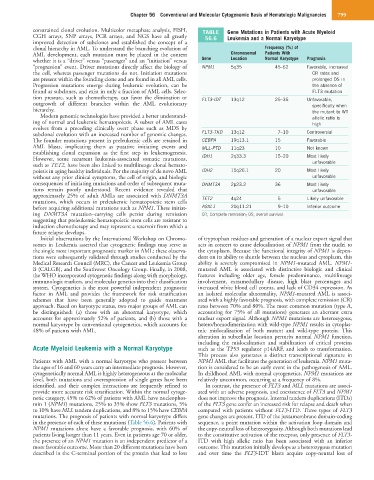
            Patients with AML with a normal karyotype who present between   NPM1 AML that facilitates the generation of leukemia. NPM1 muta-
            the ages of 16 and 60 years carry an intermediate prognosis. However,   tion is considered to be an early event in the pathogenesis of AML.
            cytogenetically normal AML is highly heterogeneous at the molecular   In childhood AML with normal cytogenetics, NPM1 mutations are
            level, both mutations and overexpression of single genes have been   relatively uncommon, occurring at a frequency of 8%.
            identified, and their complex interactions are frequently refined to   In contrast, the presence of FLT3 and MLL mutations are associ-
            provide more accurate risk stratification. Within the normal cytoge-  ated with an adverse prognosis, and coexistence of FLT3 and NPM1
            netic category, 45% to 62% of patients with AML have nucleophos-  does not improve the prognosis. Internal tandem duplications (ITDs)
            min 1 (NPM1) mutations, 25% to 35% show FLT3 mutations, 5%   of the FLT3 gene confer an increased risk for relapse and death when
            to 10% have MLL tandem duplications, and 8% to 15% have CEBPA   compared  with  patients  without  FLT3-ITD. Three  types  of  FLT3
            mutations. The prognosis of patients with normal karyotype differs   gene changes are present, ITD of the juxtamembrane domain-coding
            in the presence of each of these mutations (Table 56.6). Patients with   sequence, a point mutation within the activation loop domain and
            NPM1  mutations  alone  have  a  favorable  prognosis,  with  60%  of   the copy-neutral loss of heterozygosity. Although both mutations lead
            patients living longer than 11 years. Even in patients age 70 or older,   to the constitutive activation of the receptor, only presence of FLT3-
            the presence of an NPM1 mutation is an independent predictor of a   ITD  with  high  allelic  ratio  has  been  associated  with  an  inferior
            more favorable outcome. More than 20 different mutations have been   outcome. This mutation initially develops as a heterozygous mutation
            described in the C-terminal portion of the protein that lead to loss   and  over  time  the  FLT3-IDT  blasts  acquire  copy-neutral  loss  of

