


Page 935 - Hematology_ Basic Principles and Practice ( PDFDrive )
P. 935
818    Part VII  Hematologic Malignancies


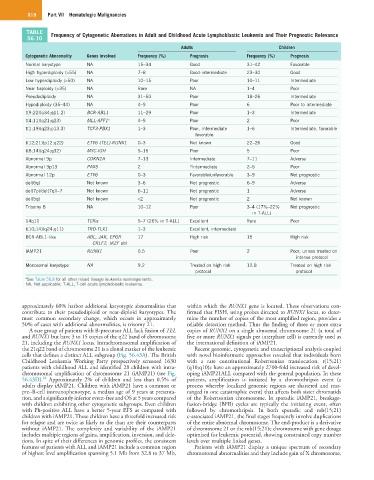
          TABLE   Frequency of Cytogenetic Aberrations in Adult and Childhood Acute Lymphoblastic Leukemia and Their Prognostic Relevance
          56.10
                                                            Adults                          Children
         Cytogenetic Abnormality  Genes Involved  Frequency (%)  Prognosis        Frequency (%)  Prognosis
         Normal karyotype    NA               15–34            Good               31–42         Favorable
         High hyperdiploidy (>55)  NA         7–8              Good-intermediate  23–30         Good
         Low hyperdiploidy (>50)  NA          10–15            Poor               10–11         Intermediate
         Near haploidy (<35)  NA              Rare             NA                 1–4           Poor
         Pseudodiploidy      NA               31–50            Poor               18–26         Intermediate
         Hypodiploidy (35–44)  NA             4–9              Poor               6             Poor to intermediate
         t(9;22)(q34;q11.2)  BCR-ABL1         11–29            Poor               1–3           Intermediate
         t(4;11)(q21;q23)    MLL-AFF1 a       4–9              Poor               2             Poor
         t(1;19)(q23;p13.3)  TCF3-PBX1        1–3              Poor, intermediate   1–6         Intermediate, favorable
                                                                 favorable
         t(12;21)(p12;q22)   ETV6 (TEL)-RUNX1  0–3             Not known          22–26         Good
         t(8;14)(q24;q32)    MYC-IGH          5–15             Poor               5             Poor
         Abnormal 9p         CDKN2A           7–13             Intermediate       7–11          Adverse
         Abnormal 9p13       PAX5             2                ?Intermediate      2–5           Poor
         Abnormal 12p        ETV6             0–3              Favorable/unfavorable  3–9       Not prognostic
         del(6q)             Not known        3–6              Not prognostic     6–9           Adverse
         del(7p)/del(7q)/−7  Not known        6–11             Not prognostic     1             Adverse
         del(5q)             Not known        <2               Not prognostic     2             Not known
         Trisomy 8           NA               10–12            Poor               3–4 (17%–22%   Not prognostic
                                                                                    in T-ALL)
         14q11               TCRα             5–7 (26% in T-ALL)  Excellent       Rare          Poor
         t(10;14)(q24;q11)   TRD-TLX1         1–3              Excellent, intermediate
         BCR-ABL1-like       ABL, JAK, EPOR   17               High risk          15            High risk
                               CRLF2, IKZF del
         iAMP21              RUNX1            0.5              Poor               2             Poor, unless treated on
                                                                                                  intense protocol
         Monosomal karyotype  NA              9.2              Treated on high risk   12.8      Treated on high risk
                                                                 protocol                         protocol
         a See Table 56.8 for all other mixed lineage leukemia rearrangements.
         NA, Not applicable; T-ALL, T-cell acute lymphoblastic leukemia.


        approximately 60% harbor additional karyotypic abnormalities that   within which the RUNX1 gene is located. These observations con-
        contribute  to  their  pseudodiploid  or  near-diploid  karyotypes. The   firmed that FISH, using probes directed to RUNX1 locus, to deter-
        most  common  secondary  change,  which  occurs  in  approximately   mine the number of copies of the most amplified region, provides a
        50% of cases with additional abnormalities, is trisomy 21.  reliable detection method. Thus the finding of three or more extra
           A rare group of patients with B-precursor ALL lack fusion of TEL   copies of RUNX1 on a single abnormal chromosome 21 (a total of
        and RUNX1 but have 3 to 15 copies of the q22 band of chromosome   five or more RUNX1 signals per interphase cell) is currently used as
        21, including the RUNX1 locus. Intrachromosomal amplification of   the international definition of iAMP21.
        the 21q22 band of chromosome 21 is a clonal marker of the leukemic   Recent genomic, cytogenetic and transcriptional analysis coupled
        cells that defines a distinct ALL subgroup (Fig. 56.43A). The British   with novel bioinformatic approaches revealed that individuals born
        Childhood  Leukemia  Working  Party  prospectively  screened  1630   with  a  rare  constitutional  Robertsonian  translocation,  t(15;21)
        patients with childhood ALL and identified 28 children with intra-  (q10;q10)c have an approximately 2700-fold increased risk of devel-
        chromosomal amplification of chromosome 21 (iAMP21) (see Fig.   oping iAMP21ALL compared with the general population. In these
               24
        56.43D).   Approximately  2%  of  children  and  less  than  0.5%  of   patients,  amplification  is  initiated  by  a  chromothripsis  event  (a
        adults display iAMP21. Children with iAMP21 have a common or   process  whereby  localized  genomic  regions  are  shattered  and  rear-
        pre–B-cell immunophenotype, a median age of 9 years at presenta-  ranged in one catastrophic event) that affects both sister chromatids
        tion, and a significantly inferior event-free and OS at 5 years compared   of the Robertsonian chromosome. In sporadic iAMP21, breakage-
        with children exhibiting other cytogenetic subgroups. Even children   fusion-bridge  (BFB)  cycles  are  typically  the  initiating  event,  often
        with  Ph-positive  ALL  have  a  better  5-year  EFS  as  compared  with   followed  by  chromothripsis.  In  both  sporadic  and  rob(15;21)
        children with iAMP21. These children have a threefold increased risk   c-associated iAMP21, the final stages frequently involve duplications
        for relapse and are twice as likely to die than are their counterparts   of the entire abnormal chromosome. The end-product is a derivative
        without  iAMP21. The  complexity  and  variability  of  the  iAMP21   of chromosome 21 or the rob(15;21)c chromosome with gene dosage
        includes multiple regions of gains, amplification, inversion, and dele-  optimized for leukemic potential, showing constrained copy number
        tions. In spite of their differences in genomic profiles, the consistent   levels over multiple linked genes.
        features of patients with ALL and iAMP21 include a common region   Patients with iAMP21 display a unique spectrum of secondary
        of highest level amplification spanning 5.1 Mb from 32.8 to 37 Mb,   chromosomal abnormalities and they include gain of X chromosome,

