


Page 938 - Hematology_ Basic Principles and Practice ( PDFDrive )
P. 938
Chapter 56  Conventional and Molecular Cytogenomic Basis of Hematologic Malignancies  821


                                                                  worse prognosis when treated with risk-adapted or subtype oriented
                                                                  protocols. Monosomal karyotype did not have an impact on prognosis
                                                                  in Ph-positive ALL irrespective of imatinib treatment.
                                                                    The lymphoid leukemias associated with Down syndrome (DS-
                                                                  ALL) are almost exclusively B-precursor ALLs. In a recent large series
                                                                  of DS-ALLs, there were only five cases of T-ALL among 700 patients.
                                                                  Also, in a sharp contrast to the myeloid neoplasms, they almost never
                                                                  occur in infants. Clinically the outcome of DS-ALL is significantly
                                                                  worse  than  sporadic  childhood  B-cell  precursor  ALLs  because  of
                                                                  intrinsic resistance to therapy and increased treatment-related mortal-
                                                                  ity. Although all known cytogenetic subgroups of childhood B-cell
                                                                  ALLs have been observed, the common abnormalities such as ETV6/
                                                                  RUNX1 fusion and hyperdiploidy, are less frequent.
                                                                    Up to 60% of DS-ALLs have aberrant expression of the cytokine
                                                                  receptor CRLF2 that is often associated with additional mutations
                                                                  activating JAK-STAT signaling. The aberrant expression of this recep-
                                                                  tor  is  caused  by  genomic  rearrangements  consisting  either  of  a
                                                                  translocation into the IgH locus control region or a microdeletion
                                                                  upstream  to  the  CRLF2  gene,  located  on  the  pseudoautosomal
                                                                  component of the sex chromosomes. This deletion fuses CRLF2 with
                                                                  the promoter of an upstream constitutively expressed P2RY8 gene.
                                                                  Analysis of the breakpoint sequences suggest that this rearrangement
                                                                  is mediated by RAG1 or RAG2 in early B-cell precursors.

                                                                  Somatic Mutations

                                                                  The most commonly altered pathways in ALL, involving the tran-
                          MYC/IgH
                                                                  scriptional  regulation  of  lymphoid  development,  such  as  PAX5
                                                                  (9p13.2),  IKZF1  (7p12.2)  and  EBF1  (5q33.3),  are  frequently
                                                                  mutated. PAX5 is required for B-lymphoid lineage commitment and
                                                                  maturation.  PAX5  genetic  alterations  include  deletions,  sequence
                                                                  mutations, and chimeric genes with at least 16 different chromosomal
                                                                  partners  (http://atlasgeneticsoncology.org/Genes/PAX5ID62.html).
                                                                  IKAROS is required for the development of all lymphoid lineages and
                                                                  its genetic lesions are implicated in resistance to chemotherapy and
                                                                  TKIs.
                                                                    Other  commonly  mutated  pathways  in  ALL  include  genes
                                                                  involved in tumor suppression and cell cycle regulation (TP53, Rb1,
                                                                  and CDKN2A), cytokine receptor, RAS-signaling, lymphoid signal-
                                                                  ing and epigenetic modification such as EZH2.
                                                                  Multistep Pathogenesis of Acute
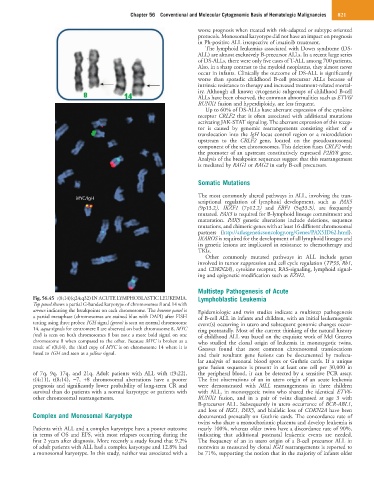
            Fig. 56.45  t(8;14)(q24;q32) IN ACUTE LYMPHOBLASTIC LEUKEMIA.   Lymphoblastic Leukemia
            Top panel shows a partial G-banded karyotype of chromosomes 8 and 14 with
            arrows indicating the breakpoints on each chromosome. The bottom panel is   Epidemiologic  and  twin  studies  indicate  a  multistep  pathogenesis
            a partial metaphase (chromosomes are stained blue with DAPI) after FISH   of B-cell ALL in infants and children, with an initial leukemogenic
            testing using three probes: IGH signal (green) is seen on normal chromosome   event(s) occurring in utero and subsequent genomic changes occur-
            14, aqua signals for centromere 8 are observed on both chromosome 8, MYC   ring postnatally. Most of the current thinking of the natural history
            (red) is seen on both chromosomes 8 but note a more bold signal on one   of childhood ALL was based on the exquisite work of Mel Greaves
            chromosome 8 when compared to the other. Because MYC is broken as a   who  studied  the  clonal  origin  of  leukemia  in  monozygotic  twins.
            result of t(8;14), the third copy of MYC is on chromosome 14 where it is   Greaves  found  that  most  common  chromosomal  translocations
            fused to IGH and seen as a yellow signal.             and  their  resultant  gene  fusions  can  be  documented  by  molecu-
                                                                  lar  analysis  of  neonatal  blood  spots  or  Guthrie  cards.  If  a  unique
                                                                  gene  fusion  sequence  is  present  in  at  least  one  cell  per  30,000  in
            of  7q,  9q,  17q,  and  21q.  Adult  patients  with  ALL  with  t(9;22),   the  peripheral  blood,  it  can  be  detected  by  a  sensitive  PCR  assay.
            t(4;11),  t(8;14),  −7,  +8  chromosomal  aberrations  have  a  poorer   The  first  observations  of  an  in  utero  origin  of  an  acute  leukemia
            prognosis and significantly lower probability of long-term CR and   were  demonstrated  with  MLL  rearrangements  in  three  children
            survival than do patients with a normal karyotype or patients with   with  ALL,  in  monozygotic  twins  who  shared  the  identical  ETV6-
            other chromosomal rearrangements.                     RUNX1  fusion,  and  in  a  pair  of  twins  diagnosed  at  age  3  with
                                                                  B-precursor ALL. Subsequently in utero occurrence of BCR-ABL1,
                                                                  and loss of IKZ1, PAX5, and biallelic loss of CDKN2A have been
            Complex and Monosomal Karyotype                       documented prenatally on Guthrie cards. The concordance rate of
                                                                  twins who share a monochorionic placenta and develop leukemia is
            Patients with ALL and a complex karyotype have a poorer outcome   nearly 100%, whereas older twins have a discordance rate of 90%,
            in terms of OS and EFS, with most relapses occurring during the   indicating  that  additional  postnatal  leukemic  events  are  needed.
            first 2 years after diagnosis. More recently a study found that 9.2%   The  frequency  of  an  in  utero  origin  of  a  B-cell  precursor  ALL  in
            of adult patients with ALL had a complex karyotype and 12.8% had   nontwins as measured by clonal IGH rearrangements is reported to
            a monosomal karyotype. In this study, neither was associated with a   be 71%, supporting the notion that in the majority of infants older

