


Page 936 - Hematology_ Basic Principles and Practice ( PDFDrive )
P. 936
Chapter 56  Conventional and Molecular Cytogenomic Basis of Hematologic Malignancies  819


                                                                  Fig.  56.44  The  Ph  CHROMOSOME  IN  ACUTE  LYMPHOBLASTIC
                                                                  LEUKEMIA. t(9;22)(q34;q11) (arrows) in a patient with acute lymphoblastic
                                                                  leukemia. Note that the first chromosome 9 has deletion of the short arms,
                                                                  a frequent finding in both adult and pediatric patients with acute lympho-
                                                                  blastic leukemia.
               A

                                                                  children than in adults with ALL and is observed in patients with
                                                                  myeloid disorders, specifically in adults with MDS. Two other genes
                                                                  residing on 12p are also rearranged: CCND2 is frequently amplified,
                                                                  and CDKN1B is often deleted.
                                                                    Approximately 5% of children and 20% to 25% of adults with
                                                                  ALL have a Ph chromosome, making it the most common structural
              B              C               D                    rearrangement in adult ALL (Fig. 56.44). The breakpoint on the Ph
                                                                  chromosome is more centromeric than in CML (see Chronic Myelog-
                                                                  enous  Leukemia  section,  earlier).  It  includes  the  5′  breakpoint  on
                                                                  chromosome 22, distal to the first exon (falling between exon e1 and
                                                                  e2) of the BCR gene, resulting in the P190 BCR-ABL1  variant, providing
                                                                  a diagnostic distinction between the lymphoid blast crisis of CML
              E                                F F                and  de  novo  ALL.  Ph-positive  ALL  is  characterized  by  a  smaller
                                                                  BCR-ABL1 (P190) protein, containing less BCR than the P210 and
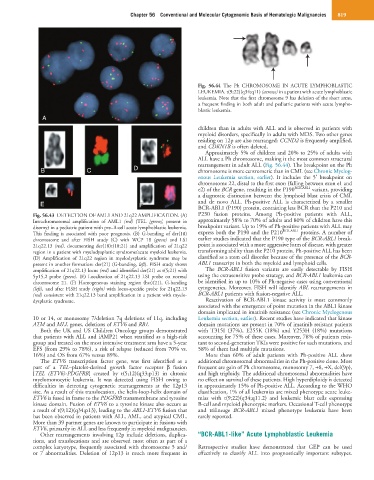
            Fig. 56.43  DETECTION OF AML1 AND 21q22 AMPLIFICATION. (A)   P230  fusion  proteins.  Among  Ph-positive  patients  with  ALL,
            Intrachromosomal  amplification  of  AML1  (red)  (TEL  [green],  present  in   approximately 58% to 70% of adults and 80% of children have this
            disomy) in a pediatric patient with pre–B-cell acute lymphoblastic leukemia.   breakpoint variant. Up to 19% of Ph-positive patients with ALL may
                                                                                             BCR-ABL1
            This  finding  is  associated  with  poor  prognosis.  (B)  G-banding  of  der(18)   express both the P190 and the P210   proteins. A number of
            chromosome  and  after  FISH  study  (C)  with  WCP  18  (green)  and  LSI   earlier studies indicated that the P190 type of the BCR-ABL1 break-
            21q22.13  (red),  documenting  der(18)t(18;21)  and  amplification  of  21q22   point is associated with a more aggressive form of disease, with greater
            region in a patient with myelodysplastic syndrome/acute myeloid leukemia.   transforming ability than the P210 protein. Ph-positive ALL has been
            (D)  Amplification  of  21q22  region  in  myelodysplastic  syndrome  may  be   classified as a stem cell disorder because of the presence of the BCR-
            present in another formation: der(21) (G-banding, left). FISH study shows   ABL1 transcript in both the myeloid and lymphoid cells.
            amplification of 21q22.13 locus (red) and identified der(21) as t(5;21) with   The  BCR-ABL1  fusion  variants  are  easily  detectable  by  FISH
            5p15.2  probe  (green).  (E)  Localization  of  21q22.13  LSI  probe  on  normal   using the extrasensitive probe strategy, and BCR-ABL1 leukemia can
            chromosome  21.  (F)  Homogeneous  staining  region  (hsr)(21),  G-banding   be identified in up to 10% of Ph-negative cases using conventional
            (left), and after FISH study (right) with locus-specific probe for 21q22.13   cytogenetics. Moreover, FISH will identify ABL rearrangements in
            (red) consistent with 21q22.13 band amplification in a patient with myelo-  BCR-ABL1 patients with fusion-negative ALL.
            dysplastic syndrome.                                    Reactivation  of  BCR-ABL1  kinase  activity  is  most  commonly
                                                                  associated with the emergence of point mutation in the ABL1 kinase
                                                                  domain implicated in imatinib resistance (see Chronic Myelogenous
            10 or 14, or monosomy 7/deletion 7q deletions of 11q, including   Leukemia section, earlier). Recent studies have indicated that kinase
            ATM and MLL genes, deletions of ETV6 and RB1.         domain mutations are present in 70% of imatinib resistant patients
              Both the UK and US Children Oncology groups demonstrated   with  T315I  (37%),  E255K  (18%)  and  Y253H  (18%)  mutations
            that patients with ALL and iAMP21 when stratified as a high-risk   accounting for 75% of these cases. Moreover, 78% of patients resis-
            group and treated on the most intensive treatment arm have a 5-year   tant to second-generation TKIs were positive for such mutations, and
            EFS (from 29% to 78%), a risk of relapse (reduced from 70% vs.   58% of them had multiple mutations.
            16%) and OS from 67% versus 89%.                        More  than  60%  of  adult  patients  with  Ph-positive  ALL  show
              The  ETV6  transcription  factor  gene,  was  first  identified  as  a   additional chromosomal abnormalities in the Ph-positive clone. Most
            part  of  a  TEL–platelet-derived  growth  factor  receptor  β  fusion   frequent are gain of Ph chromosome, monosomy 7, +8, +X, del(9p),
            [TEL  (ETV6)-PDGFRB]  created  by  t(5;12)(q33;p13)  in  chronic   and high triploidy. The additional chromosomal abnormalities have
            myelomonocytic  leukemia.  It  was  detected  using  FISH  owing  to   no effect on survival of these patients. High hyperdiploidy is detected
            difficulties  in  detecting  cytogenetic  rearrangements  at  the  12p13   in approximately 15% of Ph-positive ALL. According to the WHO
            site. As a result of this translocation, the helix-loop-helix domain of   classification, 1% of all leukemias are mixed phenotype acute leuke-
            ETV6 is fused in frame to the PDGFRB transmembrane and tyrosine   mias  with  t(9;22)(q34;q11.2)  and  leukemic  blast  cells  expressing
            kinase domain. Fusion of ETV6 to a tyrosine kinase also occurs as   B-cell and myeloid phenotypic markers. Occasional T-cell phenotype
            a result of t(9;12)(q34;p13), leading to the ABL1-ETV6 fusion that   and  trilineage  BCR-ABL1  mixed  phenotype  leukemia  have  been
            has been observed in patients with ALL, AML, and atypical CML.   rarely reported.
            More than 39 partner genes are known to participate in fusions with
            ETV6, primarily in ALL and less frequently in myeloid malignancies.
              Other rearrangements involving 12p include deletions, duplica-  “BCR-ABL1-like” Acute Lymphoblastic Leukemia
            tions, and translocations and are observed most often as part of a
            complex karyotype, frequently associated with chromosome 5 and/  Retrospective  studies  have  demonstrated  that  GEP  can  be  used
            or  7  abnormalities.  Deletion  of  12p13  is  much  more  frequent  in   effectively  to  classify  ALL  into  prognostically  important  subtypes.

