


Page 940 - Hematology_ Basic Principles and Practice ( PDFDrive )
P. 940
Chapter 56  Conventional and Molecular Cytogenomic Basis of Hematologic Malignancies  823


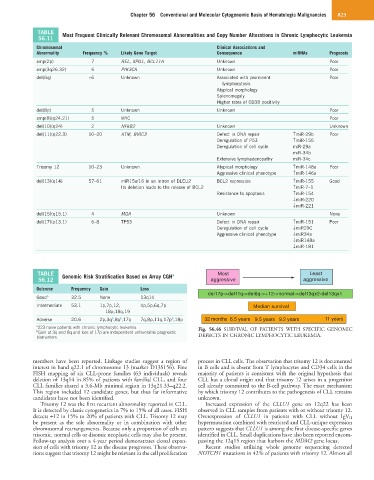
             TABLE   Most Frequent Clinically Relevant Chromosomal Abnormalities and Copy Number Alterations in Chronic Lymphocytic Leukemia
              56.11
             Chromosomal                                                Clinical Associations and
             Abnormality    Frequency %  Likely Gene Target             Consequence              miRNAs      Prognosis
             amp(2p)           7         REL, XPO1, BCL11A              Unknown                              Poor
             amp(3q26.32)      6         PIK3CA                         Unknown                              Poor
             del(6q)          ~6         Unknown                        Associated with prominent            Poor
                                                                          lymphocytosis
                                                                        Atypical morphology
                                                                        Splenomegaly
                                                                        Higher rates of CD38 positivity
             del(8p)           5         Unknown                        Unknown                              Poor
             amp(8)(q24.21)    5         MYC                                                                 Poor
             del(10)(q24)      2         NFkB2                          Unknown                              Unknown
             del(11)(q22.3)   10–20      ATM, BIRC3                     Defect in DNA repair     ↑miR-29b    Poor
                                                                        Deregulation of P53      ↑miR-155
                                                                        Deregulation of cell cycle  miR-29a
                                                                                                 miR-34b
                                                                        Extensive lymphadenopathy  miR-34c
             Trisomy 12       10–23      Unknown                        Atypical morphology      ↑miR-148a   Poor
                                                                        Aggressive clinical phenotype  ↑miR-146a
             del(13)(q14)     57–61      miR15a/16 in an intron of DLEU2  BCL2 expression        ↑miR-155    Good
                                         Its deletion leads to the release of BCL2               ↑miR-7–1
                                                                        Resistance to apoptosis  ↑miR-154
                                                                                                 ↓miR-220
                                                                                                 ↓miR-221
             del(15)(q15.1)    4         MGA                            Unknown                              None
             del(17)(p13.1)    6–8       TP53                           Defect in DNA repair     ↑miR-151    Poor
                                                                        Deregulation of cell cycle  ↓miR29C
                                                                        Aggressive clinical phenotype  ↓miR34a
                                                                                                 ↓miR148a
                                                                                                 ↓miR-181


             TABLE   Genomic Risk Stratification Based on Array CGH a   Most                          Least
              56.12                                                   aggressive                    aggressive
             Outcome    Frequency  Gain        Loss
                                                                     del17p->del11q->del6q->+12->normal->del13qx2-del13qx1
             Good b     32.5      None         13q14
             Intermediate  53.1   1p,7p,12,    4p,5p,6q,7p                          Median survival
                                   18p,18q,19
                                        b
                                                         b
             Adverse    20.6      2p,3q ,8q ,17q  7q,8p,11q,17p ,18p  32 months  6.5 years 9.5 years   9.2 years  11 years
                                      b
             a 223 naive patients with chronic lymphocytic leukemia.  Fig.  56.46  SURVIVAL  OF  PATIENTS  WITH  SPECIFIC  GENOMIC
             b Gain of 3q and 8q and loss of 17p are independent unfavorable prognostic
             biomarkers.                                          DEFECTS IN CHRONIC LYMPHOCYTIC LEUKEMIA.
            members  have  been  reported.  Linkage  studies  suggest  a  region  of   process in CLL cells. The observation that trisomy 12 is documented
            interest in band q22.1 of chromosome 13 (marker D13S156). Fine   in B cells and is absent from T lymphocytes and CD34 cells in the
            FISH  mapping  of  six  CLL-prone  families  (63  individuals)  reveals   majority of patients is consistent with the original hypothesis that
            deletion of 13q14 in 85% of patients with familial CLL, and four   CLL has a clonal origin and that trisomy 12 arises in a progenitor
            CLL families shared a 3.6-Mb minimal region in 13q21.33–q22.2.   cell already committed to the B-cell pathway. The exact mechanism
            This region included 12 candidate genes, but thus far informative   by which trisomy 12 contributes to the pathogenesis of CLL remains
            candidates have not been identified.                  unknown.
              Trisomy 12 was the first recurrent abnormality reported in CLL.   Increased  expression  of  the  CLLU1  gene  on  12q22  has  been
            It is detected by classic cytogenetics in 7% to 15% of all cases. FISH   observed in CLL samples from patients with or without trisomy 12.
            detects +12 in 15% to 20% of patients with CLL. Trisomy 12 may   Overexpression  of  CLLU1  in  patients  with  CLL  without  IgV H
            be  present  as  the  sole  abnormality  or  in  combination  with  other   hypermutation combined with restricted and CLL-unique expression
            chromosomal rearrangements. Because only a proportion of cells are   pattern suggests that CLLU1 is among the first disease-specific genes
            trisomic, normal cells or disomic neoplastic cells may also be present.   identified in CLL. Small duplications have also been reported encom-
            Follow-up analysis over a 4-year period demonstrates clonal expan-  passing the 12q15 region that harbors the MDM2 gene locus.
            sion of cells with trisomy 12 as the disease progresses. These observa-  Recent  studies  utilizing  whole  genome  sequencing  detected
            tions suggest that trisomy 12 might be relevant in the cell proliferation   NOTCH1 mutations in 42% of patients with trisomy 12. Almost all

