


Page 962 - Hematology_ Basic Principles and Practice ( PDFDrive )
P. 962
Chapter 56  Conventional and Molecular Cytogenomic Basis of Hematologic Malignancies  845


             TABLE   Genetic Rearrangements in T-ALL—cont’d
              56.18
             Genetic Lesion                      Gene                  Frequency %                          Outcome
             Activating mutation                 NRAS                  5                                    no imact
             Activating mutation                 KRAS                  2                                    NA
             Activating mutation                 JAK1                  4–18                                 no imact
             t(9;12)(p24;p13)                    ETV6-JAK2             <1                                   no imact
             Activating mutation                 FLT3                  5–10                                 no imact
             t(X;7)((q22;q34)                    IRS4                  <1                                   NA
             t(X;14)(q22;q11.2)                  IRS4
             Inactivating mutation               DNM2                  15                                   NA
             t(9;22)(q34;q11.2)                  BCR-ABL1              1                                    poor
             Modified from Belver and Ferrando Nature 16: 494, 2016.
             NA, Not available.


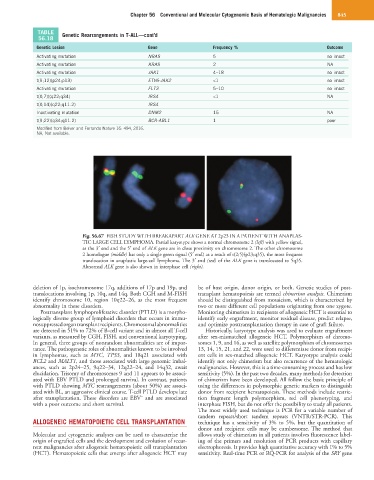
                            Fig. 56.67  FISH STUDY WITH BREAKAPART ALK GENE AT 2p23 IN A PATIENT WITH ANAPLAS-
                            TIC LARGE CELL LYMPHOMA. Partial karyotype shows a normal chromosome 2 (left) with yellow signal,
                            as the 3′ end and the 5′ end of ALK gene are in close proximity on chromosome 2. The other chromosome
                            2 homologue (middle) has only a single green signal (5′ end) as a result of t(2;5)(p23;q35), the most frequent
                            translocation in anaplastic large-cell lymphoma. The 3′ end (red) of the ALK gene is translocated to 5q35.
                            Abnormal ALK gene is also shown in interphase cell (right).


            deletion of 1p, isochromosome 17q, additions of 17p and 19p, and   be  of  host  origin,  donor  origin,  or  both.  Genetic  studies  of  post-
            translocations involving 1p, 10q, and 14q. Both CGH and M-FISH   transplant hematopoiesis are termed chimerism analysis. Chimerism
            identify  chromosome  10,  region  10q22–26,  as  the  most  frequent   should be distinguished from mosaicism, which is characterized by
            abnormality in these disorders.                       two or more different cell populations originating from one zygote.
              Posttransplant lymphoproliferative disorder (PTLD) is a morpho-  Monitoring chimerism in recipients of allogeneic HCT is essential to
            logically diverse group of lymphoid disorders that occurs in immu-  identify early engraftment, monitor residual disease, predict relapse,
            nosuppressed organ transplant recipients. Chromosomal abnormalities   and optimize posttransplantation therapy in case of graft failure.
            are detected in 51% to 72% of B-cell variant and in almost all T-cell   Historically, karyotype analysis was used to evaluate engraftment
            variants, as measured by CGH, FISH, and conventional karyotyping.   after  sex-mismatched  allogeneic  HCT.  Polymorphism  of  chromo-
            In general, three groups of nonrandom abnormalities are of impor-  somes 1, 9, and 16, as well as satellite polymorphism of chromosomes
            tance. The pathogenetic roles of abnormalities known to be involved   13, 14, 15, 21, and 22, were used to differentiate donor from recipi-
            in  lymphomas,  such  as  MYC,  TP53,  and  18q21  associated  with   ent cells in sex-matched allogeneic HCT. Karyotype analysis could
            BCL2 and MALT1, and those associated with large genomic imbal-  identify not only chimerism but also recurrence of the hematologic
            ances,  such  as  2p24–25,  9q22–34,  12q22–24,  and  14q32,  await   malignancies. However, this is a time-consuming process and has low
            elucidation. Trisomy of chromosomes 9 and 11 appears to be associ-  sensitivity (5%). In the past two decades, many methods for detection
            ated with EBV PTLD and prolonged survival. In contrast, patients   of chimerism have been developed. All follow the basic principle of
            with PTLD showing MYC rearrangements (about 50%) are associ-  using the differences in polymorphic genetic markers to distinguish
            ated with BL, an aggressive clinical course. T-cell PTLD develops late   donor from recipient hematopoiesis. These methods include restric-
                                               −
            after  transplantation. These  disorders  are  EBV   and  are  associated   tion  fragment  length  polymorphism,  red  cell  phenotyping,  and
            with a poor outcome and short survival.               interphase FISH, but do not offer the possibility to study all patients.
                                                                  The most widely used technique is PCR for a variable number of
                                                                  tandem  repeats/short  tandem  repeats  (VNTR/STR-PCR).  This
            ALLOGENEIC HEMATOPOIETIC CELL TRANSPLANTATION         technique  has  a  sensitivity  of  3%  to  5%,  but  the  quantitation  of
                                                                  donor  and  recipient  cells  may  be  cumbersome.  The  method  that
            Molecular and cytogenetic analyses can be used to characterize the   allows study of chimerism in all patients involves fluorescence label-
            origin of engrafted cells and the development and evolution of recur-  ing  of  the  primers  and  resolution  of  PCR  products  with  capillary
            rent malignancies after allogeneic hematopoietic cell transplantation   electrophoresis. It provides high quantitative accuracy with 1% to 5%
            (HCT). Hematopoietic cells that emerge after allogeneic HCT may   sensitivity. Real-time PCR or RQ-PCR for analysis of the SRY gene

