


Page 1078 - Williams Hematology ( PDFDrive )
P. 1078
1052  Part VIII:  Monocytes and Macrophages  Chapter 67:  Structure, Receptors, and Functions of Monocytes and Macrophages  1053


                  and induce an adaptive immune response or tolerance. Immature DCs   expression on activated monocytes and macrophages. CD64 allows
                  display active macropinocytosis and capture exogenous materials for   for receptor-mediated endocytosis of IgG–antigen complexes for pre-
                               33
                  cross-presentation.  It is convenient to classify plasma membrane   sentation to  T  cells, can  trigger  the  release  of  cytokines  and  ROS,
                  uptake receptors as opsonic and nonopsonic TLRs and non–TLR-de-  and can play a role in granulocyte-mediated antibody-dependent
                  pendent. The latter category includes a range of SRs 34,35  and a family of   cytotoxicity. The second IgG receptor, FcRII (CD32), is a widely dis-
                  lectin-like, carbohydrate recognition molecules. 36,37  Given the complex   tributed receptor present on many cell types, including monocytes,
                  ligands presented on the surface of microorganisms and damaged host   platelets, neutrophils, B cells, some T cells, and some capillary endo-
                  cells, or generated within the vacuolar system after uptake, these recep-  thelium. This receptor can bind complexed IgG rather than mono-
                  tors frequently cooperate with one another.           meric IgG. This FcR regulates B-cell function when coengaged with
                                                                        the B-cell receptor for antigen, namely, surface Ig. It also can induce
                  Fc Receptors                                          mediator release from myeloid cells and phagocytosis of Ig-coated
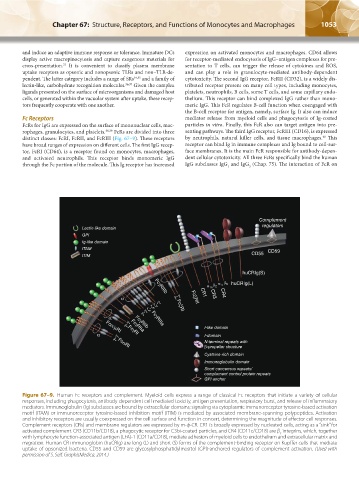
                  FcRs for IgG are expressed on the surface of mononuclear cells, mac-  particles in vitro. Finally, this FcR also can target antigen into pre-
                  rophages, granulocytes, and platelets. 38,39  FcRs are divided into three   senting pathways. The third IgG receptor, FcRIII (CD16), is expressed
                                                                                                                      40
                  distinct classes: FcRI, FcRII, and FcRIII (Fig. 67–9). These receptors   by neutrophils, natural killer cells, and tissue macrophages.  This
                  have broad ranges of expression on different cells. The first IgG recep-  receptor can bind Ig in immune complexes and Ig bound to cell-sur-
                  tor, FcRI (CD64), is a receptor found on monocytes, macrophages,   face membranes. It is the main FcR responsible for antibody-depen-
                  and activated neutrophils. This receptor binds monomeric IgG   dent cellular cytotoxicity. All three FcRs specifically bind the human
                  through the Fc portion of the molecule. This Ig receptor has increased   IgG subclasses IgG  and IgG  (Chap. 75). The interaction of FcR on
                                                                                       1
                                                                                              3


                                                                                                 Complement
                                                                                                  regulators
                                      Lectin-like domain
                                      GPI
                                      Ig-like domain
                                      ITAM                                                          CD59
                                                                                               CD55
                                      ITIM

                                                                                            huCRIg(S)

                                                                                α  m β 2  α  x  β 2  huCRIg(L)
                                                              FcγRIIIb
                                                   α          ζ–γ    γ–γ   FcξRII  CR1  CR3  CR4
                                                          γ–γ ζ–ζ     FcξRI
                                               α             FcγRIIIa
                                                     γ–γ  FcγRIIa              I-like domain
                                                        FcγRIIb
                                              Fcα/µRI
                                           α         FcγRI                     I-domain
                                                 γ–γ                           N-terminal repeats with
                                                                               β-propeller structure
                                                  FcαRI
                                                                               Cysteine-rich domain
                                                                               Immunoglobulin domain
                                                                               Short concensus repeats/
                                                                               complement control protein repeats
                                                                               GPI anchor

                  Figure 67–9.  Human Fc receptors and complement. Myeloid cells express a range of classical Fc receptors that initiate a variety of cellular
                  responses, including phagocytosis, antibody-dependent cell-mediated toxicity, antigen presentation, respiratory burst, and release of inflammatory
                  mediators. Immunoglobulin (Ig) subclasses are bound by extracellular domains; signaling via cytoplasmic immunoreceptor tyrosine-based activation
                  motif (ITAM) or immunoreceptor tyrosine-based inhibition motif (ITIM) is mediated by associated membrane-spanning polypeptides. Activation
                  and inhibitory receptors are usually coexpressed on the cell surface and function in concert, determining the magnitude of effector cell responses.
                  Complement receptors (CRs) and membrane regulators are expressed by m-ф-CR. CR1 is broadly expressed by nucleated cells, acting as a “sink” for
                  activated complement. CR3 (CD11b/CD18), a phagocytic receptor for C3bi-coated particles, and CR4 (CD11c/CD18) are β  integrins, which, together
                                                                                                        2
                  with lymphocyte function-associated antigen (LFA)-1 (CD11a/CD18), mediate adhesion of myeloid cells to endothelium and extracellular matrix and
                  migration. Human CR immunoglobin (huCRIg) are long (L) and short (S) forms of the complement-binding receptor on Kupffer cells that mediate
                  uptake of opsonized bacteria. CD55 and CD59 are glycosylphosphatidylinositol (GPI)-anchored regulators of complement activation. (Used with
                  permission of S. Seif, GraphisMedica, 2014.)


          Kaushansky_chapter 67_p1043-1074.indd   1053                                                                  9/21/15   10:43 AM

