


Page 1089 - Williams Hematology ( PDFDrive )
P. 1089
1064           Part VIII:  Monocytes and Macrophages                                                                                   Chapter 67:  Structure, Receptors, and Functions of Monocytes and Macrophages             1065


                                                                          Lysosomes


                                                                  EEA1
                                                                     Rab5


                                      Rab5
                                                                                       Rab7


                                    Myco-                       Rab7 Lamps
                                   bacterium  Listeria  Legionella  Francisella  Influenza  Leishmania  Candida
                                                  Bacteria                  Virus    Parasites  Fungi

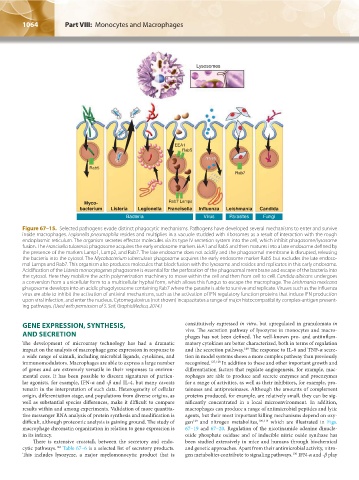
               Figure 67–15.  Selected pathogens evade distinct phagocytic mechanisms. Pathogens have developed several mechanisms to enter and survive
               inside macrophages. Legionella pneumophila resides and multiplies in a vacuole studded with ribosomes as a result of interaction with the rough
               endoplasmic reticulum. The organism secretes effector molecules via its type IV secretion system into the cell, which inhibit phagosome/lysosome
               fusion. The Francisella tularensis phagosome acquires the early endosome markers EEA1 and Rab5 and then matures into a late endosome defined by
               the presence of the markers Lamp1, Lamp2, and Rab7. The late endosome does not acidify and the phagosomal membrane is disrupted, releasing
               the bacteria into the cytosol. The Mycobacterium tuberculosis phagosome acquires the early endosome marker Rab5 but excludes the late endoso-
               mal Lamps and Rab7. This organism also produces molecules that block fusion with the lysosome and resides and replicates in this early endosome.
               Acidification of the Listeria monocytogenes phagosome is essential for the perforation of the phagosomal membrane and escape of the bacteria into
               the cytosol. Here they mobilize the actin polymerization machinery to move within the cell and then from cell to cell. Candida albicans undergoes
               a conversion from a unicellular form to a multicellular hyphal form, which allows this fungus to escape the macrophage. The Leishmania mexicana
               phagosome develops into an acidic phagolysosome containing Rab7 where the parasite is able to survive and replicate. Viruses such as the influenza
               virus are able to inhibit the activation of antiviral mechanisms, such as the activation of IFN regulatory function proteins that induce IFN production
               upon viral infection, and enter the nucleus. Cytomegalovirus (not shown) incapacitates a range of major histocompatibility complex-antigen present-
               ing pathways. (Used with permission of S. Seif, GraphisMedica, 2014.)


               GENE EXPRESSION, SYNTHESIS,                            constitutively expressed in vitro, but upregulated in granulomata in
                                                                      vivo. The secretion pathway of lysozyme in monocytes and macro-
               AND SECRETION                                          phages has not been defined. The well-known pro- and antiinflam-
               The development of  microarray technology has  had a dramatic   matory cytokines are better characterized, both in terms of regulation
               impact on the analysis of macrophage gene expression in response to   and the secretion pathway.  The response to IL-6 and TNF-α secre-
                                                                                          109
               a wide range of stimuli, including microbial ligands, cytokines, and   tion in model systems shows a more complex pathway than previously
               immunomodulators. Macrophages are able to express a large number   recognized. 127,128  In addition to these and other important growth and
               of genes and are extremely versatile in their responses to environ-  differentiation factors that regulate angiogenesis, for example, mac-
               mental cues. It  has  been possible to discern signatures of particu-  rophages are able to produce and secrete enzymes and proenzymes
               lar agonists, for example, IFN-α and -β and IL-4, but many caveats   for a range of activities, as well as their inhibitors, for example, pro-
               remain in the interpretation of such data. Heterogeneity of cellular   teinases and antiproteinases. Although the amounts of complement
               origin, differentiation stage, and populations from diverse origins, as   proteins produced, for example, are relatively small, they can be sig-
               well as substantial species differences, make it difficult to compare   nificantly concentrated in a local microenvironment. In addition,
               results within and among experiments. Validation of more quantita-  macrophages can produce a range of antimicrobial peptides and lytic
               tive messenger RNA analysis of protein synthesis and modification is   agents, but their most important killing mechanisms depend on oxy-
               difficult, although proteomic analysis is gaining ground. The study of   gen  and nitrogen metabolites, 109,114  which are illustrated in  Figs.
                                                                         129
               macrophage chromatin organization in relation to gene expression is   67–19 and 67–20. Regulation of the nicotinamide adenine dinucle-
               in its infancy.                                        otide phosphate oxidase and of inducible nitric oxide synthase has
                   There is extensive crosstalk between the secretory and endo-  been studied extensively in mice and humans through biochemical
               cytic pathways.  Table 67–6 is a selected list of secretory products.   and genetic approaches. Apart from their antimicrobial activity, nitro-
                           126
               This includes lysozyme, a major myelomonocytic product that is   gen metabolites contribute to signaling pathways.  IFN-α and -β play
                                                                                                          130


          Kaushansky_chapter 67_p1043-1074.indd   1064                                                                  9/21/15   10:43 AM

