


Page 1090 - Williams Hematology ( PDFDrive )
P. 1090
1064  Part VIII:  Monocytes and Macrophages  Chapter 67:  Structure, Receptors, and Functions of Monocytes and Macrophages  1065


                                                                                              Nutrient depletion
                                       Erythrocyte
                                                                                          Induction of
                                                                                           autophagy


                                                            Proteasome  SEC61 H  H  RAB11  Autophagosome
                                                                             RAB4/
                                           Heme                                 Recycle
                                             Fe 2+
                                             HO
                                                              TAP                             Fusion with
                                        HO                                                     lysosome
                                               Fe 2+         MHC                                        Degradation
                                           Ferritin          class I          MHC
                                                                             class II
                               A                            B                            C
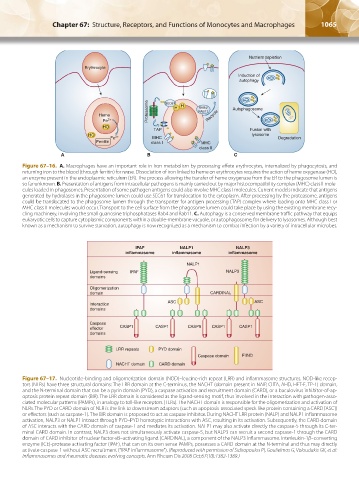
                  Figure 67–16.  A. Macrophages have an important role in iron metabolism by processing effete erythrocytes, internalized by phagocytosis, and
                  returning iron to the blood (through ferritin) for reuse. Dissociation of iron linked to heme on erythrocytes requires the action of heme oxygenase (HO),
                  an enzyme present in the endoplasmic reticulum (ER). The process allowing the transfer of heme oxygenase from the ER to the phagosome lumen is
                  so far unknown. B. Presentation of antigens from intracellular pathogens is mainly carried out by major histocompatibility complex (MHC) class II mole-
                  cules loaded in phagosomes. Presentation of some pathogen antigens could also involve MHC class I molecules. Current models indicate that antigens
                  generated by hydrolases in the phagosome lumen could use SEC61 for translocation to the cytoplasm. After processing by the proteasome, antigens
                  could be translocated to the phagosome lumen through the transporter for antigen processing (TAP) complex where loading onto MHC class I or
                  MHC class II molecules would occur. Transport to the cell surface from the phagosome lumen could take place by using the existing membrane recy-
                  cling machinery, involving the small guanosine triphosphatases Rab4 and Rab11. C. Autophagy is a conserved membrane traffic pathway that equips
                  eukaryotic cells to capture cytoplasmic components within a double-membrane vacuole, or autophagosome, for delivery to lysosomes. Although best
                  known as a mechanism to survive starvation, autophagy is now recognized as a mechanism to combat infection by a variety of intracellular microbes.


                                                        IPAF           NALP1             NALP3
                                                    inflammasome    inflammasome       inflammasome
                                                                         NALP1
                                        Ligand-sensing  IPAF                          NALP3
                                        domains
                                        Oligomerization
                                        domain                                   CARDINAL
                                        Interaction                ASC                          ASC
                                        domains


                                        Caspase
                                        effector  CASP1       CASP1      CASP5   CASP1     CASP1
                                        domains

                                                 LRR repeats   PYD domain
                                                                             Caspase domain  FIIND
                                                 NACHT domain   CARD domain

                  Figure 67–17.  Nucleotide-binding and oligomerization domain (NOD)–leucine-rich repeat (LRR) and inflammasome structures. NOD-like recep-
                  tors (NLRs) have three structural domains: The LRR domain at the C-terminus, the NACHT (domain present in NAIP, CIITA, AHD, HET-E, TP-1) domain,
                  and the N-terminal domain that can be a pyrin domain (PYD), a caspase activation and recruitment domain (CARD), or a baculovirus inhibitor-of-ap-
                  optosis protein repeat domain (BIR). The LRR domain is considered as the ligand-sensing motif, thus involved in the interaction with pathogen-asso-
                  ciated molecular patterns (PAMPs), in analogy to toll-like receptors (TLRs). The NACHT domain is responsible for the oligomerization and activation of
                  NLRs. The PYD or CARD domain of NLR is the link to downstream adaptors (such as apoptosis-associated speck-like protein containing a CARD [ASC])
                  or effectors (such as caspase-1). The BIR domain is proposed to act as caspase inhibitor. During NACHT LRR protein (NALP) and NALP1 inflammasome
                  activation, NALP3 or NALP1 interact through PYD–PYD homotypic interactions with ASC, resulting in its activation. Subsequently, the CARD domain
                  of ASC interacts with the CARD domain of caspase-1 and mediates its activation. NALP1 may also activate directly the caspase-5 through its C-ter-
                  minal CARD domain. In contrast, NALP3 does not simultaneously activate caspase-5, but NALP3 can recruit a second capsase-1 through the CARD
                  domain of CARD inhibitor of nuclear factor-κB–activating ligand (CARDINAL), a component of the NALP3 inflammasome. Interleukin-1β–converting
                  enzyme (ICE)-protease activating factor (IPAF), that can on its own sense PAMPs, possesses a CARD domain at the N-terminal and thus may directly
                  activate caspase-1 without ASC recruitment (“IPAF inflammasome”). (Reproduced with permission of Sidiropoulos PI, Goulielmos G, Voloudakis GK, et al:
                  Inflammasomes and rheumatic diseases: evolving concepts. Ann Rheum Dis 2008 Oct;67(10):1382-1389.)


          Kaushansky_chapter 67_p1043-1074.indd   1065                                                                  9/21/15   10:43 AM

