


Page 1605 - Williams Hematology ( PDFDrive )
P. 1605
1580           Part XI:  Malignant Lymphoid Diseases                                                                                                                Chapter 95:  General Considerations for Lymphomas            1581


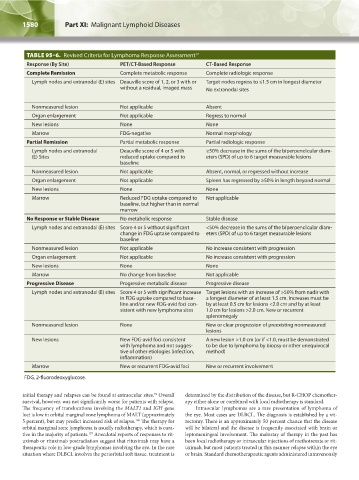
                 TABLE 95–6.  Revised Criteria for Lymphoma Response Assessment 17
                 Response (By Site)             PET/CT-Based Response        CT-Based Response
                 Complete Remission             Complete metabolic response  Complete radiologic response
                   Lymph nodes and extranodal (E) sites Deauville score of 1, 2, or 3 with or   Target nodes regress to ≤1.5 cm in longest diameter
                                                without a residual, imaged mass  No extranodal sites


                   Nonmeasured lesion           Not applicable               Absent
                   Organ enlargement            Not applicable               Regress to normal
                   New lesions                  None                         None
                   Marrow                       FDG-negative                 Normal morphology
                 Partial Remission              Partial metabolic response   Partial radiologic response
                    Lymph nodes and extranodal    Deauville score of 4 or 5 with   ≥50% decrease in the sums of the biperpendicular diam-
                   (E) Sites                    reduced uptake compared to   eters (SPD) of up to 6 target measurable lesions
                                                baseline
                   Nonmeasured lesion           Not applicable               Absent, normal, or regressed without increase
                   Organ enlargement            Not applicable               Spleen has regressed by ≥50% in length beyond normal
                   New lesions                  None                         None
                   Marrow                       Reduced FDG uptake compared to   Not applicable
                                                baseline, but higher than in normal
                                                marrow
                 No Response or Stable Disease  No metabolic response        Stable disease
                   Lymph nodes and extranodal (E) sites Score 4 or 5 without significant   <50% decrease in the sums of the biperpendicular diam-
                                                change in FDG uptake compared to   eters (SPD) of up to 6 target measurable lesions
                                                baseline
                   Nonmeasured lesion           Not applicable               No increase consistent with progression
                   Organ enlargement            Not applicable               No increase consistent with progression
                   New lesions                  None                         None
                   Marrow                       No change from baseline      Not applicable
                 Progressive Disease            Progressive metabolic disease  Progressive disease
                   Lymph nodes and extranodal (E) sites Score 4 or 5 with significant increase  Target lesions with an increase of >50% from nadir with
                                                in FDG uptake compared to base-  a longest diameter of at least 1.5 cm. Increases must be
                                                line and/or new FDG-avid foci con-  by at least 0.5 cm for lesions <2.0 cm and by at least
                                                sistent with new lymphoma sites  1.0 cm for lesions >2.0 cm. New or recurrent
                                                                             splenomegaly
                   Nonmeasured lesion           None                         New or clear progression of preexisting nonmeasured
                                                                             lesions
                   New lesions                  New FDG-avid foci consistent   A new lesion >1.0 cm (or if <1.0, must be demonstrated
                                                with lymphoma and not sugges-  to be due to lymphoma by biopsy or other unequivocal
                                                tive of other etiologies (infection,   method)
                                                inflammation)
                   Marrow                       New or recurrent FDG-avid foci  New or recurrent involvement

                FDG, 2-fluorodeoxyglucose.

               initial therapy and relapses can be found at extraocular sites.  Overall   determined by the distribution of the disease, but R-CHOP chemother-
                                                            91
               survival, however, was not significantly worse for patients with relapse.   apy either alone or combined with local radiotherapy is standard.
               The frequency of translocations involving the MALT1 and IGH gene   Intraocular lymphomas are a rare presentation of lymphoma of
               loci is low in orbital marginal zone lymphoma of MALT (approximately   the eye. Most cases are DLBCL. The diagnosis is established by a vit-
               5 percent), but may predict increased risk of relapse.  The therapy for   rectomy. There is an approximately 50 percent chance that the disease
                                                     160
               orbital marginal zone lymphoma is usually radiotherapy, which is cura-  will be bilateral and the disease is frequently associated with brain or
               tive in the majority of patients.  Anecdotal reports of responses to rit-  leptomeningeal involvement. The mainstay of therapy in the past has
                                      157
               uximab or rituximab postradiation suggest that rituximab may have a   been local radiotherapy or intraocular injections of methotrexate or rit-
               therapeutic role in low-grade lymphomas involving the eye. In the rare   uximab, but most patients treated in this manner relapse within the eye
               situation where DLBCL involves the periorbital soft tissue, treatment is   or brain. Standard chemotherapeutic agents administered intravenously


          Kaushansky_chapter 95_p1569-1586.indd   1580                                                                  9/21/15   12:17 PM

