


Page 1603 - Williams Hematology ( PDFDrive )
P. 1603
1578           Part XI:  Malignant Lymphoid Diseases                                                                                                                Chapter 95:  General Considerations for Lymphomas            1579


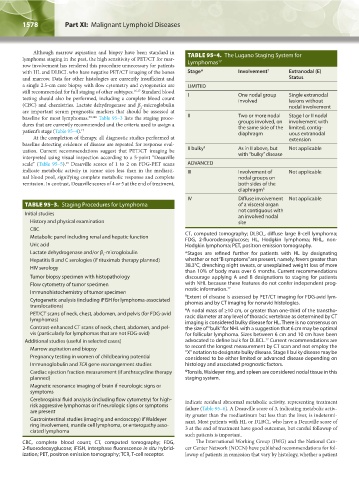
                   Although marrow aspiration and biopsy have been standard in   TABLE 95–4.  The Lugano Staging System for
               lymphoma staging in the past, the high sensitivity of PET/CT for mar-  17
               row involvement has rendered this procedure unnecessary for patients   Lymphomas
               with HL and DLBCL who have negative PET/CT imaging of the bones   Stage*  Involvement †   Extranodal (E)
               and marrow. Data for other histologies are currently insufficient and                     Status
               a single 2.5-cm core biopsy with flow cytometry and cytogenetics are   LIMITED
               still recommended for full staging of other subtypes. 16,17  Standard blood   I  One nodal group   Single extranodal
               testing should also be performed, including a complete blood count       involved         lesions without
               (CBC) and chemistries. Lactate dehydrogenase and β -microglobulin                         nodal involvement
                                                       2
               are important serum prognostic markers that should be assessed at
               baseline for most lymphomas. 33,146  Table 95–3 lists the staging proce-  II  Two or more nodal   Stage I or II nodal
               dures that are currently recommended and the criteria used to assign a   groups involved, on   involvement with
                                                                                        the same side of the  limited, contig-
               patient’s stage (Table 95–4). 17                                         diaphragm        uous extranodal
                   At the completion of therapy, all diagnostic studies performed at                     extension
               baseline detecting evidence of disease are repeated for response eval-  ‡
               uation. Current recommendations suggest that PET/CT imaging be   II bulky  As in II above, but   Not applicable
               interpreted using visual inspection according to a 5-point “Deauville    with “bulky” disease
                              15
               scale” (Table 95–5).  Deauville scores of 1 to 2 on FDG-PET scans   ADVANCED
               indicate metabolic activity in tumor sites less than in the mediasti-  III  Involvement of   Not applicable
               nal blood pool, signifying complete metabolic response and complete      nodal groups on
               remission. In contrast, Deauville scores of 4 or 5 at the end of treatment,   both sides of the
                                                                                        diaphragm §
                                                                       IV               Diffuse involvement  Not applicable
                TABLE 95–3.  Staging Procedures for Lymphoma                            of a visceral organ
                                                                                        not contiguous with
                Initial studies                                                         an involved nodal
                  History and physical examination                                      site
                  CBC
                  Metabolic panel including renal and hepatic function  CT, computed tomography; DLBCL, diffuse large B-cell lymphoma;
                                                                      FDG,  2-fluorodeoxyglucose;  HL,  Hodgkin  lymphoma;  NHL,  non-
                  Uric acid                                           Hodgkin lymphoma; PET, positron emission tomography.
                  Lactate dehydrogenase and/or β -microglobulin       *Stages are refined further for patients with HL by designating
                                          2
                  Hepatitis B and C serologies (if rituximab therapy planned)  whether or not “B symptoms” are present, namely, fevers greater than
                  HIV serology                                        38.3°C, drenching night sweats, or unexplained weight loss of more
                                                                      than 10% of body mass over 6 months. Current recommendations
                  Tumor biopsy specimen with histopathology           discourage applying A and B designations to staging for patients
                  Flow cytometry of tumor specimen                    with NHL because these features do not confer independent prog-
                                                                                    17
                  Immunohistochemistry of tumor specimen              nostic information.
                                                                      † Extent of disease is assessed by PET/CT imaging for FDG-avid lym-
                   Cytogenetic analysis (including iFISH for lymphoma-associated   phomas and by CT imaging for nonavid histologies.
                  translocations)
                                                                      ‡ A nodal mass of ≥10 cm, or greater than one-third of the transtho-
                   PET/CT scans of neck, chest, abdomen, and pelvis (for FDG-avid   racic diameter at any level of thoracic vertebrae as determined by CT
                  lymphomas)                                          imaging is considered bulky disease for HL. There is no consensus on
                   Contrast-enhanced CT scans of neck, chest, abdomen, and pel-  the size of “bulk” for NHL with a suggestion that 6 cm may be optimal
                  vis (particularly for lymphomas that are not FDG-avid)  for follicular lymphoma. Sizes between 6 cm and 10 cm have been
                                                                                                 17
                Additional studies (useful in selected cases)         advocated to define bulk for DLBCL.  Current recommendations are
                  Marrow aspiration and biopsy                        to record the longest measurement by CT scan and not employ the
                                                                      “X” notation to designate bulky disease. Stage II bulky disease may be
                  Pregnancy testing in women of childbearing potential  considered to be either limited or advanced disease depending on
                  Immunoglobulin and TCR gene rearrangement studies   histology and associated prognostic factors.
                  Cardiac ejection fraction measurement (if anthracycline therapy   § Tonsils, Waldeyer ring, and spleen are considered nodal tissue in this
                  planned)                                            staging system.
                  Magnetic resonance imaging of brain if neurologic signs or
                  symptoms
                  Cerebrospinal fluid analysis (including flow cytometry) for high-  indicate residual abnormal metabolic activity, representing treatment
                  risk aggressive lymphomas or if neurologic signs or symptoms   failure (Table 95–6). A Deauville score of 3, indicating metabolic activ-
                  are present                                         ity greater than the mediastinum but less than the liver, is indetermi-
                  Gastrointestinal studies (imaging and endoscopy) if Waldeyer   nant. Most patients with HL or DLBCL who have a Deauville score of
                  ring involvement, mantle cell lymphoma, or enteropathy asso-  3 at the end of treatment have good outcomes, but careful followup of
                  ciated lymphoma
                                                                      such patients is important.
               CBC, complete blood count; CT, computed tomography; FDG,    The International Working Group (IWG) and the National Can-
               2-fluorodeoxyglucose; iFISH, interphase fluorescence in situ hybrid-  cer Center Network (NCCN) have published recommendations for fol-
               ization; PET, positron emission tomography; TCR, T-cell receptor.  lowup of patients in remission that vary by histology, whether a patient


          Kaushansky_chapter 95_p1569-1586.indd   1578                                                                  9/21/15   12:17 PM

