


Page 1604 - Williams Hematology ( PDFDrive )
P. 1604
1578  Part XI:  Malignant Lymphoid Diseases            Chapter 95:  General Considerations for Lymphomas             1579


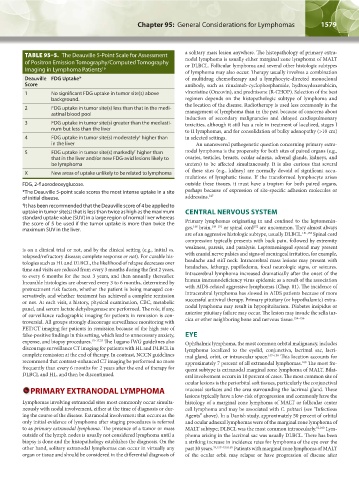
                   TABLE 95–5.  The Deauville 5-Point Scale for Assessment   a solitary mass lesion anywhere. The histopathology of primary extra-
                                                                        nodal lymphoma is usually either marginal zone lymphoma of MALT
                   of Positron Emission Tomography/Computed Tomography   or DLBCL. Follicular lymphoma and several other histologic subtypes
                   Imaging in Lymphoma Patients 16                      of lymphoma may also occur. Therapy usually involves a combination
                   Deauville  FDG Uptake*                               of multidrug chemotherapy and a lymphocyte-directed monoclonal
                   Score                                                antibody, such as rituximab-cyclophosphamide, hydroxydoxorubicin,
                   1       No significant FDG uptake in tumor site(s) above   vincristine (Oncovin), and prednisone (R-CHOP). Selection of the best
                           background.                                  regimen depends on the histopathologic subtype of lymphoma and
                                                                        the location of the disease. Radiotherapy is used less commonly in the
                   2       FDG uptake in tumor site(s) less than that in the medi-
                           astinal blood pool                           management of lymphoma than in the past because of concerns about
                                                                        induction  of  secondary  malignancies  and  delayed  cardiopulmonary
                   3       FDG uptake in tumor site(s) greater than the mediasti-  toxicities, although it still has a role in treatment of localized, stages I
                           num but less than the liver
                                                                        to II lymphomas, and for consolidation of bulky adenopathy (>10 cm)
                   4       FDG uptake in tumor site(s) moderately  higher than   in selected settings.
                                                         †
                           in the liver                                     An unanswered pathogenetic question concerning primary extra-
                   5       FDG uptake in tumor site(s) markedly  higher than   nodal lymphoma is the propensity for both sites of paired organs (e.g.,
                                                       †
                           that in the liver and/or new FDG-avid lesions likely to   ovaries, testicles, breasts, ocular adnexa, adrenal glands, kidneys, and
                           be lymphoma                                  ureters) to be affected simultaneously. It is also curious that several
                   X       New areas of uptake unlikely to be related to lymphoma  of these sites (e.g., kidney) are normally devoid of significant accu-
                                                                        mulations of lymphatic tissue. If the transformed lymphocyte arises
                  FDG, 2-fluorodeoxyglucose.                            outside these tissues, it must have a tropism for both paired organs,
                  *The Deauville 5-point scale scores the most intense uptake in a site   perhaps because of expression of site-specific adhesion molecules or
                  of initial disease.                                   addressins. 147
                  † It has been recommended that the Deauville score of 4 be applied to
                  uptake in tumor site(s) that is less than twice as high as the maximum   CENTRAL NERVOUS SYSTEM
                  standard uptake value (SUV) in a large region of normal liver whereas   Primary  lymphomas  originating  in  and  confined  to  the  leptomenin-
                  the score of 5 be used if the tumor uptake is more than twice the   148  149–151  152
                  maximum SUV in the liver.                             ges,  brain,   or spinal cord  are uncommon. They almost always
                                                                        are of an aggressive histologic subtype, usually DLBCL. 151,153  Spinal cord
                                                                        compression typically presents with back pain, followed by extremity
                                                                        weakness, paresis, and paralysis. Leptomeningeal spread may present
                  is on a clinical trial or not, and by the clinical setting (e.g., initial vs.
                  relapsed/refractory disease; complete response or not). For curable his-  with cranial nerve palsies and signs of meningeal irritation, for example,
                  tologies such as HL and DLBCL, the likelihood of relapse decreases over   headache and stiff neck. Intracerebral mass lesions may present with
                  time and visits are reduced from every 3 months during the first 2 years,   headaches, lethargy, papilledema, focal neurologic signs, or seizures.
                  to every 6 months for the next 3 years, and then annually thereafter.   Intracerebral lymphoma increased dramatically after the onset of the
                  Incurable histologies are observed every 3 to 6 months, determined by   human immunodeficiency virus epidemic as a result of the association
                  pretreatment risk factors, whether the patient is being managed con-  with AIDS-related aggressive lymphomas (Chap. 81). The incidence of
                  servatively, and whether treatment has achieved a complete remission   intracerebral lymphoma has slowed in AIDS patients because of more
                  or not. At each visit, a history, physical examination, CBC, metabolic   successful antiviral therapy. Primary pituitary (or hypothalamic) extra-
                  panel, and serum lactate dehydrogenase are performed. The role, if any,   nodal lymphoma may result in hypopituitarism. Diabetes insipidus or
                  of surveillance radiographic imaging for patients in remission is con-  anterior pituitary failure may occur. The lesion may invade the sella tur-
                                                                                                             154–156
                  troversial. All groups strongly discourage surveillance monitoring with   cica or other neighboring bone and nervous tissue.
                  PET/CT imaging for patients in remission because of the high rate of
                  false-positive findings in this setting, which lead to unnecessary anxiety,   EYE
                  expense, and biopsy procedures. 15–17,33  The Lugano IWG guidelines also   Ophthalmic lymphoma, the most common orbital malignancy, includes
                  discourage surveillance CT imaging for patients with HL and DLBCL in   lymphoma  localized  to  the  eyelid,  conjunctiva,  lacrimal  sac,  lacri-
                  complete remission at the end of therapy. In contrast, NCCN guidelines   mal gland, orbit, or intraocular space. 157–159  This location accounts for
                  recommend that contrast-enhanced CT imaging be performed no more   approximately 7 percent of all extranodal lymphomas.  The most fre-
                                                                                                                160
                  frequently than every 6 months for 2 years after the end of therapy for   quent subtype is extranodal marginal zone lymphoma of MALT. Bilat-
                  DLBCL and HL, and then be discontinued.               eral involvement occurs in 10 percent of cases. The most common site of
                                                                        ocular lesions is the periorbital soft tissues, particularly the conjunctival
                     PRIMARY EXTRANODAL LYMPHOMA                        mucosal surfaces and the area surrounding the lacrimal gland. These
                                                                        lesions typically have a low-risk of progression and commonly have the
                  Lymphomas involving extranodal sites most commonly occur simulta-  histology of a marginal zone lymphoma of MALT or follicular center
                  neously with nodal involvement, either at the time of diagnosis or dur-  cell lymphoma and may be associated with C. psittaci (see “Infectious
                  ing the course of the disease. Extranodal involvement that occurs as the   Agents” above). In a Danish study, approximately 50 percent of orbital
                  only initial evidence of lymphoma after staging procedures is referred   and ocular adnexal lymphomas were of the marginal zone lymphoma of
                  to as primary extranodal lymphoma. The presence of a tumor or mass   MALT subtype; DLBCL was the most common intraocularly. 91,160  Lym-
                  outside of the lymph nodes is usually not considered lymphoma until a   phoma arising in the lacrimal sac was usually DLBCL. There has been
                  biopsy is done and the histopathology establishes the diagnosis. On the   a striking increase in incidence rates for lymphoma of the eye over the
                  other hand, solitary extranodal lymphomas can occur in virtually any   past 30 years. 24,157–159,161  Patients with marginal zone lymphoma of MALT
                  organ or tissue and should be considered in the differential diagnosis of   of the ocular orbit may relapse or have progression of disease after


          Kaushansky_chapter 95_p1569-1586.indd   1579                                                                  9/21/15   12:17 PM

