


Page 1770 - Williams Hematology ( PDFDrive )
P. 1770
1744  Part XI:  Malignant Lymphoid Diseases                                         Chapter 107:  Myeloma            1745


                                   1                 2                3                4                 5


                                6            7            8            9           10          11          12


                                 13             14            15            16             17              18


                                 19             20            21             22              X              Y
                                                                                                         61.0 x 96.0
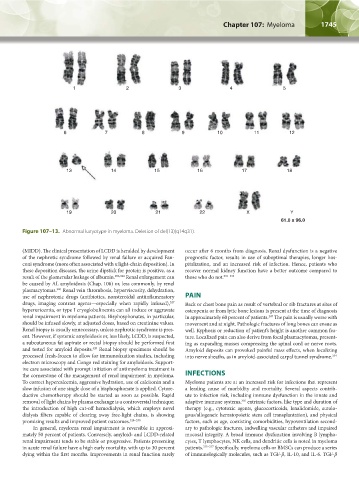
                  Figure 107–13.  Abnormal karyotype in myeloma. Deletion of del(13)(q14q31).


                  (MIDD). The clinical presentation of LCDD is heralded by development   occur after 6 months from diagnosis. Renal dysfunction is a negative
                  of the nephrotic syndrome followed by renal failure or acquired Fan-  prognostic factor, results in use of suboptimal therapies, longer hos-
                  coni syndrome (more often associated with κ light-chain deposition). In   pitalization, and an increased risk of infection. Hence, patients who
                  these deposition diseases, the urine dipstick for protein is positive, as a   recover normal kidney function have a better outcome compared to
                  result of the glomerular leakage of albumin. 256,324  Renal enlargement can   those who do not. 331–333
                  be caused by AL amyloidosis (Chap. 108) or, less commonly, by renal
                  plasmacytomas.  Renal vein thrombosis, hyperviscosity, dehydration,
                             326
                  use of nephrotoxic drugs (antibiotics, nonsteroidal antiinflammatory   PAIN
                  drugs, imaging contrast agents—especially when rapidly infused),    Back or chest bone pain as result of vertebral or rib fractures at sites of
                                                                   327
                  hyperuricemia, or type I cryoglobulinemia can all induce or aggravate   osteopenia or from lytic bone lesions is present at the time of diagnosis
                  renal impairment in myeloma patients. Bisphosphonates, in particular,   in approximately 60 percent of patients.  The pain is usually worse with
                                                                                                    247
                  should be infused slowly, at adjusted doses, based on creatinine values.   movement and at night. Pathologic fractures of long bones can ensue as
                  Renal biopsy is usually unnecessary, unless nephrotic syndrome is pres-  well. Kyphosis or reduction of patient’s height is another common fea-
                  ent. However, if systemic amyloidosis or, less likely, LCDD, is suspected,   ture. Localized pain can also derive from focal plasmacytomas, present-
                  a subcutaneous fat aspirate or rectal biopsy should be performed first   ing as expanding masses compressing the spinal cord or nerve roots.
                  and tested for amyloid deposits.  Renal biopsy specimens should be   Amyloid deposits can provoked painful mass effects, when localizing
                                         320
                  processed fresh-frozen to allow for immunofixation studies, including   into nerve sheaths, as in amyloid-associated carpal tunnel syndrome. 334
                  electron microscopy and Congo red staining for amyloidosis. Support-
                  ive care associated with prompt initiation of antimyeloma treatment is
                  the cornerstone of the management of renal impairment in myeloma.   INFECTIONS
                  To correct hypercalcemia, aggressive hydration, use of calcitonin and a   Myeloma patients are at an increased risk for infections that represent
                  slow infusion of one single dose of a bisphosphonate is applied. Cytore-  a leading cause of morbidity and mortality. Several aspects contrib-
                  ductive chemotherapy should be started as soon as possible. Rapid   ute to infection risk, including immune dysfunction in the innate and
                  removal of light chains by plasma exchange is a controversial technique;   adaptive immune systems,  extrinsic factors, like type and duration of
                                                                                           335
                  the introduction of high cut-off hemodialysis, which employs novel   therapy (e.g., cytotoxic agents, glucocorticoids, lenalidomide, autolo-
                  dialysis  filters  capable  of  clearing  away  free-light  chains,  is  showing   gous/allogeneic hematopoietic stem cell transplantation), and physical
                  promising results and improved patient outcomes. 328–330  factors, such as age, coexisting comorbidities, hypoventilation second-
                     In general, myeloma renal impairment is reversible in approxi-  ary to pathologic fractures, indwelling vascular catheters and impaired
                  mately 50 percent of patients. Conversely, amyloid- and LCDD-related   mucosal integrity. A broad immune dysfunction involving B lympho-
                  renal impairment tends to be stable or progressive. Patients presenting   cytes, T lymphocytes, NK cells, and dendritic cells is noted in myeloma
                  in acute renal failure have a high early mortality, with up to 30 percent   patients. 335–337  Specifically, myeloma cells or BMSCs can produce a series
                  dying within the first months. Improvements in renal function rarely   of immunologically molecules, such as TGF-β, IL-10, and IL-6. TGF-β


          Kaushansky_chapter 107_p1733-1772.indd   1745                                                                 9/21/15   12:34 PM

