


Page 1959 - Williams Hematology ( PDFDrive )
P. 1959
1934           Part XII:  Hemostasis and Thrombosis                                                                                        Chapter 113:  Molecular Biology and Biochemistry of the Coagulation Factors           1935


                                                      β
                       γ             A   -5.4 kb     B   -5.4 kb      XIIIB acts as a carrier protein providing the long plasma half-life of fac-
                                      α
                         -8.4 kb
                                                                      tor XIII. Factor XIIIB consists of 10 Sushi domains in tandem, of which
                     2 4 6  8 10      2 4            8  6  4  2       the first two Sushi domains are crucial for the binding to factor XIIIA.
                     13 5 7  9       1 3  5           7  5  3  1
                Gene                                          45 kb
                                                                      Factor XIII Activation and Factor XIIIa Activity
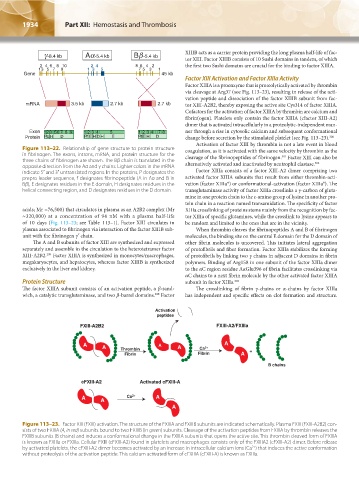
                                                                      Factor XIIIA is a proenzyme that is proteolytically activated by thrombin
                                                                      via cleavage at Arg37 (see Fig. 113–23), resulting in release of the acti-
                                                                      vation peptide and dissociation of the factor XIIIB subunit from fac-
                mRNA            3.5 kb       2.7 kb          2.7 kb   tor XIII-A2B2, thereby exposing the active site Cys314 of factor XIIIA.
                                                                      Cofactors for the activation of factor XIIIA by thrombin are calcium and
                                                                      fibrin(ogen). Platelets only contain the factor XIIIA (cfactor XIII-A2)
                                                                      dimer that is activated intracellularly in a proteolytic-independent man-
                  Exon 123567 89    1 2 3 4  5        1 2 3 4  7 8    ner through a rise in cytosolic calcium and subsequent conformational
                Protein  p EH  D    p f E H D H  E    p fE H  D       change before secretion by the stimulated platelet (see Fig. 113–23). 300
                                                                          Activation of factor XIII by thrombin is not a late event in blood
               Figure 113–22.  Relationship of gene structure to protein structure   coagulation, as it is activated with the same velocity by thrombin as the
               in fibrinogen. The exons, introns, mRNA, and protein structure for the   cleavage of the fibrinopeptides of fibrinogen.  Factor XIII can also be
                                                                                                      301
               three chains of fibrinogen are shown. The Bβ chain is translated in the                           302
               opposite direction from the Aα and γ chains. Lighter colors in the mRNA   alternatively activated and inactivated by neutrophil elastase.
               indicate 5′ and 3′ untranslated regions. In the proteins, P designates the   Factor XIIIa consists of a factor XIII-A2 dimer comprising two
               prepro leader sequence, f designates fibrinopeptide (A in Aα and B in   activated factor XIIIA subunits that result from either thrombin-acti-
               Bβ), E designates residues in the E domain, H designates residues in the   vation (factor XIIIa*) or conformational-activation (factor XIIIa°). The
               helical connecting region, and D designates residues in the D domain.  transglutaminase activity of factor XIIIa crosslinks a γ-carbon of gluta-
                                                                      mine in one protein chain to the ε-amino group of lysine in another pro-
                                                                      tein chain in a reaction named transamidation. The specificity of factor
               acids; Mr ≈76,500) that circulates in plasma as an A2B2 complex (Mr   XIIIa crosslinking of proteins stems mainly from the recognition by fac-
               ≈320,000) at a concentration of 94 nM with a plasma half-life   tor XIIIa of specific glutamines, while the crosslink to lysine appears to
               of 10 days (Fig. 113–23; see Table  113–1). Factor XIII circulates in   be random and limited to the ones that are in the vicinity.
               plasma associated to fibrinogen via interaction of the factor XIIIB sub-  When thrombin cleaves the fibrinopeptides A and B of fibrinogen
               unit with the fibrinogen γ′ chain.                     molecules, the binding site on the central E domain for the D domain of
                   The A and B subunits of factor XIII are synthesized and expressed   other fibrin molecules is uncovered. This initiates lateral aggregation
               separately and assemble in the circulation to the heterotetramer factor   of protofibrils and fiber formation. Factor XIIIa stabilizes the forming
               XIII-A2B2.  Factor XIIIA is synthesized in monocytes/macrophages,   of protofibrils by linking two γ chains in adjacent D domains in fibrin
                       299
               megakaryocytes, and hepatocytes, whereas factor XIIIB is synthesized   polymers. Binding of Arg158 in one subunit of the factor XIIIa dimer
               exclusively in the liver and kidney.                   to the αC region residue AαGlu396 of fibrin facilitates crosslinking via
                                                                      αC chains to a next fibrin molecule by the other activated factor XIIIA
               Protein Structure                                      subunit in factor XIIIa. 303
               The factor XIIIA subunit consists of an activation peptide, a β-sand-  The crosslinking of fibrin  γ-chains or  α-chains by factor XIIIa
               wich, a catalytic transglutaminase, and two β-barrel domains.  Factor   has independent and specific effects on clot formation and structure.
                                                            298

                                                            Activation
                                                            peptides
                                   FXIII-A2B2                                    FXIII-A2/FXIIIa


                                    A     A                  A     A       Ca 2+   A
                                                Thrombin
                                                  Fibrin                  Fibrin         A  +
                                                                                                  B chains


                                   cFXIII-A2           Activated cFXIII-A

                                   A      A       Ca 2+     A
                                                                  A

               Figure 113–23.  Factor XIII (FXIII) activation. The structure of the FXIIIA and FXIIIB subunits are indicated schematically. Plasma FXIII (FXIII-A2B2) con-
               sists of two FXIIIA (A, in red) subunits bound to two FXIIIB (in green) subunits. Cleavage of the activation peptides from FXIIIA by thrombin releases the
               FXIIIB subunits (B chains) and induces a conformational change in the FXIIIA subunits that opens the active site. This thrombin cleaved form of FXIIIA
               is known as FXIIIa or FXIIIa. Cellular FXIII (cFXIII-A2) found in platelets and macrophages consists only of the FXIIIA2 (cFXIII-A2) dimer. Before release
                                                                                            2+
               by activated platelets, the cFXIII-A2 dimer becomes activated by an increase in intracellular calcium ions (Ca ) that induces the active conformation
               without proteolysis of the activation peptide. This calcium activated form of cFXIIIA (cFXIII-A) is known as FXIIIa.


          Kaushansky_chapter 113_p1915-1948.indd   1934                                                                 9/21/15   2:40 PM

