


Page 245 - Williams Hematology ( PDFDrive )
P. 245
220            Part IV:  Molecular and Cellular Hematology                                                                                                Chapter 16:  Cell-Cycle Regulation and Hematologic Disorders             221


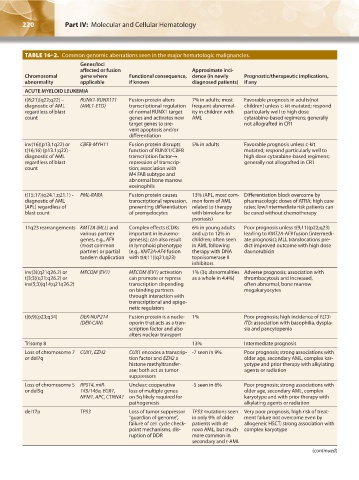
                TABLE 16–2.  Common genomic aberrations seen in the major hematologic malignancies.
                                   Genes/loci
                                   affected or fusion                   Approximate inci-
                Chromosomal        gene where      Functional consequence,  dence (in newly   Prognostic/therapeutic implications,
                abnormality        applicable      if known             diagnosed patients)  if any
                ACUTE MYELOID LEUKEMIA
                t(8;21)(q22;q22) –   RUNX1-RUNX1T1   Fusion protein alters   7% in adults; most   Favorable prognosis in adults(not
                diagnostic of AML   (AML1-ETO)     transcriptional regulation  frequent abnormal-  children) unless c-kit mutated; respond
                regardless of blast                of normal RUNX1 target   ity in children with   particularly well to high dose
                count                              genes and activates new   AML          cytarabine-based regimens; generally
                                                   target genes to pre-                   not allografted in CR1
                                                   vent apoptosis and/or
                                                   differentiation
                inv(16)(p13.1q22) or   CBFB-MYH11  Fusion protein disrupts   5% in adults  Favorable prognosis unless c-kit
                t(16;16) (p13.1;q22) -             function of RUNX1/CBFB                 mutated; respond particularly well to
                diagnostic of AML                  transcription factor→                  high dose cytarabine-based regimens;
                regardless of blast                repression of transcrip-               generally not allografted in CR1
                count                              tion; association with
                                                   M4 FAB subtype and
                                                   abnormal bone marrow
                                                   eosinophils
                t(15;17)(q24.1;q21.1) -   PML-RARA  Fusion protein causes   13% (APL, most com- Differentiation block overcome by
                diagnostic of AML                  transcriptional repression,  mon form of AML   pharmacologic doses of ATRA; high cure
                (APL) regardless of                preventing differentiation  related to therapy   rates; low/intermediate risk patients can
                blast count                        of promyelocytes     with bimolane for   be cured without chemotherapy
                                                                        psoriasis)
                11q23 rearrangements KMT2A (MLL) and   Complex effects (CDKs   6% in young adults   Poor prognosis unless t(9;11)(p22;q23)
                                   various partner   important in leukemo-  and up to 12% in   leading to KMT2A-AF9 fusion (intermedi-
                                   genes, e.g., AF9   genesis); can also result   children; often seen   ate prognosis); MLL translocations pre-
                                   (most common    in lymphoid phenotype   in AML following   dict improved outcome with high dose
                                   partner) or partial   (e.g., KMT2A-AF4 fusion   therapy with DNA   daunorubicin
                                   tandem duplication with t(4;11)(q21;q23)  topoisomerase II
                                                                        inhibitors
                inv(3)(q21q26.2) or   MECOM (EV1)  MECOM (EV1) activation   1% (3q abnormalities  Adverse prognosis; association with
                t(3;3)(q21;q26.2) or               can promote or repress   as a whole in 4.4%)  thrombocytosis and increased,
                ins(5;3)(q14;q21q26.2)             transcription depending                often abnormal, bone marrow
                                                   on binding partners                    megakaryocytes
                                                   through interaction with
                                                   transcriptional and epige-
                                                   netic regulators
                t(6;9)(p23;q34)    DEK-NUP214      Fusion protein is a nucle-  1%         Poor prognosis; high incidence of FLT3-
                                   (DEK-CAN)       oporin that acts as a tran-            ITD; association with basophilia, dyspla-
                                                   scription factor and also              sia and pancytopenia
                                                   alters nuclear transport
                Trisomy 8                                               13%               Intermediate prognosis
                Loss of chromosome 7  CUX1, EZH2   CUX1 encodes a transcrip- -7 seen in 9%  Poor prognosis; strong associations with
                or del7q                           tion factor and EZH2 a                 older age, secondary AML, complex kar-
                                                   histone methyltransfer-                yotype and prior therapy with alkylating
                                                   ase; both act as tumor                 agents or radiation
                                                   suppressors
                Loss of chromosome 5  RPS14, miR-  Unclear; cooperative   -5 seen in 6%   Poor prognosis; strong associations with
                or del5q           145/146a, EGR1,   loss of multiple genes               older age, secondary AML, complex
                                   NPM1, APC, CTNNA1 on 5q likely required for            karyotype and with prior therapy with
                                                   pathogenesis                           alkylating agents or radiation
                del17p             TP53            Loss of tumor suppressor   TP53 mutations seen  Very poor prognosis, high risk of treat-
                                                   “guardian of genome”,   in only 9% of older   ment failure not overcome even by
                                                   failure of cell cycle check-  patients with de   allogeneic HSCT; strong association with
                                                   point mechanisms, dis-  novo AML, but much  complex karyotype
                                                   ruption of DDR       more common in
                                                                        secondary and t-AML
                                                                                                                 (continued)


          Kaushansky_chapter 16_p0213-0246.indd   220                                                                   9/18/15   11:57 PM

