


Page 247 - Williams Hematology ( PDFDrive )
P. 247
222            Part IV:  Molecular and Cellular Hematology                                                                                                Chapter 16:  Cell-Cycle Regulation and Hematologic Disorders             223


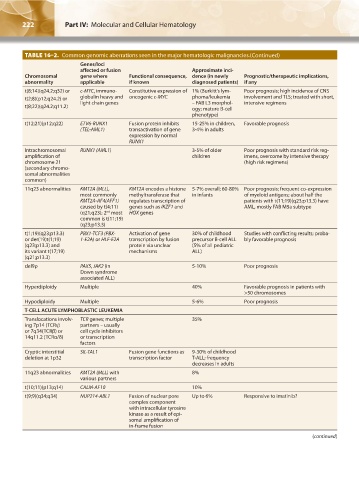
                TABLE 16–2.  Common genomic aberrations seen in the major hematologic malignancies.(Continued)
                                   Genes/loci
                                   affected or fusion                   Approximate inci-
                Chromosomal        gene where      Functional consequence,  dence (in newly   Prognostic/therapeutic implications,
                abnormality        applicable      if known             diagnosed patients)  if any
                t(8;14)(q24.2;q32) or  c-MYC, immuno-  Constitutive expression of  1% (Burkitt’s lym-  Poor prognosis; high incidence of CNS
                t(2;8)(p12;q24.2) or  globulin heavy and  oncogenic c-MYC  phoma/leukemia   involvement and TLS; treated with short,
                t(8;22)(q24.2;q11.2)  light chain genes                 – FAB L3 morphol-  intensive regimens
                                                                        ogy; mature B-cell
                                                                        phenotype)
                t(12;21)(p12;q22)  ETV6-RUNX1      Fusion protein inhibits   15-25% in children,   Favorable prognosis
                                   (TEL-AML1)      transactivation of gene   3-4% in adults
                                                   expression by normal
                                                   RUNX1
                Intrachromosomal   RUNX1 (AML1)                         3-5% of older     Poor prognosis with standard risk reg-
                amplification of                                        children          imens, overcome by intensive therapy
                chromosome 21                                                             (high risk regimens)
                (secondary chromo-
                somal abnormalities
                common)
                11q23 abnormalities  KMT2A (MLL),   KMT2A encodes a histone  5-7% overall; 60-80%  Poor prognosis; frequent co-expression
                                   most commonly   methyltransferase that   in infants    of myeloid antigens; about half the
                                   KMT2A-AF4(AFF1)   regulates transcription of           patients with t(11;19)(q23;p13.3) have
                                   caused by t(4;11)  genes such as IKZF1 and             AML, mostly FAB M5a subtype
                                   (q21;q23); 2  most   HOX genes
                                            nd
                                   common is t(11;19)
                                   (q23;p13.3)
                t(1;19)(q23;p13.3)   PBX1-TCF3 (PBX-  Activation of gene   30% of childhood   Studies with conflicting results; proba-
                or der(19)t(1;19)  1-E2A) or HLF-E2A  transcription by fusion   precursor B-cell ALL   bly favorable prognosis
                (q23;p13.3) and                    protein via unclear   (5% of all pediatric
                its variant t(17;19)               mechanisms           ALL)
                (q21;p13.3)
                del9p              PAX5, JAK2 (in                       5-10%             Poor prognosis
                                   Down syndrome
                                   associated ALL)
                Hyperdiploidy      Multiple                             40%               Favorable prognosis in patients with
                                                                                          >50 chromosomes
                Hypodiploidy       Multiple                             5-6%              Poor prognosis
                T-CELL ACUTE LYMPHOBLASTIC LEUKEMIA
                Translocations involv-  TCR genes; multiple             35%
                ing 7p14 (TCRγ)    partners – usually
                or 7q34(TCRβ) or   cell cycle inhibitors
                14q11.2 (TCRα/δ)   or transcription
                                   factors
                Cryptic interstitial   SIL-TAL1    Fusion gene functions as   9-30% of childhood
                deletion at 1p32                   transcription factor  T-ALL; frequency
                                                                        decreases in adults
                11q23 abnormalities  KMT2A (MLL) with                   8%
                                   various partners
                t(10;11)(p13;q14)  CALM-AF10                            10%
                t(9;9)(q34;q34)    NUP214-ABL1     Fusion of nuclear pore   Up to 6%      Responsive to imatinib?
                                                   complex component
                                                   with intracellular tyrosine
                                                   kinase as a result of epi-
                                                   somal amplification of
                                                   in-frame fusion
                                                                                                                 (continued)


          Kaushansky_chapter 16_p0213-0246.indd   222                                                                   9/18/15   11:57 PM

