


Page 249 - Williams Hematology ( PDFDrive )
P. 249
224            Part IV:  Molecular and Cellular Hematology                                                                                                Chapter 16:  Cell-Cycle Regulation and Hematologic Disorders             225


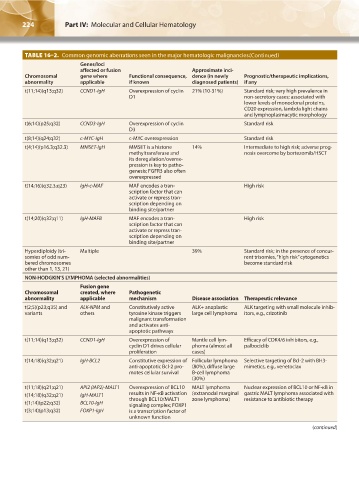
                TABLE 16–2.  Common genomic aberrations seen in the major hematologic malignancies.(Continued)
                                   Genes/loci
                                   affected or fusion                   Approximate inci-
                Chromosomal        gene where      Functional consequence,  dence (in newly   Prognostic/therapeutic implications,
                abnormality        applicable      if known             diagnosed patients)  if any
                t(11;14)(q13;q32)  CCND1-IgH       Overexpression of cyclin   21% (10-31%)  Standard risk; very high prevalence in
                                                   D1                                     non-secretory cases; associated with
                                                                                          lower levels of monoclonal proteins,
                                                                                          CD20 expression, lambda light chains
                                                                                          and lymphoplasmacytic morphology
                t(6;14)(p25;q32)   CCND3-IgH       Overexpression of cyclin               Standard risk
                                                   D3
                t(8;14)(q24;q32)   c-MYC-IgH       c-MYC overexpression                   Standard risk
                t(4;14)(p16.3;q32.3)  MMSET-IgH    MMSET is a histone   14%               Intermediate to high risk; adverse prog-
                                                   methyltransferase and                  nosis overcome by bortezomib/HSCT
                                                   its deregulation/overex-
                                                   pression is key to patho-
                                                   genesis; FGFR3 also often
                                                   overexpressed
                t(14;16)(q32.3;q23)  IgH-c-MAF     MAF encodes a tran-                    High risk
                                                   scription factor that can
                                                   activate or repress tran-
                                                   scription depending on
                                                   binding site/partner
                t(14;20)(q32;q11)  IgH-MAFB        MAF encodes a tran-                    High risk
                                                   scription factor that can
                                                   activate or repress tran-
                                                   scription depending on
                                                   binding site/partner
                Hyperdiploidy (tri-  Multiple                           39%               Standard risk; in the presence of concur-
                somies of odd num-                                                        rent trisomies, “high risk” cytogenetics
                bered chromosomes                                                         become standard risk
                other than 1, 13, 21)
                NON-HODGKIN’S LYMPHOMA (selected abnormalities)
                                   Fusion gene
                Chromosomal        created, where   Pathogenetic
                abnormality        applicable      mechanism            Disease association  Therapeutic relevance
                t(2;5)(p23;q35) and   ALK-NPM and   Constitutively active   ALK+ anaplastic   ALK targeting with small molecule inhib-
                variants           others          tyrosine kinase triggers   large cell lymphoma  itors, e.g., crizotinib
                                                   malignant transformation
                                                   and activates anti-
                                                   apoptotic pathways
                t(11;14)(q13;q32)  CCND1-IgH       Overexpression of    Mantle cell lym-  Efficacy of CDK4/6 inhibitors, e.g.,
                                                   cyclin D1 drives cellular   phoma (almost all   palbociclib
                                                   proliferation        cases)
                t(14;18)(q32;q21)  IgH-BCL2        Constitutive expression of  Follicular lymphoma   Selective targeting of Bcl-2 with BH3-
                                                   anti-apoptotic Bcl-2 pro-  (80%), diffuse large   mimetics, e.g., venetoclax
                                                   motes cellular survival  B-cell lymphoma
                                                                        (30%)
                t(11;18)(q21;q21)  API2 (IAP2)-MALT1  Overexpression of BCL10   MALT lymphoma   Nuclear expression of BCL10 or NF-κB in
                t(14;18)(q32;q21)  IgH-MALT1       results in NF-κB activation  (extranodal marginal  gastric MALT lymphoma associated with
                t(1;14)(p22;q32)   BCL10-IgH       through BCL10/MALT1   zone lymphoma)   resistance to antibiotic therapy
                                                   signaling complex; FOXP1
                t(3;14)(p13;q32)   FOXP1-IgH       is a transcription factor of
                                                   unknown function
                                                                                                                 (continued)


          Kaushansky_chapter 16_p0213-0246.indd   224                                                                   9/18/15   11:57 PM

