


Page 250 - Williams Hematology ( PDFDrive )
P. 250
224  Part IV:  Molecular and Cellular Hematology  Chapter 16:  Cell-Cycle Regulation and Hematologic Disorders        225


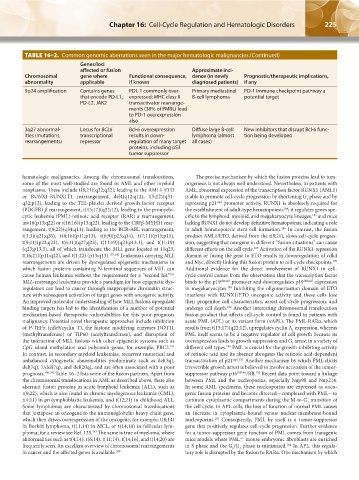
                   TABLE 16–2.  Common genomic aberrations seen in the major hematologic malignancies.(Continued)
                                     Genes/loci
                                     affected or fusion                    Approximate inci-
                   Chromosomal       gene where       Functional consequence,  dence (in newly   Prognostic/therapeutic implications,
                   abnormality       applicable       if known             diagnosed patients)  if any
                   9p24 amplification  Contains genes   PDL-1 commonly over-  Primary mediastinal   PD-1 immune checkpoint pathway a
                                     that encode PD-L1,  expressed; MHC class II   B-cell lymphoma  potential target
                                     PD-L2, JAK2      transactivator rearrange-
                                                      ments (38% of PMBL) lead
                                                      to PD-1 overexpression
                                                      also
                   3q27 abnormal-    Locus for BCL6   Bcl-6 overexpression   Diffuse large B-cell   New inhibitors that disrupt Bcl-6 func-
                   ities (mutations,   transcriptional   results in down-   lymphoma (almost   tion being developed
                   rearrangements)   repressor        regulation of many target  all cases)
                                                      proteins, including p53
                                                      tumor suppressor


                  hematologic malignancies. Among the chromosomal translocations,   The precise mechanism by which the fusion proteins lead to tum-
                  some of the most well-studied are found in AML and other myeloid   origenesis is not always well understood. Nevertheless, in patients with
                  neoplasms. These include t(8;21)(q22;q22), leading to the AML1-ETO   AML, abnormal expression of the transcription factor RUNX1 (AML1)
                  or RUNX1-RUNX1T1 rearrangement, del4(q12;q12), t(5;12)(q31-  is able to promote cell-cycle progression by shortening G  phase and by
                                                                                                                 1
                  q32;p13),  leading to the TEL-platelet derived growth factor receptor   repressing p21  promoter activity. RUNX1 is absolutely required for
                                                                                   cip1
                  (PDGFR) β rearrangement, t(15;17)(q22;12), leading to the promyelo-  the establishment of adult-type hematopoiesis ; it regulates genes spe-
                                                                                                         184
                  cytic leukemia (PML)-retinoic acid receptor (RAR) α rearrangement,   cific to the lymphoid, myeloid, and megakaryocyte lineages,  and mice
                                                                                                                   185
                  inv16(p13;q22) or t(16;16)(p13;q22), leading to the CBFβ-MYH11 rear-  lacking RUNX1 do not develop definitive hematopoiesis, indicating a role
                  rangement, t(9;22)(q34;q11), leading to the BCR-ABL rearrangement,   in adult hematopoietic stem cell formation.  In contrast, the fusion
                                                                                                         186
                  t(3;3)(q21;q26), t(8;16)(p11;p13), t(6;9)(p23;q34), t(7;11)(p15;p15),   product AML1/ETO, derived from the t(8;21), slows cell-cycle progres-
                  t(9;11)(p22;q23), t(6;11)(q27;q23), t(11;19)(q23;p13.1), and t(11;19)  sion, suggesting that one gene in different “fusion situations” can cause
                  (q23;p13.3), all of which translocate the MLL gene located at 11q23,   different effects on the cell cycle.  Activation of the RUNX1-repression
                                                                                               187
                  t(16;21)(p11;q22), and t(1;22) (p13;q13). 179,180  Leukemias carrying MLL   domain or fusing the gene to ETO results in downregulation of cdk4
                  rearrangements are driven by dysregulated epigenetic mechanisms in   and Myc, directly linking this fusion protein to cell-cycle checkpoints.
                                                                                                                          187
                  which fusion proteins containing N-terminal sequences of MLL can   Additional evidence for the direct involvement of RUNX1 in cell-
                  cause human leukemia without the requirement for a “second hit.”    cycle control comes from the observation that the transcription factor
                                                                   181
                  MLL-rearranged leukemias provide a paradigm for how epigenetic dys-  binds to the p19 INK4D  promoter and downregulates p19 INK4D  expression
                  regulation can lead to cancer through inappropriate chromatin struc-  in megakaryocytes.  Inhibiting the oligomerization domain of ETO
                                                                                       188
                  ture with subsequent activation of target genes with oncogenic activity.   interferes with RUNX1/ETO oncogenic activity and these cells lose
                  An improved molecular understanding of how MLL fusions upregulate   their progenitor cell characteristics, arrest cell-cycle progression, and
                  binding targets has led to the identification of a number of potential   undergo cell death.  Another interesting chromosomal translocation
                                                                                      189
                  mechanism-based therapeutic vulnerabilities for this poor-prognosis   fusion product that affects cell-cycle control is found in patients with
                  malignancy. Potential novel therapeutic approaches include inhibition   acute PML (APL) or its variant form (vAPL). The PML-RARα, which
                  of P-TEFb (cdk9/cyclin T), the histone modifying enzymes DOT1L   results from t(15;17)(q22;12), upregulates cyclin A  expression, whereas
                                                                                                            1
                  (methyltransferase) or TIP60 (acetyltransferase), and disruption of   PML itself seems to be a negative regulator of cell growth because its
                  the interaction of MLL fusions with other epigenetic systems such as   overexpression leads to growth suppression and G  arrest in a variety of
                                                                                                            1
                  CpG island methylation and polycomb genes, for example, PRC2.    different cell types.  PML is crucial for the growth-inhibiting activity
                                                                   181
                                                                                      190
                  In contrast, in secondary myeloid leukemias, recurrent numerical and   of retinoic acid and its absence abrogates the retinoic acid-dependent
                  unbalanced  cytogenetic  abnormalities  predominate  such  as  del(5q),   transactivation of p21 .  Another mechanism by which PML elicits
                                                                                        cip1 191
                  del(7q), 7/del(7q), and del(20q), and are often associated with a poor   irreversible growth arrest is believed to involve activation of the tumor-
                  prognosis. 180,182  Table  16–2 lists some of the fusion partners. Apart from   suppressor pathway p16 INK4A /RB.  Recent data point toward a linkage
                                                                                                192
                  the chromosomal translocations in AML as described above, there also   between PML and the nucleoporins, especially Nup98 and Nup214.
                  aberrant fusion proteins in acute lymphoid leukemia (ALL), such as   In some AML specimens, these nucleoporins are expressed as onco-
                  t(9;22), which is also found in chronic myelogenous leukemia (CML),   genic fusion proteins and become directed—complexed with PML—to
                  t(4;11) in prolymphoblastic leukemia, and t(12;21) in childhood ALL.   common cytoplasmic compartments during the M-to-G  transition of
                                                                                                                 1
                  Some lymphomas are characterized by chromosomal translocations   the cell cycle. In APL cells, the loss of function of normal PML causes
                  that juxtapose an oncogene to the immunoglobulin heavy-chain gene,   an increase in cytoplasmic-bound versus nuclear-membrane-bound
                  which then drives overexpression of the oncogene, for example, t(8;14)   nucleoporins.  Consequently, PML by itself is a tumor-suppressor
                                                                                  193
                  in Burkitt lymphoma, t(11;14) in MCL, or t(14;18) in follicular lym-  gene that positively regulates cell-cycle progression. Further evidence
                  phoma; for a review see Ref. 125.  The same is true of myeloma, where   for a tumor-suppressor gene function of PML comes from transgenic
                                         183
                  abnormalities such as t(4;14), t(6;14), t(11;14), t(14;16), and t(14;20) are   mice models where PML  mouse embryonic fibroblasts are enriched
                                                                                           –/–
                  frequently seen. An excellent overview of chromosomal rearrangements   in S phase and the G /G  phase is minimized.  In APL, this regula-
                                                                                                          194
                                                                                        0
                                                                                           1
                  in cancer and the affected genes is available. 180    tory role is disrupted by the fusion to RARα. One mechanism by which
          Kaushansky_chapter 16_p0213-0246.indd   225                                                                   9/18/15   11:57 PM

