


Page 248 - Williams Hematology ( PDFDrive )
P. 248
222  Part IV:  Molecular and Cellular Hematology  Chapter 16:  Cell-Cycle Regulation and Hematologic Disorders        223


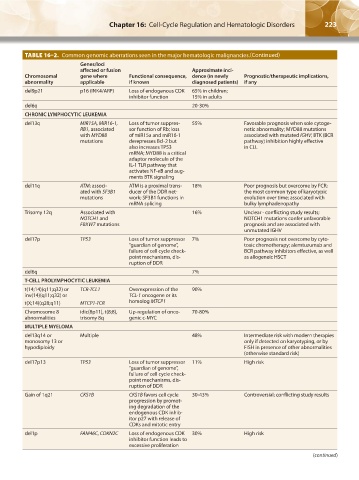
                   TABLE 16–2.  Common genomic aberrations seen in the major hematologic malignancies.(Continued)
                                     Genes/loci
                                     affected or fusion                    Approximate inci-
                   Chromosomal       gene where       Functional consequence,  dence (in newly   Prognostic/therapeutic implications,
                   abnormality       applicable       if known             diagnosed patients)  if any
                   del9p21           p16 (INK4/ARF)   Loss of endogenous CDK   65% in children;
                                                      inhibitor function   15% in adults
                   del6q                                                   20-30%
                   CHRONIC LYMPHOCYTIC LEUKEMIA
                   del13q            MIR15A, MIR16-1,   Loss of tumor suppres-  55%         Favorable prognosis when sole cytoge-
                                     RB1, associated   sor function of Rb; loss             netic abnormality; MYD88 mutations
                                     with MYD88       of miR15a and miR16-1                 associated with mutated IGHV; BTK (BCR
                                     mutations        derepresses Bcl-2 but                 pathway) inhibition highly effective
                                                      also increases TP53                   in CLL
                                                      mRNA; MYD88 is a critical
                                                      adaptor molecule of the
                                                      IL-1 TLR pathway that
                                                      activates NF-κB and aug-
                                                      ments BTK signaling
                   del11q            ATM; associ-     ATM is a proximal trans-  18%         Poor prognosis but overcome by FCR;
                                     ated with SF3B1   ducer of the DDR net-                the most common type of karyotypic
                                     mutations        work; SF3B1 functions in              evolution over time; associated with
                                                      mRNA splicing                         bulky lymphadenopathy
                   Trisomy 12q       Associated with                       16%              Unclear - conflicting study results;
                                     NOTCH1 and                                             NOTCH1 mutations confer unfavorable
                                     FBXW7 mutations                                        prognosis and are associated with
                                                                                            unmutated IGHV
                   del17p            TP53             Loss of tumor suppressor   7%         Poor prognosis not overcome by cyto-
                                                      “guardian of genome”,                 toxic chemotherapy; alemtuzumab and
                                                      failure of cell cycle check-          BCR pathway inhibitors effective, as well
                                                      point mechanisms, dis-                as allogeneic HSCT
                                                      ruption of DDR
                   del6q                                                   7%
                   T-CELL PROLYMPHOCYTIC LEUKEMIA
                   t(14;14)(q11;q32) or   TCR-TCL1    Overexpression of the   90%
                   inv(14)(q11;q32) or                TCL-1 oncogene or its
                   t(X;14)(q28;q11)  MTCP1-TCR        homolog MTCP1
                   Chromosome 8      idic(8p11), t(8;8),   Up-regulation of onco-  70-80%
                   abnormalities     trisomy 8q       genic c-MYC
                   MULTIPLE MYELOMA
                   del13q14 or       Multiple                              48%              Intermediate risk with modern therapies
                   monosomy 13 or                                                           only if detected on karyotyping, or by
                   hypodiploidy                                                             FISH in presence of other abnormalities
                                                                                            (otherwise standard risk)
                   del17p13          TP53             Loss of tumor suppressor   11%        High risk
                                                      “guardian of genome”,
                                                      failure of cell cycle check-
                                                      point mechanisms, dis-
                                                      ruption of DDR
                   Gain of 1q21      CKS1B            CKS1B favors cell cycle   30-43%      Controversial; conflicting study results
                                                      progression by promot-
                                                      ing degradation of the
                                                      endogenous CDK inhib-
                                                      itor p27 with release of
                                                      CDKs and mitotic entry
                   del1p             FAM46C, CDKN2C   Loss of endogenous CDK   30%          High risk
                                                      inhibitor function leads to
                                                      excessive proliferation
                                                                                                                   (continued)


          Kaushansky_chapter 16_p0213-0246.indd   223                                                                   9/18/15   11:57 PM

