


Page 246 - Williams Hematology ( PDFDrive )
P. 246
220  Part IV:  Molecular and Cellular Hematology  Chapter 16:  Cell-Cycle Regulation and Hematologic Disorders        221


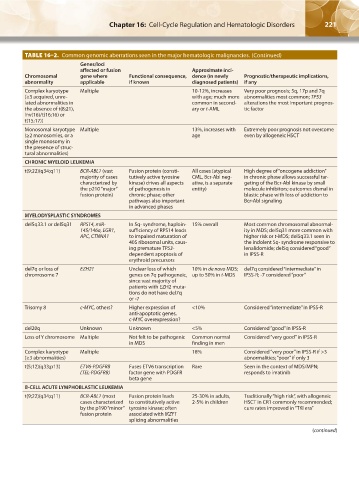
                   TABLE 16–2.  Common genomic aberrations seen in the major hematologic malignancies. (Continued)
                                     Genes/loci
                                     affected or fusion                    Approximate inci-
                   Chromosomal       gene where       Functional consequence,  dence (in newly   Prognostic/therapeutic implications,
                   abnormality       applicable       if known             diagnosed patients)  if any
                   Complex karyotype   Multiple                            10-12%, increases   Very poor prognosis; 5q, 17p and 7q
                   (≥3 acquired, unre-                                     with age; much more  abnormalities most common; TP53
                   lated abnormalities in                                  common in second-  alterations the most important prognos-
                   the absence of t(8;21),                                 ary or t-AML     tic factor
                   inv(16)/t(16;16) or
                   t(15;17))
                   Monosomal karyotype  Multiple                           13%, increases with   Extremely poor prognosis not overcome
                   (≥2 monosomies, or a                                    age              even by allogeneic HSCT
                   single monosomy in
                   the presence of struc-
                   tural abnormalities)
                   CHRONIC MYELOID LEUKEMIA
                   t(9;22)(q34;q11)  BCR-ABL1 (vast   Fusion protein (consti-  All cases (atypical   High degree of “oncogene addiction”
                                     majority of cases   tutively active tyrosine   CML, Bcr-Abl neg-  in chronic phase allows successful tar-
                                     characterized by   kinase) drives all aspects   ative, is a separate   geting of the Bcr-Abl kinase by small
                                     the p210 “major”   of pathogenesis in   entity)        molecule inhibitors; outcomes dismal in
                                     fusion protein)  chronic phase; other                  blastic phase with loss of addiction to
                                                      pathways also important               Bcr-Abl signaling
                                                      in advanced phases
                   MYELODYSPLASTIC SYNDROMES
                   del5q33.1 or del5q31  RPS14, miR-  In 5q- syndrome, haploin-  15% overall  Most common chromosomal abnormal-
                                     145/146a, EGR1,   sufficiency of RPS14 leads           ity in MDS; del5q31 more common with
                                     APC, CTNNA1      to impaired maturation of             higher risk or t-MDS; del5q33.1 seen in
                                                      40S ribosomal units, caus-            the indolent 5q- syndrome responsive to
                                                      ing premature TP53-                   lenalidomide; del5q considered “good”
                                                      dependent apoptosis of                in IPSS-R
                                                      erythroid precursors
                   del7q or loss of    EZH2?          Unclear loss of which   10% in de novo MDS;  del7q considered “intermediate” in
                   chromosome 7                       genes on 7q pathogeneic,  up to 50% in t-MDS  IPSS-R; -7 considered “poor”
                                                      since vast majority of
                                                      patients with EZH2 muta-
                                                      tions do not have del7q
                                                      or -7
                   Trisomy 8         c-MYC, others?   Higher expression of   <10%           Considered “intermediate” in IPSS-R
                                                      anti-apoptotic genes,
                                                      c-MYC overexpression?
                   del20q            Unknown          Unknown              <5%              Considered “good” in IPSS-R
                   Loss of Y chromosome  Multiple     Not felt to be pathogenic   Common normal   Considered “very good” in IPSS-R
                                                      in MDS               finding in men
                   Complex karyotype   Multiple                            18%              Considered “very poor” in IPSS-R if >3
                   (≥3 abnormalities)                                                       abnormalities; “poor” if only 3
                   t(5;12)(q33;p13)  ETV6-PDGFRB      Fuses ETV6 transcription   Rare       Seen in the context of MDS/MPN;
                                     (TEL-PDGFRB)     factor gene with PDGFR                responds to imatinib
                                                      beta gene
                   B-CELL ACUTE LYMPHOBLASTIC LEUKEMIA
                   t(9;22)(q34;q11)  BCR-ABL1 (most   Fusion protein leads   25-30% in adults,   Traditionally “high risk”, with allogeneic
                                     cases characterized  to constitutively active   2-5% in children  HSCT in CR1 commonly recommended;
                                     by the p190 “minor”  tyrosine kinase; often            cure rates improved in “TKI era”
                                     fusion protein   associated with IKZF1
                                                      splicing abnormalities
                                                                                                                   (continued)


          Kaushansky_chapter 16_p0213-0246.indd   221                                                                   9/18/15   11:57 PM

