


Page 251 - Williams Hematology ( PDFDrive )
P. 251
226            Part IV:  Molecular and Cellular Hematology                                                                                                Chapter 16:  Cell-Cycle Regulation and Hematologic Disorders             227


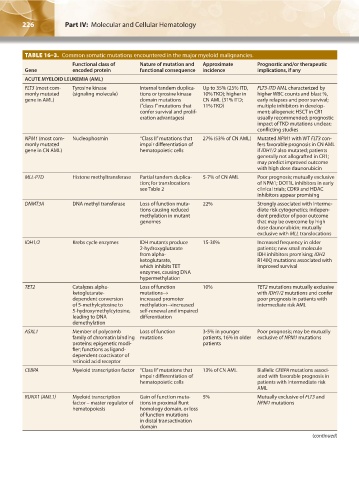
                TABLE 16–3.  Common somatic mutations encountered in the major myeloid malignancies.
                                Functional class of    Nature of mutation and   Approximate   Prognostic and/or therapeutic
                Gene            encoded protein        functional consequence  incidence      implications, if any
                ACUTE MYELOID LEUKEMIA (AML)
                FLT3 (most com-  Tyrosine kinase       Internal tandem duplica-  Up to 35% (25% ITD,   FLT3-ITD AML characterized by
                monly mutated   (signaling molecule)   tions or tyrosine kinase   10% TKD); higher in   higher WBC counts and blast %,
                gene in AML)                           domain mutations     CN AML (31% ITD;   early relapses and poor survival;
                                                       (“class I” mutations that   11% TKD)   multiple inhibitors in develop-
                                                       confer survival and prolif-            ment; allogeneic HSCT in CR1
                                                       eration advantages)                    usually recommended; prognostic
                                                                                              impact of TKD mutations unclear;
                                                                                              conflicting studies
                NPM1 (most com-  Nucleophosmin         “Class II” mutations that   27% (53% of CN AML)  Mutated NPM1 with WT FLT3 con-
                monly mutated                          impair differentiation of              fers favorable prognosis in CN AML
                gene in CN AML)                        hematopoietic cells                    if IDH1/2 also mutated; patients
                                                                                              generally not allografted in CR1;
                                                                                              may predict improved outcome
                                                                                              with high dose daunorubicin
                MLL-PTD         Histone methyltransferase  Partial tandem duplica-  5-7% of CN AML  Poor prognosis; mutually exclusive
                                                       tion; for translocations               of NPM1; DOT1L inhibitors in early
                                                       see Table 2                            clinical trials; CDK9 and HDAC
                                                                                              inhibitors appear promising
                DNMT3A          DNA methyl transferase  Loss of function muta-  22%           Strongly associated with interme-
                                                       tions causing reduced                  diate risk cytogenetics; indepen-
                                                       methylation in mutant                  dent predictor of poor outcome
                                                       genomes                                that may be overcome by high
                                                                                              dose daunorubicin; mutually
                                                                                              exclusive with MLL translocations
                IDH1/2          Krebs cycle enzymes    IDH mutants produce   15-30%           Increased frequency in older
                                                       2-hydroxyglutarate                     patients; new small molecule
                                                       from alpha-                            IDH inhibitors promising; IDH2
                                                       ketoglutarate,                         R140Q mutations associated with
                                                       which inhibits TET                     improved survival
                                                       enzymes, causing DNA
                                                       hypermethylation
                TET2            Catalyzes alpha-       Loss of function     10%               TET2 mutations mutually exclusive
                                ketoglutarate-         mutations→                             with IDH1/2 mutations and confer
                                dependent conversion   increased promoter                     poor prognosis in patients with
                                of 5-methylcytosine to   methylation→increased                intermediate risk AML
                                5-hydroxymethylcytosine,   self-renewal and impaired
                                leading to DNA         differentiation
                                demethylation
                ASXL1           Member of polycomb     Loss of function     3-5% in younger   Poor prognosis; may be mutually
                                family of chromatin binding  mutations      patients, 16% in older  exclusive of NPM1 mutations
                                proteins; epigenetic modi-                  patients
                                fier; functions as ligand-
                                dependent coactivator of
                                retinoid acid receptor
                CEBPA           Myeloid transcription factor  “Class II” mutations that   13% of CN AML  Biallelic CEBPA mutations associ-
                                                       impair differentiation of              ated with favorable prognosis in
                                                       hematopoietic cells                    patients with intermediate risk
                                                                                              AML
                RUNX1 (AML1)    Myeloid transcription    Gain of function muta-  5%           Mutually exclusive of FLT3 and
                                factor – master regulator of   tions in proximal Runt         NPM1 mutations
                                hematopoiesis          homology domain, or loss
                                                       of function mutations
                                                       in distal transactivation
                                                       domain
                                                                                                                 (continued)


          Kaushansky_chapter 16_p0213-0246.indd   226                                                                   9/18/15   11:57 PM

