


Page 253 - Williams Hematology ( PDFDrive )
P. 253
228            Part IV:  Molecular and Cellular Hematology                                                                                                Chapter 16:  Cell-Cycle Regulation and Hematologic Disorders             229


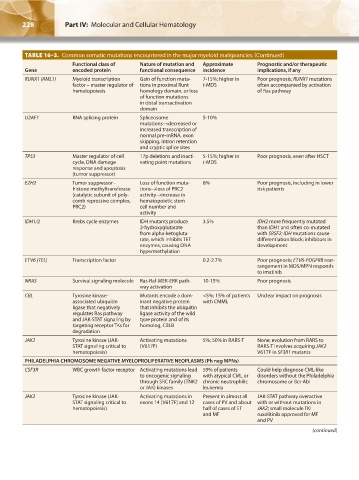
                TABLE 16–3.  Common somatic mutations encountered in the major myeloid malignancies.(Continued)
                                Functional class of    Nature of mutation and   Approximate   Prognostic and/or therapeutic
                Gene            encoded protein        functional consequence  incidence      implications, if any
                RUNX1 (AML1)    Myeloid transcription    Gain of function muta-  7-15%; higher in   Poor prognosis; RUNX1 mutations
                                factor – master regulator of   tions in proximal Runt   t-MDS  often accompanied by activation
                                hematopoiesis          homology domain, or loss               of Ras pathway
                                                       of function mutations
                                                       in distal transactivation
                                                       domain
                U2AF1           RNA splicing protein   Spliceosome          5-10%
                                                       mutations→decreased or
                                                       increased transcription of
                                                       normal pre-mRNA, exon
                                                       skipping, intron retention
                                                       and cryptic splice sites
                TP53            Master regulator of cell   17p deletions and inacti-  5-15%; higher in   Poor prognosis, even after HSCT
                                cycle, DNA damage      vating point mutations  t-MDS
                                response and apoptosis
                                (tumor suppressor)
                EZH2            Tumor suppressor -     Loss of function muta-  6%             Poor prognosis, including in lower
                                histone methyltransferase   tions→loss of PRC2                risk patients
                                (catalytic subunit of poly-  activity→increase in
                                comb repressive complex,   hematopoietic stem
                                PRC2)                  cell number and
                                                       activity
                IDH1/2          Krebs cycle enzymes    IDH mutants produce   3.5%             IDH2 more frequently mutated
                                                       2-hydroxyglutarate                     than IDH1 and often co-mutated
                                                       from alpha-ketogluta-                  with SRSF2; IDH mutations cause
                                                       rate, which inhibits TET               differentiation block; inhibitors in
                                                       enzymes, causing DNA                   development
                                                       hypermethylation
                ETV6 (TEL)      Transcription factor                        0.2-2.7%          Poor prognosis; ETV6-PDGFRB rear-
                                                                                              rangement in MDS/MPN responds
                                                                                              to imatinib
                NRAS            Survival signaling molecule  Ras-Raf-MEK-ERK path-  10-15%    Poor prognosis
                                                       way activation
                CBL             Tyrosine kinase-       Mutants encode a dom-  <5%; 15% of patients   Unclear impact on prognosis
                                associated ubiquitin   inant negative protein   with CMML
                                ligase that negatively   that inhibits the ubiquitin
                                regulates Ras pathway   ligase activity of the wild
                                and JAK-STAT signaling by   type protein and of its
                                targeting receptor TKs for   homolog, CBLB
                                degradation
                JAK2            Tyrosine kinase (JAK-  Activating mutations   5%; 50% in RARS-T  None; evolution from RARS to
                                STAT signaling critical to   (V617F)                          RARS-T involves acquiring JAK2
                                hematopoiesis)                                                V617F in SF3B1 mutants
                PHILADELPHIA CHROMOSOME NEGATIVE MYELOPROLIFERATIVE NEOPLASMS (Ph neg MPNs)
                CSF3R           WBC growth factor receptor Activating mutations lead  59% of patients   Could help diagnose CML-like
                                                       to oncogenic signaling   with atypical CML or   disorders without the Philadelphia
                                                       through SRC family (TNK2  chronic neutrophilic   chromosome or Bcr-Abl
                                                       or JAK) kinases      leukemia
                JAK2            Tyrosine kinase (JAK-  Activating mutations in   Present in almost all   JAK-STAT pathway overactive
                                STAT signaling critical to   exons 14 (V617F) and 12  cases of PV and about  with or without mutations in
                                hematopoiesis)                              half of cases of ET   JAK2; small molecule TKI
                                                                            and MF            ruxolitinib approved for MF
                                                                                              and PV
                                                                                                                 (continued)


          Kaushansky_chapter 16_p0213-0246.indd   228                                                                   9/18/15   11:57 PM

