


Page 687 - Williams Hematology ( PDFDrive )
P. 687
662            Part VI:  The Erythrocyte                                                                                                                                  Chapter 46:  Erythrocyte Membrane Disorders              663


                                    Ankyrin complex                            Junctional complex


                              GPA                  GPA                  GPC

                                       b3  b3               b3  b3               b3   b3

                                                                       p55              Rh
                                            4.2   Rh complex
                                                                                       GLUT1
                                      Ankyrin                                4.1R  Adducin       Dematin  Vertical interactions


                                      4.2
                                                                          Actin       Tropomyosin
                                                 Spectrin                             Tropomodulin
                                        b-Spectrin  self-association
                                 a-Spectrin
                                                           Horizontal interactions

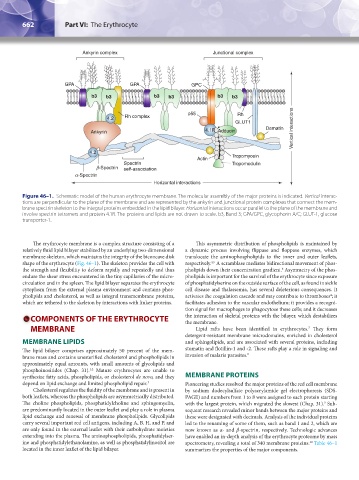
               Figure 46–1.  Schematic model of the human erythrocyte membrane. The molecular assembly of the major proteins is indicated. Vertical interac-
               tions are perpendicular to the plane of the membrane and are represented by the ankyrin and junctional protein complexes that connect the mem-
               brane spectrin skeleton to the integral proteins embedded in the lipid bilayer. Horizontal interactions occur parallel to the plane of the membrane and
               involve spectrin tetramers and protein 4.1R. The proteins and lipids are not drawn to scale. b3, Band 3; GPA/GPC, glycophorin A/C; GLUT-1, glucose
               transporter-1.


                   The erythrocyte membrane is a complex structure consisting of a   This asymmetric distribution of phospholipids is maintained by
               relatively fluid lipid bilayer stabilized by an underlying two-dimensional   a dynamic process involving flippase and floppase enzymes, which
               membrane skeleton, which maintains the integrity of the biconcave disk   translocate the aminophospholipids to the inner and outer leaflets,
               shape of the erythrocyte (Fig. 46–1). The skeleton provides the cell with   respectively.  A scramblase mediates bidirectional movement of phos-
                                                                               4,5
               the strength and flexibility to deform rapidly and repeatedly and thus   pholipids down their concentration gradient.  Asymmetry of the phos-
                                                                                                      6
               endure the shear stress encountered in the tiny capillaries of the micro-  pholipids is important for the survival of the erythrocyte since exposure
               circulation and in the spleen. The lipid bilayer separates the erythrocyte   of phosphatidylserine on the outside surface of the cell, as found in sickle
               cytoplasm from the external plasma environment and contains phos-  cell disease and thalassemia, has several deleterious consequences. It
               pholipids and cholesterol, as well as integral transmembrane proteins,   activates the coagulation cascade and may contribute to thromboses ; it
                                                                                                                       4
               which are tethered to the skeleton by interactions with linker proteins.  facilitates adhesion to the vascular endothelium; it provides a recogni-
                                                                      tion signal for macrophages to phagocytose these cells; and it decreases
                    COMPONENTS OF THE ERYTHROCYTE                     the interaction of skeletal proteins with the bilayer, which destabilizes
                                                                      the membrane.
                  MEMBRANE                                                Lipid rafts have been identified in erythrocytes.  They form
                                                                                                               7
                                                                      detergent-resistant membrane microdomains, enriched in cholesterol
               MEMBRANE LIPIDS                                        and sphingolipids, and are associated with several proteins, including
               The lipid bilayer comprises approximately 50 percent of the mem-  stomatin and flotillin-1 and -2. These rafts play a role in signaling and
               brane mass and contains unesterified cholesterol and phospholipids in   invasion of malaria parasites. 8
               approximately equal amounts, with small amounts of glycolipids and
               phosphoinositides (Chap. 31).  Mature erythrocytes are unable to
                                      1,2
               synthesize fatty acids, phospholipids, or cholesterol de novo, and they   MEMBRANE PROTEINS
               depend on lipid exchange and limited phospholipid repair. 3  Pioneering studies resolved the major proteins of the red cell membrane
                   Cholesterol regulates the fluidity of the membrane and is present in   by sodium dodecylsulfate polyacrylamide gel electrophoresis (SDS-
               both leaflets, whereas the phospholipids are asymmetrically distributed.   PAGE) and numbers from 1 to 8 were assigned to each protein starting
               The  choline  phospholipids,  phosphatidylcholine  and  sphingomyelin,   with the largest protein, which migrated the slowest (Chap. 31).  Sub-
                                                                                                                     9
               are predominantly located in the outer leaflet and play a role in plasma   sequent research revealed minor bands between the major proteins and
               lipid exchange and renewal of membrane phospholipids. Glycolipids   these were designated with decimals. Analysis of the individual proteins
               carry several important red cell antigens, including A, B, H, and P, and   led to the renaming of some of them, such as band 1 and 2, which are
               are only found in the external leaflet with their carbohydrate moieties   now known as α- and β-spectrin, respectively. Technologic advances
               extending into the plasma. The aminophospholipids, phosphatidylser-  have enabled an in-depth analysis of the erythrocyte proteome by mass
               ine and phosphatidylethanolamine, as well as phosphatidylinositol are   spectrometry, revealing a total of 340 membrane proteins.  Table 46–1
                                                                                                                10
               located in the inner leaflet of the lipid bilayer.     summarizes the properties of the major components.


          Kaushansky_chapter 46_p0661-0688.indd   662                                                                   9/17/15   6:41 PM

