


Page 690 - Williams Hematology ( PDFDrive )
P. 690
664  Part VI:  The Erythrocyte                                Chapter 46:  Erythrocyte Membrane Disorders             665


                  3 as part of a macromolecular complex, and may serve as a chaperone   Linker proteins mediate the vertical attachment of the skeleton to inte-
                  for band 3 targeting to the membrane.  GPC associates with protein   gral membrane proteins in the lipid bilayer (see Fig. 46–1). The primary
                                              25
                  4.1R and p55, thereby providing an additional contact site between the   connecting protein is ankyrin, which links spectrin to the cytoplasmic
                  membrane and the skeleton (see Fig. 46–1).  These interactions play a   domain of band 3, as well as to the Rh–RhAG complex. Protein 4.1R
                                                 19
                  role in stabilizing the membrane.                     provides an additional link with GPC and band 3.
                     Other Integral Membrane Proteins  The Rh-RhAG group of   Spectrin  Spectrin  is  the  major  constituent  of  the  erythrocyte
                  proteins is part of a macromolecular band 3 complex, which stabilizes   membrane skeleton and is present at approximately 240,000 molecules
                  the membrane. RhAG belongs to the ammonium transporter family of   per cell.  It is a multifunctional protein composed of two homologous
                                                                              29
                  proteins, but its function is controversial. Numerous other proteins are   but structurally distinct subunits, α and β, encoded by separate genes,
                  embedded in the lipid bilayer, many of which are implicated in clini-  which may have evolved from duplication of a single ancestral gene
                                                                                                                          30
                  cal immunohematology and membrane disorders, such as the XK, Kell,   (see Table  46–1 and Fig. 46–3). Both α- and β-spectrin contain tandem
                  Kidd, Duffy, and Lutheran glycoproteins (see Fig. 46–1). 11,19  Additional   homologous spectrin repeats that are approximately 106 amino acids
                  integral membrane proteins include ion pumps and channels, such as   long and are folded into three antiparallel helices, A, B, and C. Each
                  stomatin, aquaporin, glucose transporter (GLUT-1), and various cation   repeat is connected to the adjacent repeat by short ordered α-helical
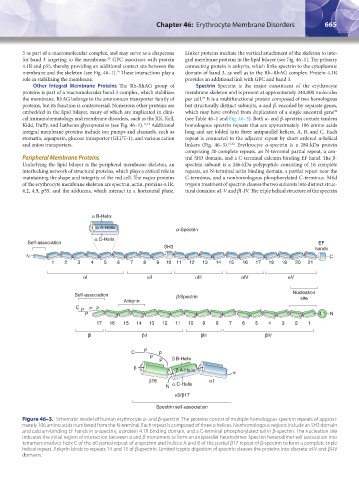
                  and anion transporters.                               linkers (Fig. 46–3). 31,32  Erythrocyte  α-spectrin is a 280-kDa protein
                                                                        comprising 20 complete repeats, an N-terminal partial repeat, a cen-
                  Peripheral Membrane Proteins                          tral SH3 domain, and a C-terminal calcium-binding EF hand. The β-
                  Underlying the lipid bilayer is the peripheral membrane skeleton, an   spectrin subunit is a 246-kDa polypeptide consisting of 16 complete
                  interlocking network of structural proteins, which plays a critical role in   repeats, an N-terminal actin binding domain, a partial repeat near the
                  maintaining the shape and integrity of the red cell. The major proteins   C-terminus, and a nonhomologous phosphorylated C-terminus. Mild
                  of the erythrocyte membrane skeleton are spectrin, actin, proteins 4.1R,   trypsin treatment of spectrin cleaves the two subunits into distinct struc-
                  4.2, 4.9, p55, and the adducins, which interact in a horizontal plane.   tural domains: αI-V and βI-IV. The triple helical structure of the spectrin


                                         α B-Helix
                                          α A-Helix                  a-Spectrin

                                          α C-Helix
                    Self-association                                                                                 EF
                                                                 SH3                                                hands
                   N                                                                                                     C
                            1   2   3    4   5    6   7   8    9  10  11  12  13   14  15   16  17  18   19  20   21

                                      αl                    αll             αlll           αlV             αV

                                   Self-association                  b-Spectrin                             Nucleation
                                                    Ankyrin                                                    site
                                    C   P P
                                      P
                                       P                                                                             4.1 N
                                           17  16   15  14  13   12  11  10   9    8   7    6   5   4    3   2    1

                                        βl                βll                 βlll                 βlV


                                                      C    P    P
                                                             P      β B-Helix
                                                                P
                                                       β
                                                                     β A-Helix          α
                                                            β16                 α1
                                                                  N  α C-Helix
                                                                     α0/β17

                                                               Spectrin self-association
                  Figure 46–3.  Schematic model of human erythrocyte α- and β-spectrin. The proteins consist of multiple homologous spectrin repeats of approxi-
                  mately 106 amino acids numbered from the N-terminal. Each repeat is composed of three α helices. Nonhomologous regions include an SH3 domain
                  and calcium-binding EF hands in α-spectrin, a protein 4.1R binding domain, and a C-terminal phosphorylated tail in β-spectrin. The nucleation site
                  indicates the initial region of interaction between α and β monomers to form an antiparallel heterodimer. Spectrin heterodimer self association into
                  tetramers involves helix C of the α0 partial repeat of α-spectrin and helices A and B of the partial β17 repeat of β-spectrin to form a complete triple
                  helical repeat. Ankyrin binds to repeats 14 and 15 of β-spectrin. Limited tryptic digestion of spectrin cleaves the proteins into discrete αI-V and βI-IV
                  domains.


          Kaushansky_chapter 46_p0661-0688.indd   665                                                                   9/17/15   6:41 PM

