


Page 689 - Williams Hematology ( PDFDrive )
P. 689
664            Part VI:  The Erythrocyte                                                                                                                                  Chapter 46:  Erythrocyte Membrane Disorders              665


                   The membrane proteins are classified as either integral or periph-
               eral based on the ease with which they can be removed from whole red
               cell membrane preparations in the laboratory. Integral or transmem-
               brane proteins are embedded in the lipid bilayer by hydrophobic inter-
               actions and require detergents to extract them. They often protrude        642
               from the bilayer and extend into the plasma and/or the interior of the     Asn
               erythrocyte and these structural features correlate with their functions
               as transport proteins, receptors, signaling molecules, and carriers of red
               cell antigens.
                   Peripheral proteins constitute the membrane skeleton and are   1  2 3 4  5 67 89  10 11  12 13
               loosely attached to the cytoplasmic face of the lipid bilayer and can be
               extracted by high or low salt concentrations or by high pH. Attachment   400
               is mediated indirectly by covalent or noncovalent interactions with the                           Carbonic
               cytoplasmic domains of the transmembrane proteins, as well as by direct                           anhydrase
               interactions with the inner leaflet of the lipid bilayer. These associations              C  911
               are dynamic and the affinity of binding is regulated by post-translational
               modifications of the proteins, including phosphorylation, methylation,
               glycosylation, or lipid modification (myristoylation, palmitoylation, or   Cytoplasmic protein binding domain:
               farnesylation). Peripheral proteins typically function either as structural   Ankyrin, adducin, 4.1R, 4.2
               proteins and form part of the membrane skeleton or they serve as linker   Glycolytic enzymes
               proteins attaching the skeleton to the bilayer.                   Hemoglobin, hemichromes
                   Many erythrocyte proteins belong to superfamilies and have
               homologues in nonerythroid cells that are structurally related but are   N
               encoded by different genes. This genetic diversity explains why the clini-  1  8
               cal expression of most (but not all) red cell membrane protein mutations   Tyr-P
               is confined to the erythroid lineage. Several proteins exist in different
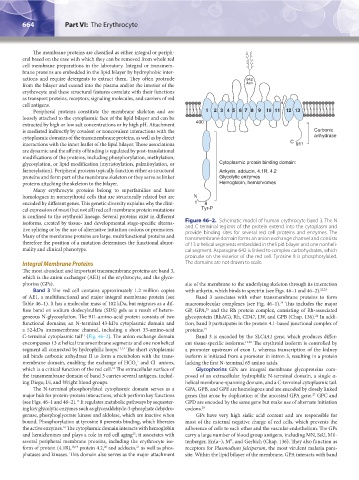
               isoforms, created by tissue- and developmental stage-specific alterna-  Figure 46–2.  Schematic model of human erythrocyte band 3. The N
               tive splicing or by the use of alternative initiation codons or promoters.   and C terminal regions of the protein extend into the cytoplasm and
                                                                      provide binding sites for several red cell proteins and enzymes. The
               Many of the membrane proteins are large, multifunctional proteins and   transmembrane domain forms an anion exchange channel and consists
               therefore the position of a mutation determines the functional abnor-  of 13 α helical segments embedded in the lipid bilayer and one nonheli-
               mality and clinical phenotype.                         cal segment. Asparagine 642 is linked to complex carbohydrates, which
                                                                      protrude on the exterior of the red cell. Tyrosine 8 is phosphorylated.
               Integral Membrane Proteins                             The domains are not drawn to scale.
               The most abundant and important transmembrane proteins are band 3,
               which is the anion exchanger (AE1) of the erythrocyte, and the glyco-
               phorins (GPs).                                         site of the membrane to the underlying skeleton through its interaction
                   Band 3 The red cell contains approximately 1.2 million copies   with ankyrin, which binds to spectrin (see Figs. 46–1 and 46–2). 22,23
               of AE1, a multifunctional and major integral membrane protein (see   Band 3 associates with other transmembrane proteins to form
               Table  46–1). It has a molecular mass of 102 kDa, but migrates as a dif-  macromolecular complexes (see Fig. 46–1).  This includes the major
                                                                                                      24
               fuse band on sodium dodecylsulfate (SDS) gels as a result of hetero-  GP, GPA,  and the Rh protein complex, consisting of Rh-associated
                                                                             25
               geneous N-glycosylation. The 911-amino-acid protein consists of two   glycoprotein (RhAG), Rh, CD47, LW, and GPB (Chap. 136).  In addi-
                                                                                                                  24
               functional domains; an N-terminal 43-kDa cytoplasmic domain and   tion, band 3 participates in the protein 4.1-based junctional complex of
               a 52-kDa transmembrane channel, including a short 33-amino-acid   proteins. 19
               C-terminal cytoplasmic tail  (Fig. 46–2). The anion exchange domain   Band 3 is encoded by the SLC4A1 gene, which produces differ-
                                   11
               encompasses 13 α helical transmembrane segments and one nonhelical   ent tissue-specific isoforms. 11,26  The erythroid isoform is controlled by
               segment all connected by hydrophilic loops. 12,13  The short cytoplasmic   a promoter upstream of exon 1, whereas transcription of the kidney
               tail binds carbonic anhydrase II to form a metabolon with the trans-  isoform is initiated from a promoter in intron 3, resulting in a protein
               membrane domain, enabling the exchange of HCO  and Cl  anions,   lacking the first N-terminal 65 amino acids.
                                                      –
                                                            –
                                                     3
               which is a critical function of the red cell.  The extracellular surface of   Glycophorins  GPs are integral membrane glycoproteins com-
                                             14
               the transmembrane domain of band 3 carries several antigens, includ-  posed of an extracellular hydrophilic N-terminal domain, a single α-
               ing Diego, I/i, and Wright blood groups.               helical membrane-spanning domain, and a C-terminal cytoplasmic tail.
                   The N-terminal phosphorylated cytoplasmic domain serves as a   GPA, GPB, and GPE are homologous and are encoded by closely linked
               major hub for protein-protein interactions, which perform key functions   genes that arose by duplication of the ancestral GPA gene.  GPC and
                                                                                                                 27
               (see Figs. 46–1 and 46–2).  It regulates metabolic pathways by sequester-  GPD are encoded by the same gene but make use of alternate initiation
                                  15
               ing key glycolytic enzymes such as glyceraldehyde-3-phosphate dehydro-  codons. 28
               genase, phosphoglycerate kinase and aldolase, which are inactive when   GPs have very high sialic acid content and are responsible for
               bound. Phosphorylation at tyrosine 8 prevents binding, which liberates   most of the external negative charge of red cells, which prevents the
               the active enzymes.  The cytoplasmic domain interacts with hemoglobin   adherence of cells to each other and the vascular endothelium. The GPs
                             16
               and hemichromes and plays a role in red cell aging ; it associates with   carry a large number of blood group antigens, including MN, SsU, Mil-
                                                    17
               several peripheral membrane proteins, including the erythrocyte iso-  tenberger, En(a–), M , and Gerbich (Chap. 136). They also function as
                                                                                     K
                                           20
                                                      21
               form of protein (4.1R), 18,19  protein 4.2,  and adducin,  as well as phos-  receptors for Plasmodium falciparum, the most virulent malaria para-
               phatases and kinases. This domain also serves as the major attachment   site. Within the lipid bilayer of the membrane, GPA interacts with band
          Kaushansky_chapter 46_p0661-0688.indd   664                                                                   9/17/15   6:41 PM

