


Page 1010 - Clinical Immunology_ Principles and Practice ( PDFDrive )
P. 1010
974          Part Seven  Organ-Specific Inflammatory Disease


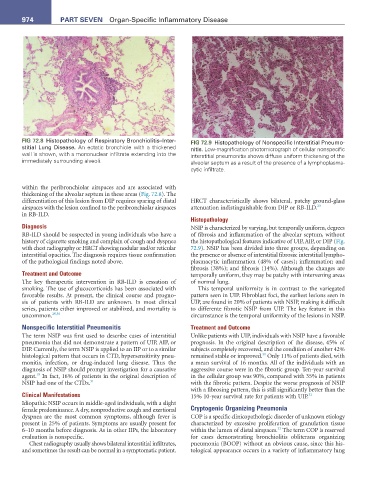
        FIG 72.8  Histopathology of Respiratory Bronchiolitis–Inter-  FIG 72.9  Histopathology of Nonspecific Interstitial Pneumo-
        stitial Lung Disease. An ectatic bronchiole with a thickened   nitis. Low-magnification photomicrograph of cellular nonspecific
        wall is shown, with a mononuclear infiltrate extending into the   interstitial pneumonitis shows diffuse uniform thickening of the
        immediately surrounding alveoli.                       alveolar septum as a result of the presence of a lymphoplasma-
                                                               cytic infiltrate.


        within the peribronchiolar airspaces and are associated with
        thickening of the alveolar septum in these areas (Fig. 72.8). The
        differentiation of this lesion from DIP requires sparing of distal   HRCT characteristically shows bilateral, patchy ground-glass
        airspaces with the lesion confined to the peribronchiolar airspaces   attenuation indistinguishable from DIP or RB-ILD. 23
        in RB-ILD.
                                                               Histopathology
        Diagnosis                                              NSIP is characterized by varying, but temporally uniform, degrees
        RB-ILD should be suspected in young individuals who have a   of fibrosis and inflammation of the alveolar septum, without
        history of cigarette smoking and complain of cough and dyspnea   the histopathological features indicative of UIP, AIP, or DIP (Fig.
        with chest radiography or HRCT showing nodular and/or reticular   72.9). NSIP has been divided into three groups, depending on
        interstitial opacities. The diagnosis requires tissue confirmation   the presence or absence of interstitial fibrosis: interstitial lympho-
        of the pathological findings noted above.              plasmacytic inflammation  (48% of  cases);  inflammation  and
                                                               fibrosis (38%); and fibrosis (14%). Although the changes are
        Treatment and Outcome                                  temporally uniform, they may be patchy with intervening areas
        The  key  therapeutic  intervention in  RB-ILD  is  cessation  of   of normal lung.
        smoking. The use of glucocorticoids has been associated with   This  temporal  uniformity is  in  contrast  to  the variegated
        favorable results. At present, the clinical course and progno-  pattern seen in UIP. Fibroblast foci, the earliest lesions seen in
        sis of patients with RB-ILD are unknown. In most clinical   UIP, are found in 20% of patients with NSIP, making it difficult
        series, patients either improved or stabilized, and mortality is     to differente fibrotic NSIP from UIP. The key feature in this
        uncommon. 29,30                                        circumstance is the temporal uniformity of the lesions in NSIP.
        Nonspecific Interstitial Pneumonitis                   Treatment and Outcome
        The term NSIP was first used to describe cases of interstitial   Unlike patients with UIP, individuals with NSIP have a favorable
        pneumonia that did not demonstrate a pattern of UIP, AIP, or   prognosis. In the original description of the disease, 45% of
        DIP. Currently, the term NSIP is applied to an IIP or to a similar   subjects completely recovered, and the condition of another 42%
                                                                                       31
        histological pattern that occurs in CTD, hypersensitivity pneu-  remained stable or improved.  Only 11% of patients died, with
        monitis, infection, or drug-induced lung disease. Thus the   a mean survival of 16 months. All of the individuals with an
        diagnosis of NSIP should prompt investigation for a causative   aggressive course were in the fibrotic group. Ten-year survival
             18
        agent.  In fact, 16% of patients in the original description of   in the cellular group was 90%, compared with 35% in patients
        NSIP had one of the CTDs. 31                           with the fibrotic pattern. Despite the worse prognosis of NSIP
                                                               with a fibrosing pattern, this is still significantly better than the
        Clinical Manifestations                                15% 10-year survival rate for patients with UIP. 32
        Idiopathic NSIP occurs in middle-aged individuals, with a slight
        female predominance. A dry, nonproductive cough and exertional   Cryptogenic Organizing Pneumonia
        dyspnea  are  the  most  common  symptoms,  although  fever  is   COP is a specific clinicopathologic disorder of unknown etiology
        present in 25% of patients. Symptoms are usually present for   characterized by excessive proliferation of granulation tissue
                                                                                            33
        6–10 months before diagnosis. As in other IIPs, the laboratory   within the lumen of distal airspaces.  The term COP is reserved
        evaluation is nonspecific.                             for cases demonstrating bronchiolitis obliterans organizing
           Chest radiography usually shows bilateral interstitial infiltrates,   pneumonia (BOOP) without an obvious cause, since this his-
        and sometimes the result can be normal in a symptomatic patient.   tological appearance occurs in a variety of inflammatory lung

