


Page 1009 - Clinical Immunology_ Principles and Practice ( PDFDrive )
P. 1009
CHaPter 72  Immunological Lung Diseases                973


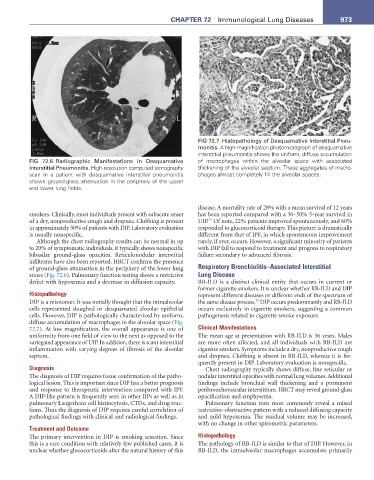
                                                                  FIG 72.7  Histopathology of Desquamative Interstitial Pneu-
                                                                  monitis. A high-magnification photomicrograph of desquamative
                                                                  interstitial pneumonitis shows the uniform, diffuse accumulation
           FIG 72.6  Radiographic Manifestations in Desquamative   of macrophages within  the alveolar space with associated
           Interstitial Pneumonitis. High-resolution computed tomography   thickening of the alveolar septum. These aggregates of macro-
           scan  in  a  patient  with  desquamative  interstitial  pneumonitis   phages almost completely fill the alveolar spaces.
           shows ground-glass attenuation in the periphery of the upper
           and lower lung fields.


                                                                  disease. A mortality rate of 28% with a mean survival of 12 years
           smokers. Clinically, most individuals present with subacute onset   has been reported compared with a 30–50% 5-year survival in
                                                                     24
           of a dry, nonproductive cough and dyspnea. Clubbing is present   UIP.  Of note, 22% patients improved spontaneously, and 60%
           in approximately 50% of patients with DIP. Laboratory evaluation   responded to glucocorticoid therapy. This picture is dramatically
           is usually nonspecific.                                different from that of IPF, in which spontaneous improvement
             Although the chest radiography results can be normal in up   rarely, if ever, occurs. However, a significant minority of patients
           to 20% of symptomatic individuals, it typically shows nonspecific   with DIP fail to respond to treatment and progress to respiratory
           bibasilar ground-glass opacities. Reticulonodular interstitial   failure secondary to advanced fibrosis.
           infiltrates have also been reported. HRCT confirms the presence
           of ground-glass attenuation in the periphery of the lower lung   Respiratory Bronchiolitis–Associated Interstitial
           zones (Fig. 72.6). Pulmonary function testing shows a restrictive   Lung Disease
           defect with hypoxemia and a decrease in diffusion capacity.  RB-ILD is a distinct clinical entity that occurs in current or
                                                                  former cigarette smokers. It is unclear whether RB-ILD and DIP
           Histopathology                                         represent different diseases or different ends of the spectrum of
                                                                                     29
           DIP is a misnomer. It was initially thought that the intraalveolar   the same disease process.  DIP occurs predominantly and RB-ILD
           cells represented sloughed or desquamated alveolar epithelial   occurs exclusively in cigarette smokers, suggesting a common
           cells. However, DIP is pathologically characterized by uniform,   pathogenesis related to cigarette smoke exposure.
           diffuse accumulation of macrophages in the alveolar space (Fig.
           72.7). At low magnification, the overall appearance is one of   Clinical Manifestations
           uniformity from one field of view to the next as opposed to the   The mean age at presentation with RB-ILD is 36 years. Males
           variegated appearance of UIP. In addition, there is scant interstitial   are more often affected, and all individuals with RB-ILD are
           inflammation with varying degrees of fibrosis of the alveolar   cigarette smokers. Symptoms include a dry, nonproductive cough
           septum.                                                and dyspnea. Clubbing is absent in RB-ILD, whereas it is fre-
                                                                  quently present in DIP. Laboratory evaluation is nonspecific.
           Diagnosis                                                Chest radiography typically shows diffuse, fine reticular or
           The diagnosis of DIP requires tissue confirmation of the patho-  nodular interstitial opacities with normal lung volumes. Additional
           logical lesion. This is important since DIP has a better prognosis   findings include bronchial wall thickening and a prominent
           and response to therapeutic intervention compared with IPF.    peribronchovascular interstitium. HRCT may reveal ground-glass
           A DIP-like pattern is frequently seen in other IIPs as well as in   opacification and emphysema.
           pulmonary Langerhans cell histiocytosis, CTDs, and drug reac-  Pulmonary function tests most commonly reveal a mixed
           tions. Thus the diagnosis of DIP requires careful correlation of   restrictive–obstructive pattern with a reduced diffusing capacity
           pathological findings with clinical and radiological findings.  and mild hypoxemia. The residual volume may be increased,
                                                                  with no change in other spirometric parameters.
           Treatment and Outcome
           The primary intervention in DIP is smoking cessation. Since   Histopathology
           this is a rare condition with relatively few published cases, it is   The pathology of RB-ILD is similar to that of DIP. However, in
           unclear whether glucocorticoids alter the natural history of this   RB-ILD, the intraalveolar macrophages accumulate primarily

