


Page 1006 - Clinical Immunology_ Principles and Practice ( PDFDrive )
P. 1006
970          Part Seven  Organ-Specific Inflammatory Disease


                                                               an interplay between immunological, genetic, environmental,
                                                                                       16
                                                               and viral factors (Fig. 72.4).  Some cases of IPF are familial,
                                                               inherited as an autosomal dominant trait with variable penetrance.
                                                               Recently, dysregulated expression of a mucin gene, MUC5B, has
                                                                                                        19
                                                               been associated with development of familial IPF.  Mutations
                                                               in the telomerase ribonucleoprotein complex associated with
                                                                                                                 16
                                                               telomere shortening have also been linked with familial IPF.
                                                               In addition, surfactant protein C mutations have been rarely
                                                               associated with IPF.
                                                                  In the normal lung, the interstitium is thin and delicate with
          A                                                    few lymphoid cells and fibroblasts. Following the initiation of
                                                               the inflammatory process, damage to the alveolar epithelial cell
                                                               occurs, followed by vascular leak, fibroblast activation and
                                                               proliferation, ECM synthesis, and activation of the innate immune
                                                                     16
                                                               system.  The release of danger-associated molecular patterns
                                                               from dead or dying cells results in macrophage activation. Fol-
                                                               lowing activation, alveolar macrophages secrete IL-1, IL-8, tumor
                                                               necrosis factor-α (TNF-α), PDGF, and IGF-1. This  cytokine
                                                               milieu promotes the activation and recruitment of neutrophils
                                                               and lymphocytes to the area of alveolitis.
                                                                  T lymphocytes, which accumulate in the alveolar space and
                                                               interstitium, express an activated phenotype, including the
                                                               expression of human leukocyte antigen D-related (HLA-DR)
                                                               and IL-2 receptor. Following activation, CD4 T cells evolve into
                                                               three major subsets distinguished by the cytokines produced
          B                                                    (Chapters 9 and 16). In IPF, T cells expressing  a Th2-type
                                                               phenotype predominate, producing IL-4, -5, and -13. In addition,
                                                               the Th17 cytokine, IL-17A, has been linked to the development
                                                               of bleomycin-induced lung injury and collagen deposition. 11,12
                                                               Evidence also suggests that patients with IPF have oligoclonal
                                                               CD4 T-cell expansions that proliferate in response to antigens
                                                                                    20
                                                               present in diseased tissue.  Treg function may be impaired in
                                                                              13
                                                               patients with IPF.  In addition, immune complexes have been
                                                               identified in the serum and lungs of patients with IPF. 21
                                                                  In addition to their role as scavengers, alveolar macrophages
                                                               are vital in the repair phase of inflammation. However, the
                                                               distinguishing feature between a self-resolving inflammatory
                                                               process and a fibrotic response, as seen in IPF, is the accumulation
                                                               of collagen. Evidence suggests that the fibrotic process in IPF is
                                                               a consequence of dysregulation of both collagen synthesis and
                                                               degradation. Macrophage-derived growth factors, including
          C
                                                               TGF-β, PDGF, and IGF-1, stimulate fibroblast proliferation and
                                                                                22
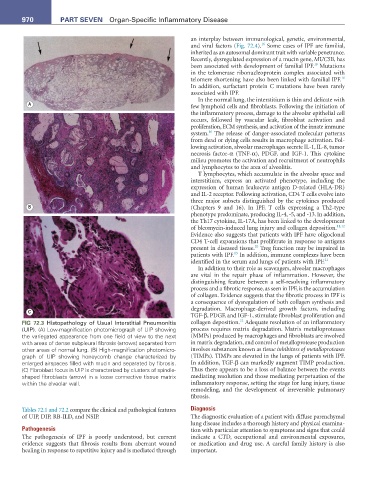
        FIG 72.3  Histopathology of Usual Interstitial Pneumonitis   collagen deposition.  Adequate resolution of an inflammatory
        (UIP). (A) Low-magnification photomicrograph of UIP showing   process requires matrix degradation. Matrix metalloproteases
        the variegated appearance from one field of view to the next   (MMPs) produced by macrophages and fibroblasts are involved
        with areas of dense subpleural fibrosis (arrows) separated from   in matrix degradation, and control of metalloprotease production
        other areas of normal lung. (B) High-magnification photomicro-  involves substances known as tissue inhibitors of metalloproteases
        graph of UIP  showing honeycomb change characterized  by   (TIMPs). TIMPs are elevated in the lungs of patients with IPF.
        enlarged airspaces filled with mucin and separated by fibrosis.   In addition, TGF-β can markedly augment TIMP production.
        (C) Fibroblast focus in UIP is characterized by clusters of spindle-  Thus there appears to be a loss of balance between the events
        shaped fibroblasts (arrow) in a loose connective tissue matrix   mediating resolution and those mediating perpetuation of the
        within the alveolar wall.                              inflammatory response, setting the stage for lung injury, tissue
                                                               remodeling, and the development of irreversible pulmonary
                                                               fibrosis.

        Tables 72.1 and 72.2 compare the clinical and pathological features   Diagnosis
        of UIP, DIP, RB-ILD, and NSIP.                         The diagnostic evaluation of a patient with diffuse parenchymal
                                                               lung disease includes a thorough history and physical examina-
        Pathogenesis                                           tion with particular attention to symptoms and signs that could
        The pathogenesis of IPF is poorly understood, but current   indicate a CTD, occupational and environmental exposures,
        evidence suggests that fibrosis results from aberrant wound   or medication and drug use.  A careful family history is also
        healing in response to repetitive injury and is mediated through   important.

