


Page 1011 - Clinical Immunology_ Principles and Practice ( PDFDrive )
P. 1011
CHaPter 72  Immunological Lung Diseases                975


           disorders, including CTDs, malignancy, infections, and those   opacities can be migratory and usually have a peripheral distribu-
           caused by medications.                                 tion similar to those seen in chronic eosinophilic pneumonia.
                                                                  Rarer radiographic manifestations include linear or nodular
           Clinical Manifestations                                interstitial opacities and honeycombing. The presence of a pleural
           The onset of disease is usually in the fifth to sixth decades of   effusion or pleural thickening should suggest an associated CTD.
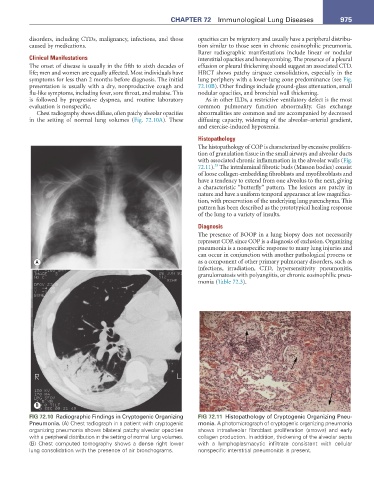
           life; men and women are equally affected. Most individuals have   HRCT shows patchy airspace consolidation, especially in the
           symptoms for less than 2 months before diagnosis. The initial   lung periphery with a lower-lung zone predominance (see Fig.
           presentation is usually with a dry, nonproductive cough and   72.10B). Other findings include ground-glass attenuation, small
           flu-like symptoms, including fever, sore throat, and malaise. This   nodular opacities, and bronchial wall thickening.
           is followed by progressive dyspnea, and routine laboratory   As in other ILDs, a restrictive ventilatory defect is the most
           evaluation is nonspecific.                             common pulmonary function abnormality. Gas exchange
             Chest radiography shows diffuse, often patchy alveolar opacities   abnormalities are common and are accompanied by decreased
           in the  setting  of  normal lung volumes (Fig.  72.10A). These   diffusing  capacity, widening  of  the alveolar–arterial  gradient,
                                                                  and exercise-induced hypoxemia.

                                                                  Histopathology
                                                                  The histopathology of COP is characterized by excessive prolifera-
                                                                  tion of granulation tissue in the small airways and alveolar ducts
                                                                  with associated chronic inflammation in the alveolar walls (Fig.
                                                                       33
                                                                  72.11).  The intraluminal fibrotic buds (Masson bodies) consist
                                                                  of loose collagen-embedding fibroblasts and myofibroblasts and
                                                                  have a tendency to extend from one alveolus to the next, giving
                                                                  a characteristic “butterfly” pattern. The lesions are patchy in
                                                                  nature and have a uniform temporal appearance at low magnifica-
                                                                  tion, with preservation of the underlying lung parenchyma. This
                                                                  pattern has been described as the prototypical healing response
                                                                  of the lung to a variety of insults.
                                                                  Diagnosis
                                                                  The presence of BOOP in a lung biopsy does not necessarily
                                                                  represent COP, since COP is a diagnosis of exclusion. Organizing
                                                                  pneumonia is a nonspecific response to many lung injuries and
                                                                  can occur in conjunction with another pathological process or
             A                                                    as a component of other primary pulmonary disorders, such as
                                                                  infections, irradiation, CTD, hypersensitivity pneumonitis,
                                                                  granulomatosis with polyangiitis, or chronic eosinophilic pneu-
                                                                  monia (Table 72.3).


             B
           FIG 72.10  Radiographic Findings in Cryptogenic Organizing   FIG 72.11  Histopathology of Cryptogenic Organizing Pneu-
           Pneumonia. (A) Chest radiograph in a patient with cryptogenic   monia. A photomicrograph of cryptogenic organizing pneumonia
           organizing pneumonia shows bilateral patchy alveolar opacities   shows intraalveolar fibroblast proliferation (arrows) and early
           with a peripheral distribution in the setting of normal lung volumes.   collagen production. In addition, thickening of the alveolar septa
           (B) Chest computed tomography shows a dense right lower   with  a  lymphoplasmacytic  infiltrate  consistent  with  cellular
           lung consolidation with the presence of air bronchograms.   nonspecific interstitial pneumonitis is present.

