


Page 1005 - Clinical Immunology_ Principles and Practice ( PDFDrive )
P. 1005
CHaPter 72  Immunological Lung Diseases                969


              A                                                 B
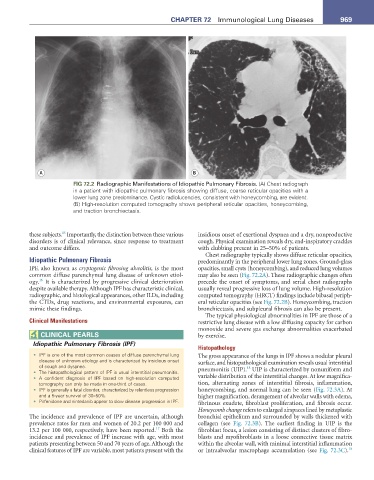
                         FIG 72.2  Radiographic Manifestations of Idiopathic Pulmonary Fibrosis. (A) Chest radiograph
                         in a patient with idiopathic pulmonary fibrosis showing diffuse, coarse reticular opacities with a
                         lower lung zone predominance. Cystic radiolucencies, consistent with honeycombing, are evident.
                         (B) High-resolution computed tomography shows peripheral reticular opacities, honeycombing,
                         and traction bronchiectasis.


                     15
           these subjects.  Importantly, the distinction between these various   insidious onset of exertional dyspnea and a dry, nonproductive
           disorders is of clinical relevance, since response to treatment   cough. Physical examination reveals dry, end-inspiratory crackles
           and outcome differs.                                   with clubbing present in 25–50% of patients.
                                                                    Chest radiography typically shows diffuse reticular opacities,
           Idiopathic Pulmonary Fibrosis                          predominantly in the peripheral lower lung zones. Ground-glass
           IPF, also known as cryptogenic fibrosing alveolitis, is the most   opacities, small cysts (honeycombing), and reduced lung volumes
           common diffuse parenchymal lung disease of unknown etiol-  may also be seen (Fig. 72.2A). These radiographic changes often
              16
           ogy.  It is characterized by progressive clinical deterioration   precede the onset of symptoms, and serial chest radiographs
           despite available therapy. Although IPF has characteristic clinical,   usually reveal progressive loss of lung volume. High-resolution
           radiographic, and histological appearances, other ILDs, including   computed tomography (HRCT) findings include bibasal periph-
           the CTDs, drug reactions, and environmental exposures, can   eral reticular opacities (see Fig. 72.2B). Honeycombing, traction
           mimic these findings.                                  bronchiectasis, and subpleural fibrosis can also be present.
                                                                    The typical physiological abnormalities in IPF are those of a
           Clinical Manifestations                                restrictive lung disease with a low diffusing capacity for carbon
                                                                  monoxide and severe gas exchange abnormalities exacerbated
               CLInICaL PearLS                                    by exercise.
            Idiopathic Pulmonary Fibrosis (IPF)
                                                                  Histopathology
            •  IPF is one of the most common causes of diffuse parenchymal lung   The gross appearance of the lungs in IPF shows a nodular pleural
              disease of unknown etiology and is characterized by insidious onset   surface, and histopathological examination reveals usual interstitial
              of cough and dyspnea.                                               18
            •  The histopathological pattern of IPF is usual interstitial pneumonitis.  pneumonitis (UIP).  UIP is characterized by nonuniform and
            •  A confident diagnosis of IPF based on high-resolution computed   variable distribution of the interstitial changes. At low magnifica-
              tomography can only be made in one-third of cases.  tion, alternating zones of interstitial fibrosis, inflammation,
            •  IPF is generally a fatal disorder, characterized by relentless progression   honeycombing, and normal lung can be seen (Fig. 72.3A). At
              and a 5-year survival of 30–50%.                    higher magnification, derangement of alveolar walls with edema,
            •  Pirfenidone and nintedanib appear to slow disease progression in IPF.  fibrinous exudate, fibroblast proliferation, and fibrosis occur.
                                                                  Honeycomb change refers to enlarged airspaces lined by metaplastic
           The incidence and prevalence of IPF are uncertain, although   bronchial epithelium and surrounded by walls thickened with
           prevalence rates for men and women of 20.2 per 100 000 and   collagen (see  Fig. 72.3B). The earliest finding in UIP is the
                                                    17
           13.2 per 100 000, respectively, have been reported.  Both the   fibroblast focus, a lesion consisting of distinct clusters of fibro-
           incidence and prevalence of IPF increase with age, with most   blasts and myofibroblasts in a loose connective tissue matrix
           patients presenting between 50 and 70 years of age. Although the   within the alveolar wall, with minimal interstitial inflammation
                                                                                                                   18
           clinical features of IPF are variable, most patients present with the   or intraalveolar macrophage accumulation (see  Fig. 72.3C).

