


Page 1007 - Clinical Immunology_ Principles and Practice ( PDFDrive )
P. 1007
CHaPter 72  Immunological Lung Diseases                971


            TABLE 72.1  Clinical Features of the Idiopathic Interstitial Pneumonias
                                   UIP               DIP              rB-ILD      aIP                 nSIP
            Mean age (years)       57                42               36          49                  49
            Childhood              No                Rare             No          Rare                Occasionally
            Onset                  Insidious         Insidious        Insidious   Acute               Subacute, insidious
            Mortality (mean survival)  68% (5–6 years)  27% (12 years)  0%        62% (1–2 months)    11% (17 months)
            Response to steroids   Poor              Good             Good        Poor                Good
            Recovery possible      No                Yes              Yes         Yes                 Yes
           AIP, acute interstitial pneumonitis; DIP, desquamative interstitial pneumonitis; NSIP, nonspecific interstitial pneumonia; RB-ILD, respiratory bronchiolitis–associated interstitial lung
           disease; UIP, usual interstitial pneumonitis.
           Adapted from Katzenstein AL, Myers JL. Idiopathic pulmonary fibrosis: clinical relevance of pathological classification. Am J Respir Crit Care Med 1998; 157: 1301.


            TABLE 72.2  Histopathological Features of                  Genes?          Environment?       Infection?
            the Idiopathic Interstitial Pneumonias
                       UIP       DIP/rB-ILD  aIP     nSIP                               Persistent
            Temporal   Variegated  Uniform   Uniform  Uniform                           sequential
             appearance                                                                  injury
            Interstitial   Scant  Scant      No      Prominent
             inflammation
            Collagen/  Patchy    Diffuse (DIP)   No  Diffuse
             fibrosis             Focal (RB-ILD)                          Epithelial and  Inflammation  Immune response
            Fibroblast   Fibroblast   No     Diffuse  Rare               endothelial injury          (Th2>Th1)
             proliferation  foci
                         prominent
            BOOP       No        No          No      Focal                                         IL-4, IL-6, IL-8
            Honeycomb   Yes      No          No      Rare
             change
            Intraalveolar   Focal  Diffuse (DIP)   No  Patchy                     TGF-β, IGF, PDGF
             macrophages          Focal (RB-ILD)
            Hyaline    No        No          Focal   No                    Angiogenesis
             membranes
           AIP, acute interstitial pneumonitis; BOOP, bronchiolitis obliterans organizing   Endothelin-1
           pneumonia; DIP, desquamative interstitial pneumonitis; NSIP, nonspecific interstitial
           pneumonia; RB-ILD, respiratory bronchiolitis–associated interstitial lung disease;
           UIP, usual interstitial pneumonitis.                                       Fibroproliferation  Failure of apoptosis
           Adapted from Katzenstein AL, Myers JL. Idiopathic pulmonary fibrosis: clinical
           relevance of pathological classification. Am J Respir Crit Care Med 1998; 157: 1301.

                                                                      Fibroblast     Extracellular matrix
                                                                      Myofibroblast     deposition
                                                                      Foci
               KeY COnCePtS                                                           Lung remodeling
            Pathogenesis of the Idiopathic Interstitial
            Pneumonias (IIPs)
            •  Although the inciting event(s) is unknown in the different diseases,      Fibrosis
              a common result is a dysregulated fibroproliferative response (similar
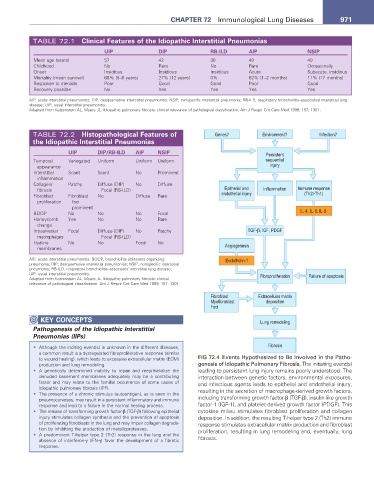
              to wound healing), which leads to excessive extracellular matrix (ECM)   FIG 72.4  Events Hypothesized to Be Involved in the Patho-
              production and lung remodeling.                     genesis of Idiopathic Pulmonary Fibrosis. The initiating event(s)
            •  A  genetically  determined  inability  to  repair  and  reepithelialize  the   leading to persistent lung injury remains poorly understood. The
              denuded basement membranes adequately may be a contributing   interaction between genetic factors, environmental exposures,
              factor and may relate to the familial occurrence of some cases of   and infectious agents leads to epithelial and endothelial injury,
              idiopathic pulmonary fibrosis (IPF).                resulting in the secretion of macrophage-derived growth factors,
            •  The presence of a chronic stimulus (autoantigen), as is seen in the
              pneumoconioses, may result in a persistent inflammatory and immune   including transforming growth factor-β (TGF-β), insulin-like growth
              response and lead to a failure in the normal healing process.  factor-1 (IGF-1), and platelet-derived growth factor (PDGF). This
            •  The release of transforming growth factor-β (TGF-β) following epithelial   cytokine milieu stimulates fibroblast proliferation and collagen
              injury stimulates collagen synthesis and the prevention of apoptosis   deposition. In addition, the resulting T-helper type 2 (Th2) immune
              of proliferating fibroblasts in the lung and may impair collagen degrada-  response stimulates extracellular matrix production and fibroblast
              tion by inhibiting the production of metalloproteases.  proliferation, resulting in lung remodeling and, eventually, lung
            •  A predominant T-helper type 2 (Th2) response in the lung and the   fibrosis.
              absence of interferon-γ (IFN-γ) favor the development of a fibrotic
              response.

