


Page 1008 - Clinical Immunology_ Principles and Practice ( PDFDrive )
P. 1008
972          Part Seven  Organ-Specific Inflammatory Disease


           The history and physical findings in IPF are nonspecific.
        However, extrapulmonary involvement does not occur; the pres-
        ence of fever, arthralgias, myalgias, or pleuritis should suggest a
        connective tissue disorder. Antinuclear antibodies (ANAs) and
        rheumatoid factor are present in 10–20% of patients with IPF, but
        titers greater than 1 : 320 should suggest an alternative diagnosis.
           The  majority of  patients  with  IPF  have  abnormal  chest
        radiography results at the time of presentation. Basal peripheral
        reticular opacities are the characteristic radiographic findings.
        A confident diagnosis of IPF from HRCT of the lung requires
        the presence of patchy, peripheral bibasal reticular abnormalities
                         23
        with honeycombing.  The presence of extensive ground-glass
        opacities on HRCT should suggest an alternative diagnosis, such
        as  DIP,  hypersensitivity  pneumonitis,  bronchiolitis  obliterans
        organizing pneumonia (BOOP), or NSIP.
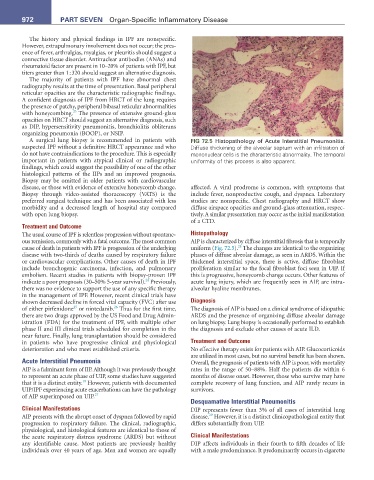
           A surgical lung biopsy is recommended in patients with   FIG 72.5  Histopathology of Acute Interstitial Pneumonitis.
        suspected IPF without a definitive HRCT appearance and who   Diffuse thickening of the alveolar septum with an infiltration of
        do not have contraindications to the procedure. This is especially   mononuclear cells is the characteristic abnormality. The temporal
        important  in  patients  with  atypical  clinical  or  radiographic   uniformity of this process is also apparent.
        findings, which could suggest the possibility of one of the other
        histological patterns of the IIPs and an improved prognosis.
        Biopsy may be omitted in older patients with cardiovascular
        disease, or those with evidence of extensive honeycomb change.   affected.  A viral prodrome is common, with symptoms that
        Biopsy  through  video-assisted thoracoscopy  (VATS)  is  the   include fever, nonproductive cough, and dyspnea. Laboratory
        preferred surgical technique and has been associated with less   studies are nonspecific. Chest radiography and HRCT show
        morbidity and a decreased length of hospital stay compared   diffuse airspace opacities and ground-glass attenuation, respec-
        with open lung biopsy.                                 tively. A similar presentation may occur as the initial manifestation
                                                               of a CTD.
        Treatment and Outcome
        The usual course of IPF is relentless progression without spontane-  Histopathology
        ous remission, commonly with a fatal outcome. The most common   AIP is characterized by diffuse interstitial fibrosis that is temporally
                                                                               28
        cause of death in patients with IPF is progression of the underlying   uniform (Fig. 72.5).  The changes are identical to the organizing
        disease with two-thirds of deaths caused by respiratory failure   phases of diffuse alveolar damage, as seen in ARDS. Within the
        or cardiovascular complications. Other causes of death in IPF   thickened interstitial space, there is active, diffuse fibroblast
        include bronchogenic carcinoma, infection, and pulmonary   proliferation similar to the focal fibroblast foci seen in UIP. If
        embolism. Recent studies in patients with biopsy-proven IPF   this is progressive, honeycomb change occurs. Other features of
                                                 24
        indicate a poor prognosis (30–50% 5-year survival).  Previously,   acute lung injury, which are frequently seen in AIP, are intra-
        there was no evidence to support the use of any specific therapy   alveolar hyaline membranes.
        in the management of IPF. However, recent clinical trials have
        shown decreased decline in forced vital capacity (FVC) after use   Diagnosis
                         25
                                      26
        of either pirfenidone  or nintedanib.  Thus for the first time,   The diagnosis of AIP is based on a clinical syndrome of idiopathic
        there are two drugs approved by the US Food and Drug Admin-  ARDS and the presence of organizing diffuse alveolar damage
        istration (FDA) for the treatment of IPF, with multiple other   on lung biopsy. Lung biopsy is occasionally performed to establish
        phase II and III clinical trials scheduled for completion in the   the diagnosis and exclude other causes of acute ILD.
        near future. Finally, lung transplantation should be considered
        in patients who have progressive clinical and physiological   Treatment and Outcome
        deterioration and who meet established criteria.       No effective therapy exists for patients with AIP. Glucocorticoids
                                                               are utilized in most cases, but no survival benefit has been shown.
        Acute Interstitial Pneumonia                           Overall, the prognosis of patients with AIP is poor, with mortality
        AIP is a fulminant form of IIP. Although it was previously thought   rates in the range of 50–88%. Half the patients die within 6
        to represent an acute phase of UIP, some studies have suggested   months of disease onset. However, those who survive may have
                            18
        that it is a distinct entity.  However, patients with documented   complete recovery of lung function, and AIP rarely recurs in
        UIP/IPF experiencing acute exacerbations can have the pathology   survivors.
        of AIP superimposed on UIP. 27
                                                               Desquamative Interstitial Pneumonitis
        Clinical Manifestations                                DIP represents fewer than 3% of all cases of interstitial lung
                                                                     29
        AIP presents with the abrupt onset of dyspnea followed by rapid   disease.  However, it is a distinct clinicopathological entity that
        progression to respiratory failure. The clinical, radiographic,   differs substantially from UIP.
        physiological, and histological features are identical to those of
        the acute respiratory distress syndrome (ARDS) but without   Clinical Manifestations
        any identifiable cause. Most patients are previously healthy   DIP affects individuals in their fourth to fifth decades of life
        individuals over 40 years of age. Men and women are equally   with a male predominance. It predominantly occurs in cigarette

