


Page 106 - Clinical Immunology_ Principles and Practice ( PDFDrive )
P. 106
CHAPtER 5  The Major Histocompatibility Complex                  91


           HLA typing by NGS has been introduced only recently, it is   Hyphen used to separate  Suffix used to denote
           likely that this new method will transform the way HLA typing   gene name from HLA prefix  changes in expression
           is performed in the coming years.
                                                                                             Field separators
                                                                                   Separator
               KEY CoNCEPtS
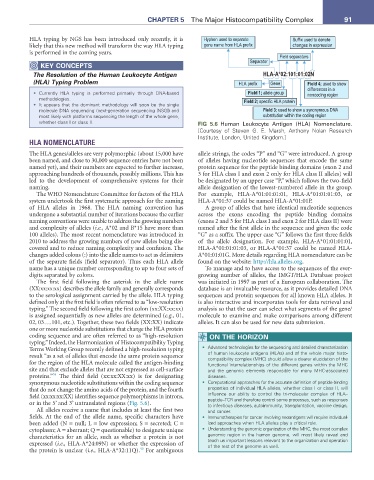
            The Resolution of the Human Leukocyte Antigen                              HLA-A*02:101:01:02N
            (HLA) Typing Problem                                               HLA prefix  Gene       Field 4; used to show
                                                                                                      differences in a
            •  Currently HLA typing is performed primarily through DNA-based      Field 1; allele group  noncoding region
              methodologies.                                                     Field 2; specific HLA protein
            •  It  appears  that  the  dominant  methodology  will  soon  be  the  single
              molecule DNA sequencing (next-generation sequencing [NSG]) and           Field 3; used to show a synonymous DNA
              most likely with platforms sequencing the length of the whole gene,      substitution within the coding region
              whether class I or class II.                        FIG 5.6  Human Leukocyte Antigen (HLA) Nomenclature.
                                                                  [Courtesy of Steven G. E. Marsh, Anthony Nolan Research
                                                                  Institute, London, United Kingdom.]
           HLA NOMENCLATURE

           The HLA genes/alleles are very polymorphic (about 15,000 have   allele strings, the codes “P” and “G” were introduced. A group
           been named, and close to 30,000 sequence entries have not been   of alleles having nucleotide sequences that encode the same
           named yet), and their numbers are expected to further increase,   protein sequence for the peptide binding domains (exon 2 and
           approaching hundreds of thousands, possibly millions. This has   3 for HLA class I and exon 2 only for HLA class II alleles) will
           led to the development of comprehensive systems for their   be designated by an upper case “P,” which follows the two-field
           naming.                                                allele designation of the lowest-numbered allele in the group.
             The WHO Nomenclature Committee for factors of the HLA   For example, HLA-A*01:01:01:01, HLA-A*01:01:01:03, or
           system undertook the first systematic approach for the naming   HLA-A*01:37 could be named HLA-A*01:01P.
           of HLA  alleles in 1968. The HLA naming  convention  has   A group of alleles that have identical nucleotide sequences
           undergone a substantial number of iterations because the earlier   across the exons encoding the peptide binding domains
           naming conventions were unable to address the growing numbers   (exons 2 and 3 for HLA class I and exon 2 for HLA class II) were
           and complexity of alleles (i.e., A*02 and B*15 have more than   named after the first allele in the sequence and given the code
           100 alleles). The most recent nomenclature was introduced in   “G” as a suffix. The upper case “G” follows the first three fields
           2010 to address the growing numbers of new alleles being dis-  of the allele designation. For example, HLA-A*01:01:01:01,
           covered and to reduce naming complexity and confusion. The   HLA-A*01:01:01:03, or HLA-A*01:37 could be named HLA-
           changes added colons (:) into the allele names to act as delimiters   A*01:01:01G. More details regarding HLA nomenclature can be
           of  the  separate  fields  (field  separator).  Thus  each  HLA  allele   found on the website: http://hla.alleles.org.
           name has a unique number corresponding to up to four sets of   To manage and to have access to the sequences of the ever-
           digits separated by colons.                            growing number of alleles, the IMGT/HLA Database project
             The first field following the asterisk in the allele name   was initiated in 1997 as part of a European collaboration. The
           (XX:xx:xx:xx) describes the allele family and generally corresponds   database is an invaluable resource, as it provides detailed DNA
           to the serological assignment carried by the allele. HLA typing   sequences and protein sequences for all known HLA alleles. It
           defined only at the first field is often referred to as “low-resolution   is also interactive and incorporates tools for data retrieval and
           typing.” The second field following the first colon (xx:XX:xx:xx)   analysis so that the user can select what segments of the gene/
           is assigned sequentially as new alleles are determined (e.g., 01,   molecule to examine and make comparisons among different
           02, 03….101, etc.). Together, these two fields (XX:XX) indicate   alleles. It can also be used for new data submission.
           one or more nucleotide substitutions that change the HLA protein
           coding sequence and are often referred to as “high-resolution    oN tHE HoRIZoN
           typing.” Indeed, the Harmonization of Histocompatibility Typing
           Terms Working Group recently defined a high-resolution typing   •  Advanced technologies for the sequencing and detailed characterization
           result “as a set of alleles that encode the same protein sequence   of human leukocyte antigens (HLAs) and of the whole major histo-
                                                                     compatibility complex (MHC) should allow a clearer elucidation of the
           for the region of the HLA molecule called the antigen-binding   functional interrelationships of the different genes within the MHC
           site and that exclude alleles that are not expressed as cell-surface   and the genomic elements responsible for many MHC-associated
                  39
           proteins.”  The third field (xx:xx:XX:xx) is for designating   diseases.
           synonymous nucleotide substitutions within the coding sequence   •  Computational approaches for the accurate definition of peptide-binding
           that do not change the amino acids of the protein, and the fourth   properties of individual HLA alleles, whether class I or class II, will
           field (xx:xx:xx:XX) identifies sequence polymorphisms in introns,   influence our ability to control the tri-molecular complex of HLA–
                                                                     peptide–TCR and therefore control some processes, such as responses
           or in the 5’ and 3’ untranslated regions (Fig. 5.6).      to infectious diseases, autoimmunity, transplantation, vaccine design,
             All alleles receive a name that includes at least the first two   and cancer.
           fields. At the end of the allele name, specific characters have   •  Immunotherapies for cancer involving neoantigens will require individual-
           been added (N = null; L = low expression; S = secreted; C =   ized approaches when HLA alleles play a critical role.
           cytoplasm; A = aberrant; Q = questionable) to designate unique   •  Understanding the genomic organization of the MHC, the most complex
           characteristics for an allele, such as whether a protein is not   genomic  region  in  the  human  genome,  will  most  likely  reveal  and
           expressed (i.e., HLA-A*24:09N) or whether the expression of   teach us important lessons relevant to the organization and operation
                                                                     of the rest of the genome as well.
                                               40
           the protein is unclear (i.e., HLA-A*32:11Q).  For ambiguous

