


Page 110 - Clinical Immunology_ Principles and Practice ( PDFDrive )
P. 110
94           Part one  Principles of Immune Response


                                                                                    Antigen-binding
                                                                                    Antigen-binding
                                                                     Antibody           sitesite
                    N
                    CH 3
             N
                                  Protein carrier
                                  with CD4 T-cell                                      Epitope
         A A Haplen B-cell epitope  epitopes                         Antigen


                                                                                                     O   O
                                                                                          Hapten       N

                                                                                                            O
                                                                         Epitope
                                                                                                          N
                                                                                                       O    O

                                                                   Carrier
           Glyconjugate      Carbohydrate           Protein                                       T-cell
         A B  vaccine        B-cell epitope         carrier                                       epitope
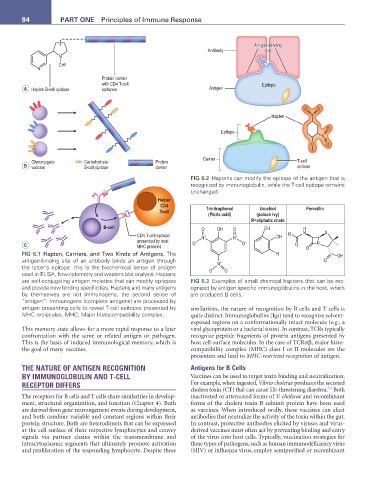
                                                               FIG 6.2  Haptens can modify the epitope of the antigen that is
                                                               recognized by immunoglobulin, while the T-cell epitope remains
                                                               unchanged.
                                                     Helper
                                                     CD4            Trinitrophenol    Urushiol       Penicillin
                                                     Tcell
                                                                     (Picric acid)   (poison ivy)
                                                                                   R=aliphatic chain
                                   B-cell                          O    OH   O         OH           H
                                              CD4 T-cell epitope   N +       N +           OH  R    N      S
                                              presented by host  –               –                       N
         A C                                  MHC proteins      O               O                 O  O
        FIG 6.1  Hapten, Carriers, and Two Kinds of Antigens. The                          R                   OH
        antigen-binding site of an antibody binds an antigen through     +                                 O
        the latter’s epitope: this is the biochemical sense of antigen   –  N
        used in ELISA, flow-cytometry and western blot analysis. Haptens   O  O
        are self-conjugating antigen moieties that can modify epitopes   FIG 6.3  Examples of small chemical haptens that can be rec-
        and provide new binding specificities. Haptens and many antigens   ognized by antigen specific immunoglobulins in the host, which
        by themselves are not immunogens, the second sense of   are produced B cells.
        “antigen”. Immunogens (complete antigens) are processed by
        antigen presenting cells to reveal T-cell epitopes presented by   similarities, the nature of recognition by B cells and T cells is
        MHC molecules. MHC, Major histocompatibility complex.   quite distinct. Immunoglobulins (Igs) tend to recognize solvent-
                                                               exposed regions on a conformationally intact molecule (e.g., a
        This memory state allows for a more rapid response to a later   viral glycoprotein or a bacterial toxin). In contrast, TCRs typically
        confrontation  with  the  same  or related antigen or  pathogen.   recognize peptide fragments of protein antigens presented by
        This is the basis of induced immunological memory, which is   host cell-surface molecules. In the case of TCRαβ, major histo-
        the goal of many vaccines.                             compatibility complex (MHC) class I or II molecules are the
                                                               presenters and lead to MHC-restricted recognition of antigen.
        THE NATURE OF ANTIGEN RECOGNITION                      Antigens for B Cells
        BY IMMUNOGLOBULIN AND T-CELL                           Vaccines can be used to target toxin binding and neutralization.
        RECEPTOR DIFFERS                                       For example, when ingested, Vibrio cholerae produces the secreted
                                                                                                            3,4
                                                               cholera toxin (CT) that can cause life-threatening diarrhea.  Both
        The receptors for B cells and T cells share similarities in develop-  inactivated or attenuated forms of V. cholerae and recombinant
        ment, structural organization, and function (Chapter 4). Both   forms of the cholera toxin B subunit protein have been used
        are derived from gene rearrangement events during development,   as vaccines. When introduced orally, these vaccines can elicit
        and both combine variable and constant regions within their   antibodies that neutralize the activity of the toxin within the gut.
        protein structure. Both are heterodimers that can be expressed   In contrast, protective antibodies elicited by viruses and virus-
        at the cell surface of their respective lymphocytes and convey   derived vaccines most often act by preventing binding and entry
        signals via partner chains within  the transmembrane and   of the virus into host cells. Typically, vaccination strategies for
        intracytoplasmic segments that ultimately promote activation   these types of pathogens, such as human immunodeficiency virus
        and proliferation of the responding lymphocyte. Despite these   (HIV) or influenza virus, employ semipurified or recombinant

