


Page 1354 - Clinical Immunology_ Principles and Practice ( PDFDrive )
P. 1354
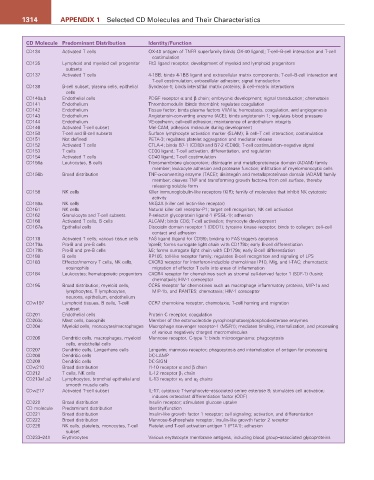
1314         APPENDIX 1  Selected CD Molecules and Their Characteristics


          CD Molecule Predominant Distribution    Identity/Function
          CD134      Activated T cells            OX-40 antigen of TNFR superfamily (binds OX-40 ligand); T-cell–B-cell interaction and T-cell
                                                   costimulation
          CD135      Lymphoid and myeloid cell progenitor   Flt3 ligand receptor; development of myeloid and lymphoid progenitors
                       subsets
          CD137      Activated T cells            4-1BB; binds 4-1BB ligand and extracellular matrix components; T-cell–B-cell interaction and
                                                   T-cell costimulation; extracellular adhesion; signal transduction
          CD138      B-cell subset, plasma cells, epithelial   Syndecan-1; binds interstitial matrix proteins; B cell–matrix interactions
                       cells
          CD140a,b   Endothelial cells            PDGF receptor α and β chain; embryonic development; signal transduction; chemotaxis
          CD141      Endothelium                  Thrombomodulin (binds thrombin); regulates coagulation
          CD142      Endothelium                  Tissue factor; binds plasma factors VII/VIIa; hemostasis, coagulation, and angiogenesis
          CD143      Endothelium                  Angiotensin-converting enzyme (ACE); binds angiotensin 1; regulates blood pressure
          CD144      Endothelium                  VE-cadherin; cell–cell adhesion; maintenance of endothelium integrity
          CD146      Activated T-cell subset      Mel-CAM, adhesion molecule during development
          CD150      T-cell and B-cell subsets    Surface lymphocyte activation marker (SLAM); B cell–T cell interaction; costimulation
          CD151      Not defined                  PETA-3; regulates platelet aggregation and mediator release
          CD152      Activated T cells            CTLA-4; binds B7-1 (CD80) and B7-2 (CD86); T-cell costimulation–negative signal
          CD153      T cells                      CD30 ligand; T-cell activation, differentiation, and regulation
          CD154      Activated T cells            CD40 ligand; T-cell costimulation
          CD156a     Leukocytes, B cells          Transmembrane glycoprotein; disintegrin and metalloproteinase domain (ADAM) family
                                                   member; leukocyte adhesion and protease function; infiltration of myelomonocytic cells
          CD156b     Broad distribution           TNF-α-converting enzyme (TACE); disintegrin and metalloproteinase domain (ADAM) family
                                                   member; cleaves TNF and transforming growth factor-α from cell surface, thereby
                                                   releasing soluble form
          CD158      NK cells                     Killer immunoglobulin-like receptors (KIR); family of molecules that inhibit NK cytotoxic
                                                   activity
          CD159a     NK cells                     NKG2A (killer cell lectin-like receptor)
          CD161      NK cells                     Natural killer cell receptor-P1; target cell recognition; NK cell activation
          CD162      Granulocyte and T-cell subsets  P-selectin glycoprotein ligand-1 (PSGL-1); adhesion
          CD166      Activated T cells, B cells   ALCAM; binds CD6; T-cell activation; thymocyte development
          CD167a     Epithelial cells             Discoidin domain receptor 1 (DDD1); tyrosine kinase receptor; binds to collagen; cell–cell
                                                   contact and adhesion
          CD178      Activated T cells; various tissue cells  FAS ligand (ligand for CD95); binding to FAS triggers apoptosis
          CD179a     Pro-B and pre-B cells        VpreB; forms surrogate light chain with CD179b; early B-cell differentiation
          CD179b     Pro-B and pre-B cells        λ5; forms surrogate light chain with CD179a; early B-cell differentiation
          CD180      B cells                      RP105; toll-like receptor family; regulates B-cell recognition and signaling of LPS
          CD183      Effector/memory T cells, NK cells,   CXCR3 receptor for interferon-inducible chemokines IP10, Mig, and I-TAC; chemotactic
                       eosinophils                 migration of effector T cells into areas of inflammation
          CD184      Leukocytes; hematopoietic progenitors  CXCR4 receptor for chemokines such as stromal cell-derived factor 1 (SDF-1) (fusin);
                                                   chemotaxis; HIV-1 coreceptor
          CD195      Broad distribution; myeloid cells,   CCR5 receptor for chemokines such as macrophage inflammatory proteins, MIP-1a and
                       lymphocytes, T lymphocytes,   MIP-1b, and RANTES; chemotaxis; HIV-1 coreceptor
                       neurons, epithelium, endothelium
          CDw197     Lymphoid tissues, B cells, T-cell    CCR7 chemokine receptor; chemotaxis; T-cell homing and migration
                       subset
          CD201      Endothelial cells            Protein C receptor; coagulation
          CD203c     Mast cells, basophils        Member of the ectonucleotide pyrophosphatase/phosphodiesterase enzymes
          CD204      Myeloid cells, monocytes/macrophages  Macrophage scavenger receptor-1 (MSR1); mediates binding, internalization, and processing
                                                   of various negatively charged macromolecules
          CD206      Dendritic cells, macrophages, myeloid   Mannose receptor, C-type 1; binds microorganisms; phagocytosis
                       cells, endothelial cells
          CD207      Dendritic cells, Langerhans cells  Langerin; mannose receptor; phagocytosis and internalization of antigen for processing
          CD208      Dendritic cells              DC-LAMP
          CD209      Dendritic cells              DC-SIGN
          CDw210     Broad distribution           I1-10 receptor α and β chain
          CD212      T cells, NK cells            IL-12 receptor β 1  chain
          CD213a1,a2  Lymphocytes, bronchial epithelial and   IL-13 receptor α 1  and α 2  chains
                       smooth muscle cells
          CDw217     Activated T-cell subset      IL-17; cytotoxic T-lymphocyte–associated serine esterase 8; stimulates cell activation;
                                                   induces osteoclast differentiation factor (ODF)
          CD220      Broad distribution           Insulin receptor; stimulates glucose uptake
          CD molecule  Predominant distribution   Identity/function
          CD221      Broad distribution           Insulin-like growth factor 1 receptor; cell signaling; activation, and differentiation
          CD222      Broad distribution           Mannose-6-phosphate receptor; insulin-like growth factor 2 receptor
          CD226      NK cells, platelets, monocytes, T-cell   Platelet and T-cell activation antigen 1 (PTA1); adhesion
                       subset
          CD233–241  Erythrocytes                 Various erythrocyte membrane antigens, including blood group–associated glycoproteins

