


Page 62 - Clinical Immunology_ Principles and Practice ( PDFDrive )
P. 62
CHaPTEr 3  Innate Immunity                47


               KEY CONCEPTS                                        TABLE 3.3  Classes of Pattern recognition
            Pattern Recognition Receptors (PRRs)                   receptors (Prrs)

            •  Toll-like receptors consist of an extracellular domain containing leucine-  Pattern
              rich repeats (LRRs) for ligand binding and a cytoplasmic Toll/IL-1 receptor   recognition
              domain that links to adapter proteins and complex signaling   receptor              Ligand
              pathways.                                            Toll-like receptors   TLR1/2   Triacyl lipopeptides
            •  Nucleotide oligomerization domain (NOD)-like receptors are a family   (TLRs)  TLR2  Zymosan
              of 22 proteins that contain LRRs for potential ligand binding, a NOD,   TLR3        dsRNA
              and a caspase activation and recruitment domain (CARD), Pyrin domain,   TLR4        LPS, RSV glycoprotein,
              or a baculovirus inhibitor of apoptosis repeat (BIR) domain for initiation           HSPs, pneumolysin
              of signaling.                                                        TLR2/6         Diacyl lipopeptide
            •  Retinoic  acid-inducible  gene  (RIG)-like  receptors  consist  of  two   TLR7     ssRNA
              N-terminal CARD for signaling and an RNA helicase domain.            TLR8           ssRNA
                                           2+
            •  C-type lectin receptors (CLRs) contain a C (Ca )-type recognition domain   TLR9    dsDNA, hemozoin
              and mediate diverse functions, depending on the signaling pathways   TLR10          ?
              they activate.
            •  Scavenger receptors are a diverse group of receptors that recognize   NOD-like receptors   TLR11  Profilin-like protein
                                                                                   NOD1
                                                                                                  DAP, MDP
              a variety of ligands and mediate the uptake of oxidized lipoproteins   (NLRs)  NOD2  MDP
              and may be involved in atherosclerotic plaque formation.
                                                                                   CIITA          ?
                                                                                   NAIP           Legionella pneumophilia,
                                                                                                   flagellin?
                                                                                   IPAF           PAMPs
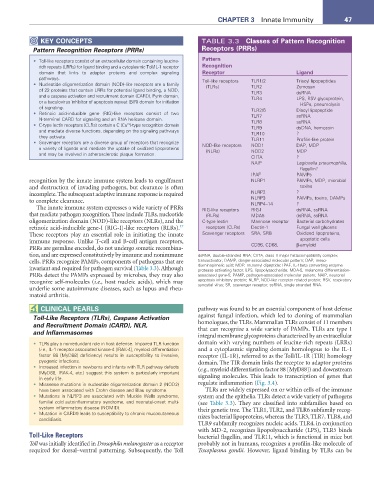
           recognition by the innate immune system leads to engulfment             NLRP1          PAMPs, MDP, microbial
           and destruction of invading pathogens, but clearance is often                           toxins
           incomplete. The subsequent adaptive immune response is required         NLRP2          ?
           to complete clearance.                                                  NLRP3          PAMPs, toxins, DAMPs
                                                                                   NLRP4–14
                                                                                                  ?
             The innate immune system expresses a wide variety of PRRs   RIG-like receptors   RIG-I  dsRNA, ssRNA
           that mediate pathogen recognition. These include TLRs, nucleotide   (RLRs)  MDA5       dsRNA, ssRNA
           oligomerization domain (NOD)-like receptors (NLRs), and the   C-type lectin   Mannose receptor  Bacterial carbohydrates
                                                            47
           retinoic acid-inducible gene-I (RIG-I)-like receptors (RLRs).    receptors (CLRs)  Dectin-1  Fungal wall glucans
           These receptors play an essential role in initiating the innate   Scavenger receptors  SRA, SRB  Oxidized lipoproteins,
           immune response. Unlike T-cell and B-cell antigen receptors,                            apoptotic cells
           PRRs are germline encoded, do not undergo somatic recombina-            CD36, CD68,    β-amyloid
           tion, and are expressed constitutively by immune and nonimmune   dsRNA, double-stranded RNA; CIITA, class II major histocompatibility complex
           cells. PRRs recognize PAMPs, components of pathogens that are   transactivator; DAMP, danger-associated molecular pattern; DAP, meso-
           invariant and required for pathogen survival (Table 3.3). Although   diaminopimelic acid; MDP, muramyl dipeptide; IPAF, IL-1beta converting enzyme
                                                                  protease activating factor; LPS, lipopolysaccharide; MDA-5, melanoma differentiation-
           PRRs detect the PAMPs expressed by microbes, they may also   associated gene-5; PAMP, pathogen-associated molecular pattern; NAIP, neuronal
           recognize self-molecules (i.e., host nucleic acids), which  may   apoptosis inhibitory protein; NLRP, NOD-like receptor related protein; RSV, respiratory
                                                                  syncytial virus; SR, scavenger receptor; ssRNA, single stranded RNA.
           underlie some autoimmune diseases, such as lupus and rheu-
           matoid arthritis.
               CLINICaL PEarLS                                    pathway was found to be an essential component of host defense
            Toll-Like Receptors (TLRs), Caspase Activation        against fungal infection, which led to cloning of mammalian
            and Recruitment Domain (CARD), NLR,                   homologues, the TLRs. Mammalian TLRs consist of 11 members
            and Inflammasomes                                     that can recognize a wide variety of PAMPs. TLRs are type 1
                                                                  integral membrane glycoproteins characterized by an extracellular
            •  TLRs play a nonredundant role in host defense. Impaired TLR function   domain with varying numbers of leucine-rich repeats (LRRs)
              (i.e., IL-1 receptor associated kinase-4 [IRAK-4], myeloid differentiation   and a cytoplasmic signaling domain homologous to the IL-1
              factor 88 [MyD88] deficiency) results in susceptibility to invasive,   receptor (IL-1R), referred to as the Toll/IL-1R (TIR) homology
              pyogenic infections.                                domain. The TIR domain links the receptor to adaptor proteins
            •  Increased infection in newborns and infants with TLR pathway defects   (e.g., myeloid differentiation factor 88 [MyD88]) and downstream
              (MyD88, IRAK-4, etc.) suggest this system is particularly important
              in early life.                                      signaling molecules. This leads to transcription of genes that
            •  Missense mutations in nucleotide oligomerization domain 2 (NOD2)   regulate inflammation (Fig. 3.4).
              have been associated with Crohn disease and Blau syndrome.  TLRs are widely expressed on or within cells of the immune
            •  Mutations in NLRP3 are associated with Muckle Wells syndrome,   system and the epithelia. TLRs detect a wide variety of pathogens
              familial cold autoinflammatory syndrome, and neonatal-onset multi-  (see  Table 3.3). They are classified into subfamilies based on
              system inflammatory disease (NOMID).                their genetic tree. The TLR1, TLR2, and TLR6 subfamily recog-
            •  Mutation in CARD9 leads to susceptibility to chronic mucocutaneous
              candidiasis.                                        nizes bacterial lipoproteins, whereas the TLR3, TLR7, TLR8, and
                                                                  TLR9 subfamily recognizes nucleic acids. TLR4, in conjunction
                                                                  with MD-2, recognizes lipopolysaccharide (LPS), TLR5 binds
           Toll-Like Receptors                                    bacterial flagellin, and TLR11, which is functional in mice but
           Toll was initially identified in Drosophila melanogaster as a receptor   probably not in humans, recognizes a profilin-like molecule of
           required for dorsal–ventral patterning. Subsequently, the Toll   Toxoplasma gondii. However, ligand binding by TLRs can be

