


Page 63 - Clinical Immunology_ Principles and Practice ( PDFDrive )
P. 63
48           ParT ONE  Principles of Immune Response


                         Toll-like receptor                    increased expression of MHC molecules along with expression
                         IL-1/18 receptor                      of costimulatory molecules (e.g., B7–1, B7–2, and IL-12p70)
                                                               results in subsequent development of adaptive immune responses.
                                  Leucine-rich repeats (LRR)   IL-12p70 stimulates IFN-γ production by T cells, which further
                                  ligand binding               augments the microbicidal activities of phagocytes. Stimulation
                                                               of TLR3, -7, -8, and -9 elicits the production of proinflammatory
                                                               cytokines, as well as type 1 IFNs, which play a crucial role in
                                Toll-IL-1 receptor             innate antiviral immunity and also influence adaptive immune
                                Domain (TIR)                   responses.
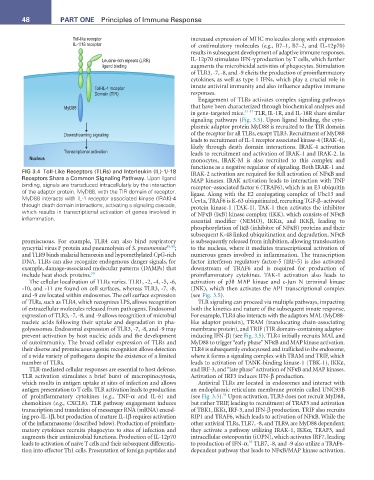
                                                                  Engagement of TLRs activates complex signaling pathways
                      MyD88                                    that have been characterized through biochemical analyses and
                                                               in gene-targeted mice. 51-53  TLR, IL-1R, and IL-18R share similar
                                                               signaling pathways (Fig. 3.5). Upon ligand binding, the cyto-
                                                               plasmic adaptor protein MyD88 is recruited to the TIR domain
                      Downstreaming signaling                  of the receptor for all TLRs, except TLR3. Recruitment of MyD88
                                                               leads to recruitment of IL-1 receptor associated kinase-4 (IRAK-4),
                                                               likely through death domain interactions. IRAK-4 activation
                      Transcriptional activation               leads to recruitment and activation of IRAK-1 and IRAK-2. In
           Nucleus                                             monocytes, IRAK-M  is  also  recruited  to this  complex  and
                                                               functions as a negative regulator of signaling. Both IRAK-1 and
        FIG 3.4  Toll-Like Receptors (TLRs) and Interleukin (IL)-1/-18   IRAK-2 activation are required for full activation of NFκB and
        Receptors Share a Common Signaling Pathway. Upon ligand   MAP kinases. IRAK activation leads to interaction with TNF
        binding, signals are transduced intracellularly by the interaction   receptor–associated factor 6 (TRAF6), which is an E3 ubiquitin
        of the adaptor protein, MyD88, with the TIR domain of receptor.   ligase. Along with the E2 conjugating complex of Ubc13 and
        MyD88 interacts with IL-1 receptor associated kinase (IRAK)-4   Uev1a, TRAF6 is K-63 ubiquitinated, recruiting TGF-β–activated
        through death domain interactions, activating a signaling cascade,   protein kinase-1 (TAK-1). TAK-1 then activates the inhibitor
        which results in transcriptional activation of genes involved in   of NFκB (IκB) kinase complex (IKK), which consists of NFκB
        inflammation.                                          essential  modifier  (NEMO),  IKKα,  and  IKKβ,  leading  to
                                                               phosphorylation of IκB (inhibitor of NFκB) proteins and their
                                                               subsequent K-48 linked ubiquitination and degradation. NFκB
        promiscuous. For example, TLR4 can also bind respiratory   is subsequently released from inhibition, allowing translocation
        syncytial virus F protein and pneumolysin of S. pneumoniae 48,49 ;   to the nucleus, where it mediates transcriptional activation of
        and TLR9 binds malarial hemozoin and hypomethylated CpG-rich   numerous genes involved in inflammation. The transcription
        DNA. TLRs can also recognize endogenous danger signals, for   factor interferon regulatory factor-5 (IRF-5) is also activated
        example, damage-associated molecular patterns (DAMPs) that   downstream of TRAF6 and is required for production of
        include heat shock proteins. 50                        proinflammatory cytokines. TAK-1 activation also leads to
           The cellular localization of TLRs varies. TLR1, -2, -4, -5, -6,   activation of p38 MAP kinase and c-Jun N terminal kinase
        -10, and -11 are found on cell surfaces, whereas TLR3, -7, -8,   (JNK), which then activates the AP1 transcriptional complex
        and -9 are located within endosomes. The cell surface expression   (see Fig. 3.5).
        of TLRs, such as TLR4, which recognizes LPS, allows recognition   TLR signaling can proceed via multiple pathways, impacting
        of extracellular molecules released from pathogens. Endosomal   both the kinetics and nature of the subsequent innate response.
        expression of TLR3, -7, -8, and -9 allows recognition of microbial   For example, TLR4 also interacts with the adaptors MAL (MyD88-
        nucleic acids following their uptake and degradation in pha-  like adaptor protein), TRAM (translocating chain-associating
        golysosomes. Endosomal expression of TLR3, -7, -8, and -9 may   membrane protein), and TRIF (TIR domain–containing adaptor-
        prevent activation by host nucleic acids and the development   inducing IFN-β) (see Fig. 3.5). TLR4 initially recruits MAL and
        of autoimmunity. The broad cellular expression of TLRs and   MyD88 to trigger “early phase” NFκB and MAP kinase activation.
        their diverse and promiscuous agonist recognition allows detection   TLR4 is subsequently endocytosed and trafficked to the endosome,
        of a wide variety of pathogens despite the existence of a limited   where it forms a signaling complex with TRAM and TRIF, which
        number of TLRs.                                        leads to activation of TANK-binding kinase-1 (TBK-1), IKKε,
           TLR-mediated cellular responses are essential to host defense.   and IRF-3, and “late phase” activation of NFκB and MAP kinases.
        TLR activation stimulates a brief burst of macropinocytosis,   Activation of IRF3 induces IFN-β production.
        which results in antigen uptake at sites of infection and allows   Antiviral TLRs are located in endosomes and interact with
        antigen presentation to T cells. TLR activation leads to production   an endoplasmic reticulum membrane protein called UNC93B
                                                                          54
        of  proinflammatory  cytokines  (e.g.,  TNF-α  and  IL-6)  and   (see Fig. 3.5).  Upon activation, TLR3 does not recruit MyD88,
        chemokines (e.g., CXCL8). TLR pathway engagement induces   but rather TRIF, leading to recruitment of TRAF3 and activation
        transcription and translation of messenger RNA (mRNA) encod-  of TBK1, IKKι, IRF-3, and IFN-β production. TRIF also recruits
        ing pro-IL-1β, but production of mature IL-1β requires activation   RIP1 and TRAF6, which leads to activation of NFκB. While the
        of the inflammasome (described below). Production of proinflam-  other antiviral TLRs, TLR7, -8, and TLR9, are MyD88 dependent;
        matory cytokines recruits phagocytes to sites of infection and   they activate a pathway utilizing IRAK-1, IKKα, TRAF3, and
        augments their antimicrobial functions. Production of IL-12p70   intracellular osteopontin (iOPN), which activates IRF7, leading
                                                                                  55
        leads to activation of naïve T cells and their subsequent differentia-  to production of IFN-α.  TLR7, -8, and -9 also utilize a TRAF6-
        tion into effector Th1 cells. Presentation of foreign peptides and   dependent pathway that leads to NFκB/MAP kinase activation.

