


Page 64 - Clinical Immunology_ Principles and Practice ( PDFDrive )
P. 64
CHaPTEr 3  Innate Immunity                49


                                    TLR4
                     TLR5


                                 MAL   TRAM                    TLR3
                            MyD88                                        Endosomes
                                             TRIF                                   TLR7,8,9
                 MyD88         Early
                            IRAK4         Late                    UNC93B
                        IRAK1  IRAK2                                            UNC93B
                                            TRAF3    TRAF3  TRIF
                                                            RIP1                        MyD88     TRAF3
                    IRF5    TRAF6                                TRAF6            BTK                  OPNi
                            TAK1    MAPKs                                             IRAK4  IRAK1  IKKα
                                                                 TAK1    MAPKs
                                           TBK1/IKKι  TBK1/IKKι
                                                                            IRF5   TRAF6
                            IKK                                                     TAK1    MAPKs      IRF7


                                                                  IKK                IKK
                                     AP1         IRF3
                            IκB                                   IκB                IκB     AP1
                            NF-κB
                                                                 NF-κB              NF-κB


                Nucleus  Proinflammatory         Type 1                     Proinflammatory            Type 1
                           cytokines            interferons                   cytokines               interferons

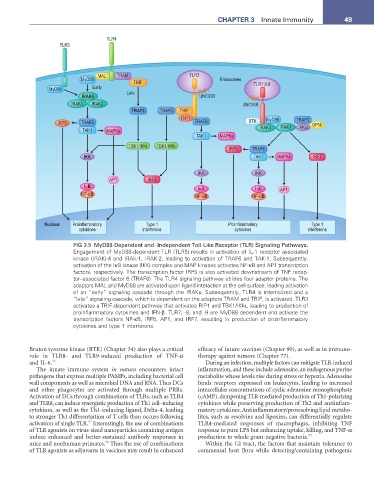
                         FIG 3.5  MyD88-Dependent and -Independent Toll-Like Receptor (TLR) Signaling Pathways.
                         Engagement of MyD88-dependent TLR (TLR5) results in activation of IL-1 receptor associated
                         kinase (IRAK)-4 and IRAK-1, IRAK-2, leading to activation of TRAF6 and TAK-1. Subsequently,
                         activation of the IκB kinase (IKK) complex and MAP kinases activates NF-κB and AP1 transcription
                         factors, respectively. The transcription factor IRF5 is also activated downstream of TNF recep-
                         tor–associated factor 6 (TRAF6). The TLR4 signaling pathway utilizes four adaptor proteins. The
                         adaptors MAL and MyD88 are activated upon ligand interaction at the cell surface, leading activation
                         of an “early” signaling cascade through the IRAKs. Subsequently, TLR4 is internalized and a
                         “late” signaling cascade, which is dependent on the adaptors TRAM and TRIF, is activated. TLR3
                         activates a TRIF-dependent pathway that activates RIP1 and TBK1/IKKι, leading to production of
                         proinflammatory cytokines and IFN-β. TLR7, -8, and -9 are MyD88 dependent and activate the
                         transcription factors NF-κB, IRF5, AP1, and IRF7, resulting in production of proinflammatory
                         cytokines and type 1 interferons.


           Bruton tyrosine kinase (BTK) (Chapter 34) also plays a critical   efficacy of future vaccines (Chapter 90), as well as in immuno-
           role in TLR8- and TLR9-induced production of TNF-α     therapy against tumors (Chapter 77).
           and IL-6. 56                                             During an infection, multiple factors can mitigate TLR-induced
             The innate immune system  in natura encounters intact   inflammation, and these include adenosine, an endogenous purine
           pathogens that express multiple PAMPs, including bacterial cell   metabolite whose levels rise during stress or hypoxia. Adenosine
           wall components as well as microbial DNA and RNA. Thus DCs   binds receptors expressed on leukocytes, leading to increased
           and other phagocytes are activated through multiple PRRs.   intracellular concentrations of cyclic adenosine monophosphate
           Activation of DCs through combinations of TLRs, such as TLR4   (cAMP), dampening TLR-mediated production of Th1-polarizing
           and TLR8, can induce synergistic production of Th1 cell–inducing   cytokines while preserving production of Th2 and antiinflam-
           cytokines, as well as the Th1-inducing ligand, Delta-4, leading   matory cytokines. Antiinflammatory/proresolving lipid metabo-
           to stronger Th1 differentiation of T cells than occurs following   lites, such as resolvins and lipoxins, can differentially regulate
                              57
           activation of single TLR.  Interestingly, the use of combinations   TLR4-mediated responses of macrophages, inhibiting TNF
           of TLR agonists on virus-sized nanoparticles containing antigen   response to pure LPS but enhancing uptake, killing, and TNF-α
           induce enhanced and better-sustained antibody responses in   production to whole gram-negative bacteria. 59
                                   58
           mice and nonhuman primates.  Thus the use of combinations   Within the GI tract, the factors that maintain tolerance to
           of TLR agonists as adjuvants in vaccines may result in enhanced   commensal  host  flora  while  detecting/containing  pathogenic

