


Page 595 - Clinical Immunology_ Principles and Practice ( PDFDrive )
P. 595
CHaPTEr 41  Immunological Mechanisms of Airway Diseases and Pathways to Therapy                      573


           positive skin testing to fungal antigens or elevated serum fungal-  agents potentially useful in the management of rhinitis include
           antigen-specific IgE titers. Imaging consistent with  AFRS is   oral steroids, oral leukotriene (LT) receptor antagonists, intranasal
           obtained by CT and magnetic resonance imaging (MRI). Fulfilling   chromones, and intranasal ipratropium bromide. 8
           the remaining criteria for AFRS requires histological examination   In addition to pharmaceutical approaches, allergen immu-
           and microbiology for fungi within the mucin and tissue obtained   notherapy offers a means of providing long-term relief from
           at the time of surgery. 5                              rhinitis (Chapter 91). Two types of immunotherapy are available:
                                                                  subcutaneous immunotherapy (SCIT) and sublingual immu-
               KEY CONCEPTS                                       notherapy (SLIT). An important concern associated with the
                                                                  use of SCIT is anaphylaxis, whereas this risk is probably much
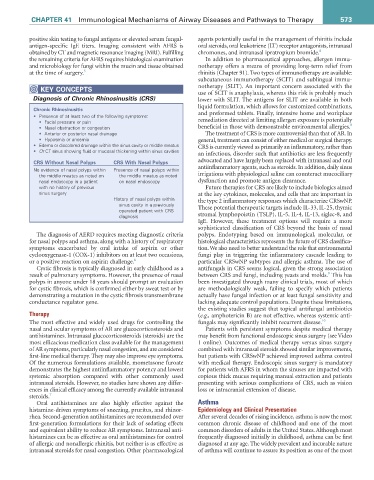
            Diagnosis of Chronic Rhinosinusitis (CRS)             lower with SLIT. The antigens for SLIT are available in both
                                                                  liquid formulation, which allows for customized combinations,
            Chronic rhinosinusitis
            •  Presence of at least two of the following symptoms:  and preformed tablets. Finally, intensive home and workplace
              •  Facial pressure or pain                          remediation directed at limiting allergen exposure is potentially
                                                                                                                    8
              •  Nasal obstruction or congestion                  beneficial in those with demonstrable environmental allergies.
              •  Anterior or posterior nasal drainage               The treatment of CRS is more controversial than that of AR. In
              •  Hyposmia or anosmia                              general, treatment can consist of either medical or surgical therapy.
            •  Edema or discolored drainage within the sinus cavity or middle meatus  CRS is currently viewed as primarily an inflammatory, rather than
            •  Or CT sinus showing fluid or mucosal thickening within sinus cavities
                                                                  an infectious, disorder such that antibiotics are less frequently
            CrS Without Nasal Polyps  CrS With Nasal Polyps       advocated and have largely been replaced with intranasal and oral
            No evidence of nasal polyps within   Presence of nasal polyps within   antiinflammatory agents, such as steroids. In addition, daily sinus
              the middle meatus as noted on   the middle meatus as noted   irrigations with physiological saline can counteract mucociliary
              nasal endoscopy in a patient   on nasal endoscopy   dysfunction and promote antigen clearance.
              with no history of previous                           Future therapies for CRS are likely to include biologics aimed
              sinus surgery                                       at the key cytokines, molecules, and cells that are important in
                                      History of nasal polyps within   the type 2 inflammatory responses which characterize CRSwNP.
                                        sinus cavity in a previously   These potential therapeutic targets include IL-33, IL-25, thymic
                                        operated patient with CRS
                                        diagnosis                 stromal lymphopoietin (TSLP), IL-5, IL-4, IL-13, siglec-8, and
                                                                  IgE. However, these treatment options will require a more
                                                                  sophisticated classification of CRS beyond the basis of nasal
             The diagnosis of AERD requires meeting diagnostic criteria   polyps. Endotyping based on immunological, molecular, or
           for nasal polyps and asthma, along with a history of respiratory   histological characteristics represents the future of CRS classifica-
           symptoms  exacerbated  by  oral  intake  of  aspirin  or  other   tion. We also need to better understand the role that environmental
           cyclooxygenase-1 (COX-1) inhibitors on at least two occasions,   fungi play in triggering the inflammatory cascade leading to
           or a positive reaction on aspirin challenge. 6         particular CRSwNP subtypes and allergic asthma. The use of
             Cystic fibrosis is typically diagnosed in early childhood as a   antifungals in CRS seems logical, given the strong association
                                                                                                            9
           result of pulmonary symptoms. However, the presence of nasal   between CRS and fungi, including yeasts and molds.  This has
           polyps in anyone under 18 years should prompt an evaluation   been investigated through many clinical trials, most of which
           for cystic fibrosis, which is confirmed either by sweat test or by   are methodologically weak, failing to specify which patients
           demonstrating a mutation in the cystic fibrosis transmembrane   actually have fungal infection or at least fungal sensitivity and
           conductance regulator gene.                            lacking adequate control populations. Despite these limitations,
                                                                  the existing studies suggest that topical antifungal antibiotics
           Therapy                                                (e.g., amphotericin B) are not effective, whereas systemic anti-
           The most effective and widely used drugs for controlling the   fungals may significantly inhibit recurrent disease. 10
           nasal and ocular symptoms of AR are glucocorticosteroids and   Patients with persistent symptoms despite medical therapy
           antihistamines. Intranasal glucocorticosteroids (steroids) are the   may benefit from functional endoscopic sinus surgery (see Video
           most efficacious medication class available for the management   1 online). Outcomes of medical therapy versus sinus surgery
           of AR symptoms, particularly nasal congestion, and are considered   combined with intranasal steroids showed similar improvements,
           first-line medical therapy. They may also improve eye symptoms.   but patients with CRSwNP achieved improved asthma control
           Of the numerous formulations available, mometasone furoate   with medical therapy. Endoscopic sinus surgery is mandatory
           demonstrates the highest antiinflammatory potency and lowest   for patients with AFRS in whom the sinuses are impacted with
           systemic  absorption  compared  with  other  commonly  used   copious thick mucus requiring manual extraction and patients
           intranasal steroids. However, no studies have shown any differ-  presenting with serious complications of CRS, such as vision
           ences in clinical efficacy among the currently available intranasal   loss or intracranial extension of disease.
           steroids. 7
             Oral  antihistamines  are  also  highly  effective  against  the   Asthma
           histamine-driven symptoms of sneezing, pruritus, and rhinor-  Epidemiology and Clinical Presentation
           rhea. Second-generation antihistamines are recommended over   After several decades of rising incidence, asthma is now the most
           first-generation formulations for their lack of sedating effects   common  chronic  disease  of  childhood  and  one  of  the  most
           and equivalent ability to reduce AR symptoms. Intranasal anti-  common disorders of adults in the United States. Although most
           histamines can be as effective as oral antihistamines for control   frequently diagnosed initially in childhood, asthma can be first
           of allergic and nonallergic rhinitis, but neither is as effective as   diagnosed at any age. The widely prevalent and incurable nature
           intranasal steroids for nasal congestion. Other pharmacological   of asthma will continue to assure its position as one of the most

