


Page 597 - Clinical Immunology_ Principles and Practice ( PDFDrive )
P. 597
CHaPTEr 41  Immunological Mechanisms of Airway Diseases and Pathways to Therapy                      575


            TABLE 41.1  Eosinophilic Lung Disorders
                                          Proposed Immune
            Disease        Causative agent  Mechanism
            Loeffler syndrome  Inhaled food,   T cell–mediated
                            infection, or   hypersensitivity
                            medication      reaction
            Drug rash with   Drugs:       Hypersensitivity reaction
             eosinophilia and   sulfonamides,   to drug
             systemic       phenobarbital,
             symptoms       sulfasalazine,
             (DRESS)        carbamazepine,
             syndrome       and phenytoin
            Parasitic infections  Strongyloides spp.,   T-cell and B-cell clonal
                            Wuchereria      activation in response
                            bancrofti,      to parasite antigens
                            Brugia malayi   and adjuvant factors
            Allergic       Aspergillus    Immunoglobulin E (IgE)
             bronchopulmonary               and immune complex
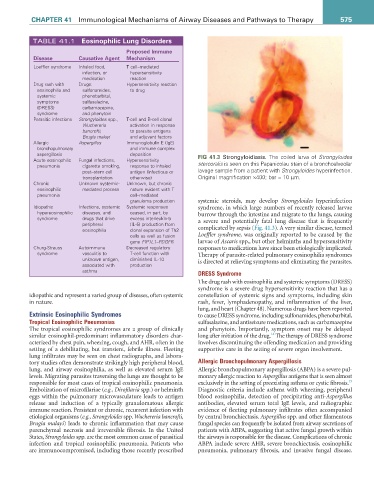
             aspergillosis                  deposition            FIG  41.3  Strongyloidiasis.  The  coiled  larva of  Strongyloides
            Acute eosinophilic   Fungal infections,   Hypersensitivity
             pneumonia      cigarette smoking,   response to inhaled   stercoralis is seen on this Papanicolau stain of a bronchoalveolar
                            post–stem cell   antigen (infectious or   lavage sample from a patient with Strongyloides hyperinfection.
                            transplantation  otherwise)           Original magnification ×400; bar = 10 µm.
            Chronic        Unknown systemic-  Unknown, but chronic
             eosinophilic   mediated process  nature evident with T
             pneumonia                      cell–mediated
                                            granuloma production  systemic steroids, may develop  Strongyloides hyperinfection
            Idiopathic     Infections, systemic   Systemic responses   syndrome, in which large numbers of recently released larvae
             hypereosinophilic   diseases, and   caused, in part, by   burrow through the intestine and migrate to the lungs, causing
             syndrome       drugs that drive   excess interleukin-5   a severe and potentially fatal lung disease that is frequently
                            peripheral      (IL-5) production from
                            eosinophilia    clonal expansion of Th2   complicated by sepsis (Fig. 41.3). A very similar disease, termed
                                            cells as well as fusion   Loeffler syndrome, was originally reported to be caused by the
                                            gene FIP1L1–PDGFR     larvae of Ascaris spp., but other helminths and hypersensitivity
            Churg-Strauss   Autoimmune    Decreased regulatory    responses to medications have since been etiologically implicated.
             syndrome       vasculitis to   T-cell function with   Therapy of parasite-related pulmonary eosinophilia syndromes
                            unknown antigen,   diminished IL-10   is directed at relieving symptoms and eliminating the parasites.
                            associated with   production
                            asthma                                DRESS Syndrome
                                                                  The drug rash with eosinophilia and systemic symptoms (DRESS)
                                                                  syndrome is a severe drug hypersensitivity reaction that has a
           idiopathic and represent a varied group of diseases, often systemic   constellation of systemic signs and symptoms, including skin
           in nature.                                             rash, fever, lymphadenopathy, and inflammation of the liver,
                                                                  lung, and heart (Chapter 48). Numerous drugs have been reported
           Extrinsic Eosinophilic Syndromes                       to cause DRESS syndrome, including sulfonamides, phenobarbital,
           Tropical Eosinophilic Pneumonias                       sulfasalazine, and antiseizure medications, such as carbamazepine
           The tropical eosinophilic syndromes are a group of clinically   and phenytoin. Importantly, symptom onset may be delayed
                                                                                          14
           similar eosinophil-predominant inflammatory disorders char-  long after initiation of the drug.  The therapy of DRESS syndrome
           acterized by chest pain, wheezing, cough, and AHR, often in the   involves discontinuing the offending medication and providing
           setting of a debilitating, but transient, febrile illness. Fleeting   supportive care in the setting of severe organ involvement.
           lung infiltrates may be seen on chest radiographs, and labora-
           tory studies often demonstrate strikingly high peripheral blood,   Allergic Bronchopulmonary Aspergillosis
           lung, and airway eosinophilia, as well as elevated serum IgE   Allergic bronchopulmonary aspergillosis (ABPA) is a severe pul-
           levels. Migrating parasites traversing the lungs are thought to be   monary allergic reaction to Aspergillus antigens that is seen almost
                                                                                                                   15
           responsible for most cases of tropical eosinophilic pneumonia.   exclusively in the setting of preexisting asthma or cystic fibrosis.
           Embolization of microfilariae (e.g., Dirofilaria spp.) or helminth   Diagnostic criteria include asthma with wheezing, peripheral
           eggs within the pulmonary microvasculature leads to antigen   blood eosinophilia, detection of precipitating anti-Aspergillus
           release and induction of a typically granulomatous allergic   antibodies, elevated serum total IgE levels, and radiographic
           immune reaction. Persistent or chronic, recurrent infection with   evidence of fleeting pulmonary infiltrates often accompanied
           etiological organisms (e.g., Strongyloides spp. Wuchereria bancrofti,   by central bronchiectasis. Aspergillus spp. and other filamentous
           Brugia malayi) leads to chronic inflammation that may cause   fungal species can frequently be isolated from airway secretions of
           parenchymal necrosis and irreversible fibrosis. In the United   patients with ABPA, suggesting that active fungal growth within
           States, Strongyloides spp. are the most common cause of parasitical   the airways is responsible for the disease. Complications of chronic
           infection and tropical eosinophilic pneumonia. Patients who   ABPA include severe AHR, severe bronchiectasis, eosinophilic
           are immunocompromised, including those recently prescribed   pneumonia, pulmonary fibrosis, and invasive fungal disease.

