


Page 66 - Clinical Immunology_ Principles and Practice ( PDFDrive )
P. 66
CHaPTEr 3  Innate Immunity                51


             dsRNA-induced activation of RIG-I and MDA-5 induces their      TLR2
           association with a mitochondria-associated adaptor known as
           interferon-β promoter stimulator-1 (IPS-1) or mitochondrial                      Dectin-1        IL-1β
           antiviral signaling  protein (MAVS)  through CARD  domain
           interactions. Downstream effectors include TBK-1 and IKKι,
           which activate IRF3 and IRF7, leading to production of type-1
           interferons (see Fig. 3.6). Of note, live bacteria are more effective
           inducers of STAT-1, type I IFN, and inflammasome pathways    MyD88           ITAM       ITAM
           compared with killed organisms, a property that may reflect the                    Syk
           importance of bacterial RNA to innate recognition of live     IRAK4
           infection. 62                                                                                 ROI
                                                                     IRAK1  IRAK2
           C-Type Lectin Receptors                                                 Raf1  CARD9   MAPKs
           C-type lectin receptors (CLRs) are a diverse group of receptors                               NLRP3
                                2+
           originally identified as Ca -dependent carbohydrate-binding                                 inflammasome
                 63
           proteins.  CLRs are defined as any protein that contains a C-type
           carbohydrate recognition domain (CRD), regardless of calcium- or        NF-κB  NFAT   AP1     Pro-IL-1β
           carbohydrate-binding ability. CLRs include numerous members
           with diverse functions, including cell adhesion, regulation of
           NK-cell function, phagocytosis, endocytosis, platelet activation,
           complement activation, tissue remodeling, and innate immunity.               Cytokine gene transcription
           In myeloid cells, CLRs can mediate internalization of microbes
           to allow for antigen processing and presentation. Some CLRs
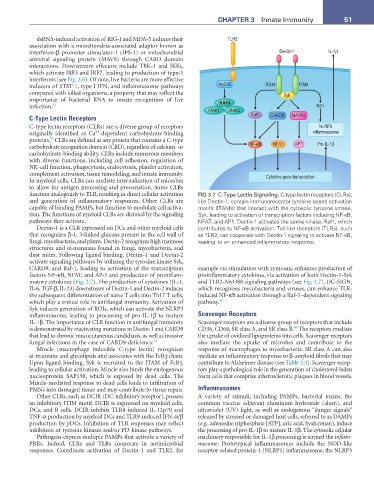
           function analogously to TLR, resulting in direct cellular activation   FIG 3.7  C-Type Lectin Signaling. C-type lectin receptors (CLRs),
           and generation of inflammatory responses. Other CLRs are   like Dectin-1, contain immunoreceptor tyrosine-based activation
           capable of binding PAMPs, but function to modulate cell activa-  motifs (ITAMs) that interact with the cytosolic tyrosine kinase,
           tion. The functions of myeloid CLRs are dictated by the signaling   Syk, leading to activation of transcription factors including NF-κB,
           pathways they activate.                                NFAT, and AP1. Dectin-1 activates the serine kinase, Raf1, which
             Dectin-1 is a CLR expressed on DCs and other myeloid cells   contributes to NF-κB activation. Toll-like receptors (TLRs), such
           that recognizes β-1, 3-linked glucans present in the cell wall of   as TLR2, can cooperate with Dectin-1 signaling to activate NF-κB,
           fungi, mycobacteria, and plants. Dectin-2 recognizes high mannose   leading to an enhanced inflammatory response.
           structures and α-mannans found in fungi, mycobacteria, and
           dust mites. Following ligand binding, Dectin-1 and Dectin-2
           activate signaling pathways by utilizing the tyrosine kinase Syk,
           CARD9, and Raf-1, leading to activation of the transcription   example via stimulation with zymosan, enhances production of
           factors NF-κB, NFAT, and AP-1 and production of proinflam-  proinflammatory cytokines, via activation of both Dectin-1-Syk
           matory cytokines (Fig. 3.7). The production of cytokines (IL-1,   and TLR2-MyD88 signaling pathways (see Fig. 3.7). DC-SIGN,
           IL-6, TGF-β, IL-23) downstream of Dectin-1 and Dectin-2 induces   which recognizes mycobacteria and viruses, can enhance TLR-
           the subsequent differentiation of naïve T cells into Th17 T cells,   induced NF-κB activation through a Raf-1–dependent signaling
           which play a critical role in antifungal immunity. Activation of   pathway. 65
           Syk induces generation of ROIs, which can activate the NLRP3
           inflammasome, leading to processing of pro-IL-1β to mature   Scavenger Receptors
           IL-1β. The importance of CLR function in antifungal immunity   Scavenger receptors are a diverse group of receptors that include
                                                                                                 66
           is demonstrated by inactivating mutations in Dectin-1 and CARD9   CD36, CD68, SR class A, and SR class B.  The receptors mediate
           that lead to chronic mucocutaneous candidiasis, as well as invasive   the uptake of oxidized lipoproteins into cells. Scavenger receptors
           fungal infections in the case of CARD9-deficiency. 64  also mediate the uptake of microbes and contribute to the
             Mincle  (macrophage  inducible  C-type  lectin)  recognizes   response of macrophages to mycobacteria. SR class A can also
           α-mannans and glycolipids and associates with the FcRγ chain.   mediate an inflammatory response to β-amyloid fibrils that may
           Upon ligand binding, Syk is recruited to the ITAM of FcRγ,   contribute to Alzheimer disease (see Table 3.3). Scavenger recep-
           leading to cellular activation. Mincle also binds the endogenous   tors play a pathological role in the generation of cholesterol-laden
           nucleoprotein SAP130, which is exposed by dead cells. The   foam cells that comprise atherosclerotic plaques in blood vessels.
           Mincle-mediated response to dead cells leads to infiltration of
           PMNs into damaged tissue and may contribute to tissue repair.  Inflammasomes
             Other CLRs, such as DCIR (DC-inhibitory receptor), possess   A  variety of  stimuli,  including  PAMPs,  bacterial  toxins,  the
           an inhibitory ITIM motif. DCIR is expressed on myeloid cells,   common vaccine adjuvant aluminum hydroxide (alum), and
           DCs, and B cells. DCIR inhibits TLR8-induced IL-12p70 and   ultraviolet (UV) light, as well as endogenous “danger signals”
           TNF-α production by myeloid DCs and TLR9-induced IFN-α/β   released by stressed or damaged host cells, referred to as DAMPs
           production by pDCs. Inhibition of TLR responses may reflect   (e.g., adenosine triphosphate [ATP], uric acid, hyaluronan), induce
           inhibition of tyrosine kinases and/or PI3 kinase pathways.  the processing of pro-IL-1β to mature IL-1β. The cytosolic cellular
             Pathogens express multiple PAMPs that activate a variety of   machinery responsible for IL-1β processing is termed the inflam-
           PRRs. Indeed, CLRs and TLRs cooperate in antimicrobial   masome. Prototypical inflammasomes include the NOD-like
           responses. Coordinate activation of Dectin-1 and TLR2, for   receptor-related protein-1 (NLRP1) inflammasome, the NLRP3

