


Page 71 - Clinical Immunology_ Principles and Practice ( PDFDrive )
P. 71
56           Part one  Principles of Immune Response


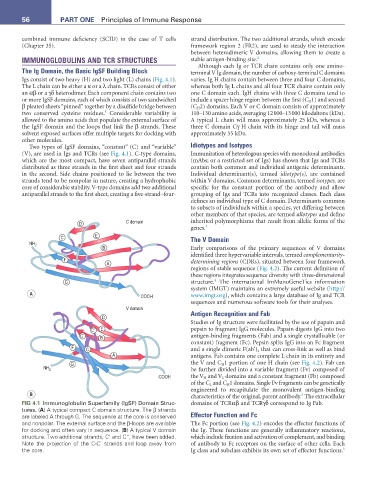
        combined immune deficiency (SCID) in the case of T cells    strand distribution. The two additional strands, which encode
        (Chapter 35).                                          framework region 2 (FR2), are used to steady the interaction
                                                               between heterodimeric V domains, allowing them to create a
        IMMUNOGLOBULINS AND TCR STRUCTURES                     stable antigen-binding site. 2
                                                                  Although each Ig or TCR chain contains only one amino-
        The Ig Domain, the Basic IgSF Building Block           terminal V Ig domain, the number of carboxy-terminal C domains
        Igs consist of two heavy (H) and two light (L) chains (Fig. 4.1).   varies. Ig H chains contain between three and four C domains,
        The L chain can be either a κ or a λ chain. TCRs consist of either   whereas both Ig L chains and all four TCR chains contain only
        an αβ or a γδ heterodimer. Each component chain contains two   one C domain each. IgH chains with three C domains tend to
        or more IgSF domains, each of which consists of two sandwiched   include a spacer hinge region between the first (C H 1) and second
        β pleated sheets “pinned” together by a disulfide bridge between   (C H 2) domains. Each V or C domain consists of approximately
                                   1
        two conserved cysteine residues.  Considerable variability is   110–130 amino acids, averaging 12 000–13 000 kilodaltons (kDa).
        allowed to the amino acids that populate the external surface of   A typical L chain will mass approximately 25 kDa, whereas a
        the IgSF domain and the loops that link the β strands. These   three C domain Cγ H chain with its hinge and tail will mass
        solvent exposed surfaces offer multiple targets for docking with   approximately 55 kDa.
        other molecules.
           Two types of IgSF domains, “constant” (C) and “variable”   Idiotypes and Isotypes
        (V), are used in Igs and TCRs (see Fig. 4.1). C-type domains,   Immunization of heterologous species with monoclonal antibodies
        which are the most compact, have seven antiparallel strands   (mAbs; or a restricted set of Igs) has shown that Igs and TCRs
        distributed as three strands in the first sheet and four strands   contain both common and individual antigenic determinants.
        in the second. Side chains positioned to lie between the two   Individual determinant(s), termed  idiotype(s), are contained
        strands tend to be nonpolar in nature, creating a hydrophobic   within V domains. Common determinants, termed isotypes, are
        core of considerable stability. V-type domains add two additional   specific for the constant portion of the antibody and allow
        antiparallel strands to the first sheet, creating a five-strand–four-  grouping of Igs and TCRs into recognized classes. Each class
                                                               defines an individual type of C domain. Determinants common
                                                               to subsets of individuals within a species, yet differing between
                                                               other members of that species, are termed allotypes and define
                           D              C domain             inherited polymorphisms that result from allelic forms of the
                                                               genes. 3
                     C          E                              The V Domain
           NH 2
                                   B                           Early comparisons of the primary sequences of  V domains
                                                               identified three hypervariable intervals, termed complementarity-
                      F                                        determining regions (CDRs), situated between four framework
                                    A
                                                               regions of stable sequence (Fig. 4.2). The current definition of
                                                               these regions integrates sequence diversity with three-dimensional
                                                                       4
                      G                                        structure.  The  international  ImMunoGeneTics information
                                                               system (IMGT) maintains an extremely useful website (http://
           A
                                               COOH            www.imgt.org), which contains a large database of Ig and TCR
                                                               sequences and numerous software tools for their analyses.
                                          V domain
                                                               Antigen Recognition and Fab
                                  D
                                                               Studies of Ig structure were facilitated by the use of papain and
                               C˝  E                           pepsin to fragment IgG molecules. Papain digests IgG into two
                           C´     B                            antigen-binding fragments (Fab) and a single crystallizable (or
                                                               constant) fragment (Fc). Pepsin splits IgG into an Fc fragment
                        F    C                                 and a single dimeric F(ab’) 2  that can cross-link as well as bind
                                      A                        antigens. Fab contains one complete L chain in its entirety and
                        G                                      the V and C H 1 portion of one H chain (see Fig. 4.2). Fab can
               NH 2                                            be further divided into a variable fragment (Fv) composed of
                                                     COOH      the V H  and V L  domains and a constant fragment (Fb) composed
                                                               of the C L  and C H 1 domains. Single Fv fragments can be genetically
                                                               engineered to recapitulate the monovalent antigen-binding
           B                                                   characteristics of the original, parent antibody.  The extracellular
                                                                                                    5
        FIG 4.1  Immunoglobulin Superfamily (IgSF) Domain Struc-  domains of TCRαβ and TCRγδ correspond to Ig Fab.
        tures. (a) A typical compact C domain structure. The β strands
        are labeled A through G. The sequence at the core is conserved   Effector Function and Fc
        and nonpolar. The external surface and the β-loops are available   The Fc portion (see Fig. 4.2) encodes the effector functions of
        for docking and often vary in sequence. (B) A typical V domain   the Ig. These functions are generally inflammatory reactions,
        structure. Two additional strands, C’ and C”, have been added.   which include fixation and activation of complement, and binding
        Note the projection of the C-C’ strands and loop away from     of antibody to Fc receptors on the surface of other cells. Each
                                                                                                                 6
        the core.                                              Ig class and subclass exhibits its own set of effector functions.

