


Page 73 - Clinical Immunology_ Principles and Practice ( PDFDrive )
P. 73
58           Part one  Principles of Immune Response


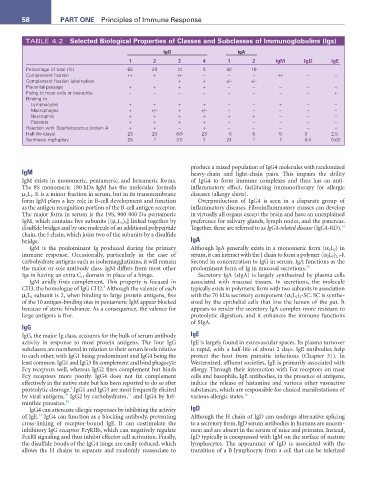
         TABLE 4.2  Selected Biological Properties of Classes and Subclasses of Immunoglobulins (Igs)
                                                       IgG                     Iga
                                           1       2       3       4       1        2      IgM      IgD      Ige
          Percentage of total (%)          65      20      10      5       90      10
          Complement fixation              ++      +       ++      −        −       −       ++       −        −
          Complement fixation (alternative)                +       +       +/−     +/−
          Placental passage                +       +       +       +        −       −       −        −        −
          Fixing to mast cells or basophils  −     −       −       −        −       −       −        −        +
          Binding to:
            Lymphocytes                    +       +       +       +        −       −       +        −        −
            Macrophages                    +       +/−     +       +/−      −       −       −        −        −
            Neutrophils                    +       +       +       +        +       +       −        −        −
            Platelets                      +       +       +       +        −       −       −        −        −
          Reaction with Staphylococcus protein A  +  +     −       +        −       −       −        −        −
          Half-life (days)                 23      23      8-9     23       6       6       5        3       2.5
          Synthesis mg/kg/day              25      ?       3.5     ?       24       ?       7        0.4     0.02


                                                               produce a mixed population of IgG4 molecules with randomized
        IgM                                                    heavy-chain  and light-chain pairs. This impairs the ability
        IgM exists in monomeric, pentameric, and hexameric forms.   of IgG4 to form immune complexes and thus has an anti-
        The 8S monomeric 180 kDa IgM has the molecular formula   inflammatory effect, facilitating immunotherapy for allergic
        µ 2 L 2 . It is a minor fraction in serum, but in its transmembrane   diseases (allergy shots).
        form IgM plays a key role in B-cell development and function   Overproduction  of  IgG4  is  seen  in  a  disparate  group  of
        as the antigen recognition portion of the B-cell antigen receptor.   inflammatory diseases. Fibroinflammatory masses can develop
        The major form in serum is the 19S, 900 000 Da pentameric     in virtually all organs except the brain and have an unexplained
        IgM, which contains five subunits [(µ 2 L 2 ) 5 ] linked together by   preference for salivary glands, lymph nodes, and the pancreas.
        disulfide bridges and by one molecule of an additional polypeptide   Together, these are referred to as IgG4-related disease (IgG4-RD). 14
        chain, the J chain, which joins two of the subunits by a disulfide
        bridge. 7                                              IgA
           IgM  is  the predominant  Ig produced  during  the  primary   Although IgA generally exists in a monomeric form (α 2 L 2 ) in
        immune response. Occasionally, particularly in the case of   serum, it can interact with the J chain to form a polymer (α 2 L 2 ) 2,3 -J.
        carbohydrate antigens such as isohemagglutinins, it will remain   Second in concentration to IgG in serum, IgA functions as the
        the major or sole antibody class. IgM differs from most other   predominant form of Ig in mucosal secretions. 15
        Igs in having an extra C H  domain in place of a hinge.   Secretory IgA (sIgA) is largely synthesized by plasma cells
           IgM avidly fixes complement. This property is focused in   associated with mucosal tissues. In secretions, the molecule
                                   8
        CH3, the homologue of IgG CH2.  Although the valence of each   typically exists in polymeric form with two subunits in association
        µ 2 L 2  subunit is 2, when binding to large protein antigens, five   with the 70 kDa secretory component (α 2 L 2 ) 2 -SC. SC is synthe-
        of the 10 antigen-binding sites in pentameric IgM appear blocked   sized by the epithelial cells that line the lumen of the gut. It
        because of steric hindrance. As a consequence, the valence for   appears to render the secretory IgA complex more resistant to
        large antigens is five.                                proteolytic digestion, and it enhances the immune functions
                                                               of SIgA.
        IgG
        IgG, the major Ig class, accounts for the bulk of serum antibody   IgE
        activity in response to most protein antigens. The four IgG   IgE is largely found in extravascular spaces. Its plasma turnover
        subclasses are numbered in relation to their serum levels relative   is rapid, with a half-life of about 2 days. IgE antibodies help
        to each other, with IgG1 being predominant and IgG4 being the   protect the host from parasitic infections (Chapter 31). In
        least common. IgG1 and IgG3 fix complement and bind phagocyte   Westernized, affluent societies, IgE is primarily associated with
        Fcγ receptors well, whereas IgG2 fixes complement but binds   allergy. Through their interaction with Fcε receptors on mast
        Fcγ receptors more poorly. IgG4 does not fix complement   cells and basophils, IgE antibodies, in the presence of antigens,
        effectively in the native state but has been reported to do so after   induce the release of histamine and various other vasoactive
                        9
        proteolytic cleavage.  IgG1 and IgG3 are most frequently elicited   substances, which are responsible for clinical manifestations of
                                           11
                      10
        by viral antigens,  IgG2 by carbohydrates,  and IgG4 by hel-  various allergic states. 16
        minthic parasites. 12
           IgG4 can attenuate allergic responses by inhibiting the activity   IgD
              13
        of IgE.  IgG4 can function as a blocking antibody, preventing   Although the H chain of IgD can undergo alternative splicing
        cross-linking of receptor-bound IgE. It can costimulate the   to a secretory form, IgD serum antibodies in humans are uncom-
        inhibitory IgG receptor FcγRIIb, which can negatively regulate   mon and are absent in the serum of mice and primates. Instead,
        FcεRI signaling and thus inhibit effector cell activation. Finally,   IgD typically is coexpressed with IgM on the surface of mature
        the disulfide bonds of the IgG4 hinge are easily reduced, which   lymphocytes. The appearance  of  IgD  is  associated  with  the
        allows  the  H  chains  to  separate  and  randomly  reassociate  to   transition of a B lymphocyte from a cell that can be tolerized

