


Page 72 - Clinical Immunology_ Principles and Practice ( PDFDrive )
P. 72
CHaPter 4  Antigen Receptor Genes, Gene Products, and Coreceptors                    57


                                  V L
                             5'         J L   C L
                                       N              3'                         Model of an immunoglobulin
                                                                                    Constant region
                                 V H
                                     D H  J H
                           5'                 C H 1                                 Hinge
                                                     Hinge   C 2       C 3
                                                             H
                                                                        H
                                     N N                                     3'     Variable region
                                                                                    Hypervariable region
                                                       S S
                                                                                 H  Heavy chain
                                                         S     S    S     S
                                                S      S S                       L  Light chain
                                     S    S
                               S                                  Gm          C  N  Amino terminus
                           HN       3  4      S    Papain  Pepsin                C  Carboxy terminus
                               1  2
                                  FR       S     S               Fc              S–S  Disulfide bridge
                                S     S               C                          Gm  Allotype (Genetic marker)
                                                                                 Km
                                              Km
                            LN         3
                                 1  2
                                   CDR
                                          Fab
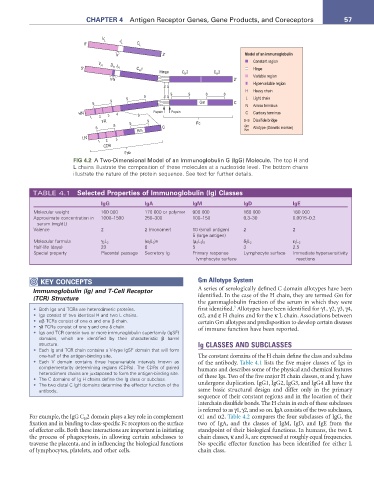
                         FIG 4.2  A Two-Dimensional Model of an Immunoglobulin G (IgG) Molecule. The top H and
                         L chains illustrate the composition of these molecules at a nucleotide level. The bottom chains
                         illustrate the nature of the protein sequence. See text for further details.
            TABLE 4.1  Selected Properties of Immunoglobulin (Ig) Classes
                                  IgG           Iga             IgM              IgD             Ige
            Molecular weight      160 000       170 000 or polymer  900 000      160 000         180 000
            Approximate concentration in   1000–1500  250–300   100–150          0.3–30          0.0015–0.2
             serum (mg/dL)
            Valence               2             2 (monomer)     10 (small antigen)  2            2
                                                                5 (large antigen)
            Molecular formula     γ 2 L 2       (α 2 L 2 )n     (µ 2 L 2 ) 5     δ 2 L 2         ε 2 L 2
            Half-life (days)      23            6               5                3               2.5
            Special property      Placental passage  Secretory Ig  Primary response   Lymphocyte surface  Immediate hypersensitivity
                                                                 lymphocyte surface               reactions


               KeY ConCePtS                                       Gm Allotype System
            Immunoglobulin (Ig) and T-Cell Receptor               A series of serologically defined C domain allotypes have been
            (TCR) Structure                                       identified. In the case of the H chain, they are termed Gm for
                                                                  the gammaglobulin fraction of the serum in which they were
                                                                              3
            •  Both Igs and TCRs are heterodimeric proteins.      first identified.  Allotypes have been identified for γ1, γ2, γ3, γ4,
            •  Igs consist of two identical H and two L chains.   α2, and ε H chains and for the κ L chain. Associations between
            •  αβ TCRs consist of one α and one β chain.          certain Gm allotypes and predisposition to develop certain diseases
            •  γδ TCRs consist of one γ and one δ chain.          of immune function have been reported.
            •  Igs and TCR contain two or more immunoglobulin superfamily (IgSF)
              domains, which are identified by their characteristic  β barrel
              structure.                                          Ig CLASSES AND SUBCLASSES
            •  Each Ig and TCR chain contains a V-type IgSF domain that will form
              one-half of the antigen-binding site.               The constant domains of the H chain define the class and subclass
            •  Each V domain contains three hypervariable intervals known as   of the antibody. Table 4.1 lists the five major classes of Igs in
              complementarity determining regions (CDRs). The CDRs of paired   humans and describes some of the physical and chemical features
              heterodimers chains are juxtaposed to form the antigen-binding site.
            •  The C domains of Ig H chains define the Ig class or subclass.  of these Igs. Two of the five major H chain classes, α and γ, have
            •  The two distal C IgH domains determine the effector function of the   undergone duplication. IgG1, IgG2, IgG3, and IgG4 all have the
              antibody.                                           same basic structural design and differ only in the primary
                                                                  sequence of their constant regions and in the location of their
                                                                  interchain disulfide bonds. The H chain in each of these subclasses
                                                                  is referred to as γ1, γ2, and so on. IgA consists of the two subclasses,
           For example, the IgG C H 2 domain plays a key role in complement   α1 and α2. Table 4.2 compares the four subclasses of IgG, the
           fixation and in binding to class-specific Fc receptors on the surface   two of IgA, and the classes of IgM, IgD, and IgE from the
           of effector cells. Both these interactions are important in initiating   standpoint of their biological functions. In humans, the two L
           the process of phagocytosis, in allowing certain subclasses to   chain classes, κ and λ, are expressed at roughly equal frequencies.
           traverse the placenta, and in influencing the biological functions   No specific effector function has been identified for either L
           of lymphocytes, platelets, and other cells.            chain class.

