


Page 74 - Clinical Immunology_ Principles and Practice ( PDFDrive )
P. 74
CHaPter 4  Antigen Receptor Genes, Gene Products, and Coreceptors                    59


           to the antigen to a cell that will respond to antigen with the
           production of antibody (Chapter 7).

           TCR αβ AND γδ
           TCR α, β γ, and δ chains are members of the IgSF and thus                                 Cβ
           share a number of structural similarities with Igs. Each chain
           contains a leader peptide and extracellular, transmembrane, and   Cα
           intracytoplasmic components. The extracellular component can
           be divided into three domains: a polymorphic V domain encoded
           by VJ (α and γ chains) or VDJ (β and δ chains) gene segments,
                                      17
           a C domain, and a hinge region.  The hinge region typically
           contains an extra cysteine (none in γ chains encoded by Cγ2)
           that forms a disulfide bond with the other partner of the het-
           erodimer. All of the transmembrane domains include a lysine
           plus or minus an arginine residue that facilitates the association
           of the TCR heterodimer with components of the CD3 signal
           transduction complex, each of which has a matching negatively   Vα
           charged residue in its own transmembrane portion (see below).                               Vβ
           The intracytoplasmic components are tiny and play a minimal
           role in signal transduction.
           TCR αβ
           The TCR α and β chains are glycoproteins with molecular weights
           that vary from 42 to 45 kDa, depending on the primary amino
           acid sequence and the degree of glycosylation. Deglycosylated
           forms have a molecular mass of 30 to 32 kDa. These chains share                      P8            α 1
           a number of invariant residues in common with Ig heavy and            P1
           light chains, in particular residues that are thought to be important
           for interactions between heavy and light chains. The structures
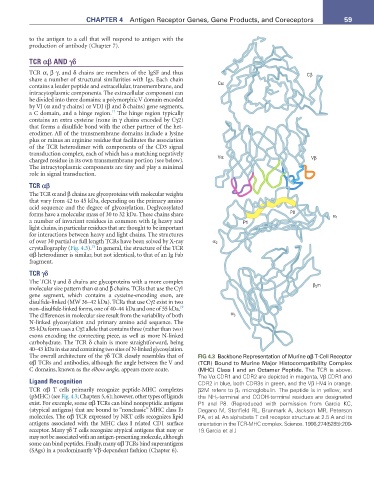
           of over 30 partial or full length TCRs have been solved by X-ray   α 2
                               18
           crystallography (Fig. 4.3).  In general, the structure of the TCR
           αβ heterodimer is similar, but not identical, to that of an Ig Fab
           fragment.
           TCR γδ
           The TCR γ and δ chains are glycoproteins with a more complex                                β m
           molecular size pattern than α and β chains. TCRs that use the Cγ1                            2
           gene segment, which contains a cysteine-encoding exon, are
           disulfide-linked (MW 36–42 kDa). TCRs that use Cγ2 exist in two
                                                            19
           non–disulfide-linked forms, one of 40–44 kDa and one of 55 kDa.
           The differences in molecular size result from the variability of both   α 3
           N-linked glycosylation and primary amino acid sequence. The
           55-kDa form uses a Cγ2 allele that contains three (rather than two)
           exons encoding the connecting piece, as well as more N-linked
           carbohydrate. The TCR δ chain is more straightforward, being
           40–43 kDa in size and containing two sites of N-linked glycosylation.
           The overall architecture of the γδ TCR closely resembles that of   FIG 4.3  Backbone Representation of Murine αβ T-Cell Receptor
           αβ TCRs and antibodies, although the angle between the V and   (TCR) Bound to Murine Major Histocompatibility Complex
           C domains, known as the elbow angle, appears more acute.  (MHC) Class I and an Octamer Peptide. The TCR is above.
                                                                  The Vα CDR1 and CDR2 are depicted in magenta, Vβ CDR1 and
           Ligand Recognition                                     CDR2 in blue, both CDR3s in green, and the Vβ HV4 in orange.
           TCR  αβ T cells primarily recognize peptide-MHC complexes   β2M refers to β 2 microglobulin. The peptide is in yellow, and
           (pMHC) (see Fig. 4.3; Chapters 5, 6); however, other types of ligands   the NH 2-terminal and COOH-terminal residues are designated
           exist. For example, some αβ TCRs can bind nonpeptidic antigens   P1  and  P8.  (Reproduced  with  permission  from  Garcia  KC,
           (atypical antigens) that are bound to “nonclassic” MHC class Ib   Degano M, Stanfield RL, Brunmark A, Jackson MR, Peterson
           molecules. The αβ TCR expressed by NKT cells recognizes lipid   PA, et al. An alphabeta T cell receptor structure at 2.5 A and its
           antigens associated with the MHC class I related CD1 surface   orientation in the TCR-MHC complex. Science. 1996;274(5285):209-
           receptor. Many γδ T cells recognize atypical antigens that may or   19.Garcia et al.)
           may not be associated with an antigen-presenting molecule, although
           some can bind peptides. Finally, many αβ TCRs bind superantigens
           (SAgs) in a predominantly Vβ-dependent fashion (Chapter 6).

